
ACNB's Post-Merger Earnings Potential: Does the Valuation Match the Growth?
The recent acquisition of Traditions Bancorp by ACNB CorporationACNB-- has reshaped the regional bank's financial landscape, offering both opportunities and challenges. While the merger has driven significant revenue growth and asset expansion, investors must scrutinize whether the stock's current valuation—pegged at a forward P/E of 9.62 and a market cap of $465.8 million—accurately reflects the company's post-merger earnings potential[1].
Revenue Growth Outpaces Earnings
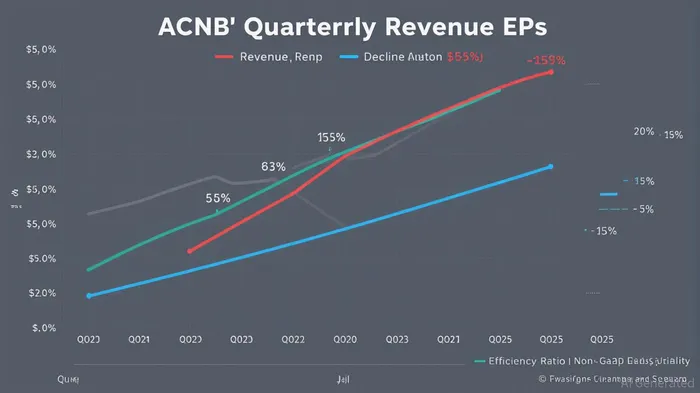
ACNB's Q2 2025 results underscore the immediate benefits of the Traditions Bancorp acquisition. Revenue surged 44.9% year-over-year to $39.7 million, exceeding analyst estimates by 2.5%[2]. This growth was fueled by a $662.2 million increase in loans and $686.0 million in deposits, with noninterest income rising to $8.7 million, driven by insurance services and wealth management[1]. However, earnings per share (EPS) fell to $1.11, missing expectations of $1.15 and declining from $1.32 in Q2 2024[2]. The drag on profitability stemmed from $1.9 million in merger-related expenses and elevated noninterest costs, which offset some of the revenue gains[1].
Valuation Metrics: Attractive but Cautious
ACNB's forward P/E ratio of 9.62 appears compelling compared to its trailing P/E of 16.30, suggesting optimism about future earnings recovery[3]. Analysts have set a median price target of $48.50 for 2025, implying a potential 10–15% upside from current levels[2]. Yet these projections hinge on the assumption that integration costs will stabilize and operational efficiencies will materialize. The efficiency ratio, a key metric for banks, improved to 56.2% (non-GAAP) in Q2 2025, up from 61.5% in the prior year, indicating progress in managing expenses relative to income[2]. If this trend continues, the stock's valuation could justify its growth narrative.
Risks and Realities
The merger's short-term costs highlight a critical risk: ACNB's ability to balance growth with profitability. While the acquisition added $1.35 billion in assets, it also introduced integration complexities that temporarily depressed EPS. For the valuation to hold, management must demonstrate that these costs are transitory. The company's decision to raise its quarterly dividend by 6.3% and repurchase 71,592 shares in Q2 signals confidence in capital returns, but it also underscores the need to maintain earnings momentum[1].
Conclusion: A Tug-of-War Between Growth and Profitability
ACNB's post-merger trajectory reflects a classic dilemma for acquirers: leveraging scale to boost revenue while managing the drag on earnings from integration. The stock's valuation appears reasonable if the company can sustain its efficiency gains and reduce merger-related expenses. However, investors should remain cautious until ACNB provides clearer guidance on long-term earnings growth—a detail currently absent from management or analyst reports. For now, the stock offers a speculative bet on a bank navigating a transformative phase, with its valuation hinging on the successful execution of its integration strategy.





Comentarios
Aún no hay comentarios