
ACEA (BIT:ACE) Valuation Amid Slowing Growth and Share Price Correction
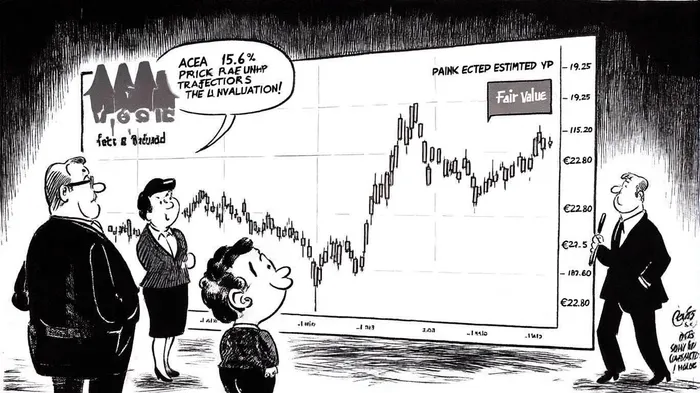
The Italian utility giant ACEA (BIT:ACE) has long been a cornerstone of stable returns for income-focused investors, but recent market dynamics have cast it in a new light: a potentially discounted entry point for those willing to navigate its slowing growth. With a current valuation significantly below estimated fair value and a robust balance sheet, ACEA presents a compelling case for selective investors, even as its earnings trajectory softens.
A Discounted Valuation Amid Stagnant Growth
ACEA's shares trade at a 15.6% discount to their estimated fair value of €22.80, according to Yahoo Finance analysts[2]. This undervaluation is underscored by a trailing P/E ratio of 12.31 and a forward P/E of 14.13[4], metrics that suggest the market is pricing in pessimism about future growth. For context, the utilities sector's average P/E typically ranges between 15 and 18, indicating ACEA is trading at a material discount to its peers[3].
The company's financials, however, tell a more nuanced story. Despite a projected annual earnings decline of 0.9% and revenue growth of just 1.4% through 2025[1], ACEA maintains a 16.37% operating margin and a 13.07% return on equity[4], figures that outperform many of its European counterparts. These metrics reflect the company's structural advantages in regulated markets, where pricing stability and long-term contracts buffer it from cyclical downturns.
Dividend Yield as a Double-Edged Sword
ACEA's 4.94% dividend yield[4] is a magnet for income seekers, but it comes with caveats. The forward annual dividend of €0.95 per share is not fully supported by free cash flow, a red flag for sustainability[3]. However, the company's €347 million net income in the trailing twelve months[4] provides a buffer, and its EBITDA guidance of 2-3% growth in 2025[3] suggests management is prioritizing cash flow preservation. For investors, this means the dividend is not without risk but remains a compelling feature in a low-yield environment.
Risks and Rewards in a High-Debt Environment
Critics point to ACEA's elevated debt levels as a drag on long-term value creation[3]. Yet, with interest rates stabilizing and regulated utility assets offering predictable cash flows, the company's leverage appears manageable. The real challenge lies in its growth trajectory: Simply Wall St analysts note that consensus revenue estimates have been downgraded, reflecting concerns about the company's ability to scale in a saturated market[3].
Strategic Entry Point for Patient Investors
For investors seeking high-quality utilities with discounted valuations, ACEA offers a rare combination of defensive attributes and income potential. Its current price of €19.25[4] implies a 28.5% upside to reach the €22.80 fair value cited by analysts[3], a margin that accommodates both earnings volatility and macroeconomic headwinds. While the company's growth is no longer exponential, its structural resilience and dividend profile make it a candidate for long-term portfolios seeking value in a correction.
Conclusion
ACEA's valuation discount, coupled with its strong operational metrics, positions it as an intriguing opportunity for investors who can tolerate its growth constraints. The key question is whether the market's pessimism is justified or overdone. Given the company's track record of navigating regulatory and economic cycles, the former seems unlikely. For those with a three- to five-year horizon, ACEA's current price represents a compelling entry point—one that balances risk with the potential for capital appreciation and income.







Comentarios
Aún no hay comentarios