
The Accelerating Shift of Treasury Assets to Bitcoin in Hyperscale Data and Its Implications for Institutional Adoption
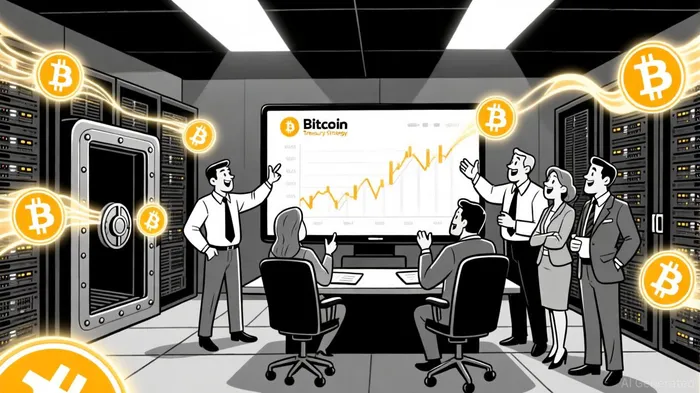
The institutional adoption of BitcoinBTC-- has reached a pivotal inflection point in 2025, with corporate treasuries and sovereign wealth funds increasingly allocating capital to the digital asset. Among the most striking examples is Hyperscale Data, Inc., a company redefining its identity as a pure-play artificial intelligence (AI) and digital asset entity. Its $100 million Bitcoin treasury strategy, announced in late September 2025, underscores a broader trend of institutional-grade infrastructure providers embracing Bitcoin as a core reserve asset[1]. This shift notNOT-- only reflects confidence in Bitcoin's utility but also signals a maturing market where digital assets are being integrated into traditional financial frameworks.
Hyperscale Data: A Case Study in Strategic Bitcoin Allocation
Hyperscale Data's transformation began with the sale of its Montana data center assets and an at-the-market equity program, generating capital to fund a dual strategy: expanding its Michigan AI data center and accumulating Bitcoin[2]. By September 2025, the company's Bitcoin holdings—acquired through open-market purchases and mining via its subsidiary Sentinum—had surged to $13.25 million, representing 39.4% of its public float[3]. This aggressive allocation mirrors the approach of companies like MicroStrategy, which has long positioned Bitcoin as a strategic hedge against macroeconomic uncertainty[4].
The company's CEO, William B. Horne, emphasized that Bitcoin serves as a “core treasury reserve asset,” aligning with institutional demand for non-correlated returns and inflation protection[5]. Hyperscale's weekly transparency reports on its crypto holdings further reinforce institutional-grade accountability, a critical factor in attracting conservative investors[6].
Institutional Adoption: A Confluence of Factors
The institutional embrace of Bitcoin is driven by three key factors:
1. Regulatory Clarity: The approval of spot Bitcoin ETFs in early 2024 by the U.S. Securities and Exchange Commission (SEC) has provided a regulated pathway for institutional participation. By Q2 2025, these ETFs—managed by firms like BlackRock, Fidelity, and Ark Invest—had attracted over $58 billion in assets under management, with BlackRock's iShares Bitcoin Trust (IBIT) alone securing $18 billion[7].
2. Infrastructure Maturity: Custodial solutions from Fidelity Digital Assets, Coinbase Custody, and BitGo have eliminated operational barriers, enabling institutions to hold Bitcoin securely without direct exposure to technical risks[8].
3. Market Stability: Bitcoin's 30-day rolling volatility has stabilized to around 35%, comparable to the S&P 500 and gold, making it a viable diversification tool[9].
Implications for the Broader Market
Hyperscale Data's strategy highlights Bitcoin's evolving role as a functional asset in institutional portfolios. By pairing AI infrastructure expansion with Bitcoin accumulation, the company is creating a dual-value engine:
- AI Infrastructure: The Michigan data center is scaling from 30 MW to 70 MW of power capacity within 20 months, positioning Hyperscale as a key player in the AI-driven economy[10].
- Bitcoin Treasury: The $100 million allocation, funded by asset sales and equity programs, demonstrates how companies can leverage Bitcoin to hedge against currency devaluation and geopolitical risks[11].
This duality is not unique to Hyperscale. A 2025 report by Kenson Investments notes that institutions now allocate 1% to 3% of portfolios to Bitcoin for diversification, with some advisors recommending 10% to 40% for crypto-savvy investors[12]. The asset's low correlation with traditional markets—currently at -0.15 against the S&P 500—further strengthens its appeal[13].
Challenges and the Road Ahead
Despite progress, challenges persist. Regulatory shifts, custodial risks, and market volatility remain concerns. However, the trajectory is clear: Bitcoin is transitioning from a speculative asset to a cornerstone of modern portfolio management. As Hyperscale Data's example illustrates, companies that integrate Bitcoin into their treasury strategies are not only future-proofing their balance sheets but also signaling to the market that digital assets are here to stay.
For institutional investors, the message is equally compelling. With Bitcoin ETFs, stable volatility, and corporate adoption accelerating, the asset is increasingly viewed as a legitimate tool for capital preservation and long-term value creation.





Comentarios
Aún no hay comentarios