
ABS-201: A Generative AI-Driven Biotech Breakthrough with Multi-Billion-Dollar Market Potential
The intersection of artificial intelligence (AI) and biotechnology is reshaping the pharmaceutical landscape, with AbsciABSI-- Corporation's ABS-201 emerging as a standout candidate in the race to address unmet medical needs in androgenetic alopecia (AGA) and endometriosis. By leveraging generative AI to design an anti-prolactin receptor (PRLR) antibody, Absci has positioned itself at the forefront of a disruptive therapeutic approach with the potential to capture significant market share in two high-growth, underserved disease areas.
Unmet Medical Needs: AGA and Endometriosis as High-Value Targets
AGA, affecting over 80 million Americans alone, remains a therapeutic challenge despite the dominance of minoxidil and finasteride. These treatments, while widely used, offer limited efficacy for many patients and are associated with side effects such as sexual dysfunction and skin irritation. Meanwhile, endometriosis-a condition impacting 9 million U.S. women-suffers from a similarly fragmented treatment paradigm. Current hormonal therapies, including GnRH agonists and progestins, suppress estrogen but fail to address the inflammatory and fibrotic pathways driving the disease, often leading to recurrence after discontinuation.
The market for AGA is projected to grow from $3.0 billion in 2024 to $6.7 billion by 2034, driven by rising awareness and innovation in non-invasive therapies. For endometriosis, the global therapeutics market is expected to exceed $3 billion by 2030, fueled by unmet needs in long-term management and fertility preservation. Together, these conditions represent a combined multi-billion-dollar opportunity for therapies that offer superior efficacy, safety, and mechanistic novelty.
ABS-201: A Dual-Indication Platform with Mechanistic Innovation
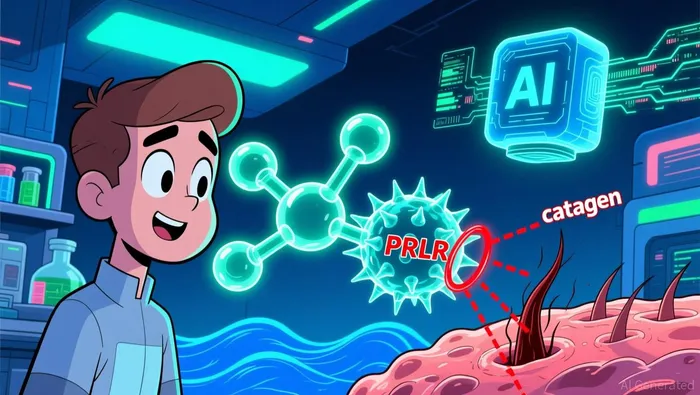
ABS-201, Absci's generative AI-designed antibody, targets the prolactin receptor (PRLR), a key driver of catagen (hair loss) in AGA and a contributor to endometriosis-related inflammation. Preclinical studies in mice demonstrated hair regrowth comparable to minoxidil but with a more favorable safety profile. For endometriosis, PRLR inhibition may modulate fibrotic and inflammatory pathways, addressing the root causes of the disease rather than merely suppressing symptoms.
The Phase 1/2a HEADLINE trial, initiated in late 2025, is evaluating ABS-201's safety, tolerability, and efficacy in up to 227 participants. The trial's multiple ascending dose (MAD) portion, focused on subcutaneous administration in AGA patients, is designed to demonstrate proof-of-concept for hair regrowth by mid-2026. If successful, this could fast-track registrational trials for AGA, with endometriosis development following in Q4 2026. This dual-indication strategy not only optimizes resource allocation but also leverages shared safety data to accelerate timelines-a critical advantage in competitive therapeutic spaces.
Market Potential and Competitive Differentiation
ABS-201's mechanism distinguishes it from existing therapies. For AGA, JAK inhibitors like tofacitinib and ruxolitinib are emerging as alternatives, but their systemic immunosuppressive effects limit long-term use. Regenerative therapies, while promising, remain in early stages and face scalability challenges. In endometriosis, non-hormonal candidates such as selective progesterone receptor modulators (SPRMs) and JNK inhibitors are in development but lack robust clinical validation. ABS-201's targeted PRLR inhibition offers a novel, disease-modifying approach with the potential to outperform these options.
Financially, Absci is well-positioned to advance ABS-201. The company's cash reserves, sufficient to fund operations through mid-2028, provide flexibility to navigate clinical milestones without immediate dilution. A KOL seminar scheduled for December 2025 aims to build investor and clinical confidence by sharing ex vivo data supporting the PRLR mechanism.
Investment Considerations: Balancing Risk and Reward
While ABS-201's potential is compelling, investors must weigh the risks inherent in early-stage biotech. The Phase 1/2a trial's interim data in 2026 will be pivotal; failure to demonstrate efficacy in the MAD portion could delay timelines or necessitate dose adjustments. Additionally, regulatory hurdles in dual-indication approvals may require separate Phase 3 trials for AGA and endometriosis, extending commercialization timelines.
However, the growing emphasis on precision medicine and AI-driven drug discovery aligns with ABS-201's development. If the PRLR pathway proves effective, Absci could establish a dominant position in both AGA and endometriosis markets, leveraging its AI platform to iterate on the molecule for other fibrotic or inflammatory conditions.
Conclusion
ABS-201 represents a convergence of cutting-edge AI, unmet medical needs, and a scalable market opportunity. By addressing the limitations of current therapies in AGA and endometriosis, Absci has the potential to redefine treatment paradigms and capture a significant share of a combined $10+ billion market. As the HEADLINE trial progresses, stakeholders will closely watch for data that could validate ABS-201's promise-and signal a new era in biotech innovation.





Comentarios
Aún no hay comentarios