
AbbVie's Revised Earnings Forecast: Implications for R&D Strategy and Shareholder Value
In the ever-evolving biopharmaceutical landscape, AbbVie's strategic recalibration in response to shifting trade policies and market dynamics underscores its commitment to long-term resilience. While the company has not explicitly disclosed revised 2025 earnings guidance figures, its recent investments in U.S. manufacturing and R&D priorities reveal a calculated approach to navigating short-term headwinds while fortifying its competitive edge.
Strategic Manufacturing Shifts and Policy Alignment
AbbVie's decision to break ground on a $195 million active pharmaceutical ingredient (API) manufacturing plant in North Chicago, Illinois, in September 2025, marks a pivotal step in its $10 billion U.S. manufacturing expansion plan over the next decade, according to a PharmExec report. This facility, slated for full operation by 2027, will focus on producing APIs for immunology, oncology, and neuroscience therapies, as noted in a PR Newswire release. The move aligns with recent U.S. policy changes imposing tariffs on imported drugs, which offer exemptions for companies that initiate domestic construction projects, per AbbVie's company page. By commencing construction ahead of a proposed 100% tariff on imported branded drugs, AbbVieABBV-- proactively mitigates potential revenue erosion, demonstrating fiscal prudence amid regulatory uncertainty, as outlined on the AbbVie R&D page.
R&D Strategy: Innovation as a Growth Engine
AbbVie's R&D strategy remains anchored in high-impact therapeutic areas-immunology, oncology, and neuroscience-where its blockbuster drugs, such as Skyrizi and Rinvoq, have already established robust market positions, as noted by The Motley Fool. These successors to the now-expiring Humira patent are projected to sustain revenue streams, with Skyrizi and Rinvoq contributing significantly to 2024's $56.33 billion in total revenue, according to the AbbVie Wikipedia page. The company's $10 billion manufacturing investment further supports this innovation pipeline by ensuring domestic production of next-generation medicines, reducing reliance on overseas supply chains, and accelerating time-to-market for new therapies, as reflected in its Yahoo Finance profile.
Shareholder Value: Balancing Capital Allocation and Operational Efficiency
While AbbVie has not released specific 2025 Q3 revenue or EPS adjustments, its capital allocation strategy signals confidence in long-term value creation. The North Chicago plant is expected to enhance operational efficiency by shifting API production from Europe and Asia to the U.S., thereby lowering logistics costs and insulating the company from geopolitical risks, as the PharmExec report described above indicated. Analysts at The Motley Fool note that AbbVie's focus on domestic manufacturing and R&D could drive double-digit total returns through 2030, bolstered by its strong balance sheet and consistent dividend growth. Additionally, the company's alignment with U.S. trade policies not only safeguards margins but also positions it to capitalize on a broader industry trend toward onshoring critical pharmaceutical infrastructure, as detailed in the earlier PR Newswire release.
Long-Term Resilience Amid Short-Term Challenges
AbbVie's strategic investments highlight its ability to adapt to macroeconomic pressures while maintaining a forward-looking innovation agenda. The $10 billion U.S. manufacturing initiative, coupled with a robust R&D pipeline, ensures the company remains agile in the face of patent expirations, regulatory shifts, and competitive threats. By prioritizing domestic production and therapeutic innovation, AbbVie is not merely reacting to short-term headwinds but embedding resilience into its operational and financial frameworks.
Conclusion
AbbVie's revised earnings forecast, though not quantified in recent disclosures, is best understood through the lens of its strategic priorities: de-risking operations via domestic manufacturing, accelerating R&D in high-growth therapeutic areas, and aligning with U.S. policy incentives. These moves collectively reinforce its capacity to deliver sustained shareholder value, even as it navigates the post-Humira era. For investors, the company's emphasis on long-term resilience-rooted in innovation and operational agility-offers a compelling case for continued confidence.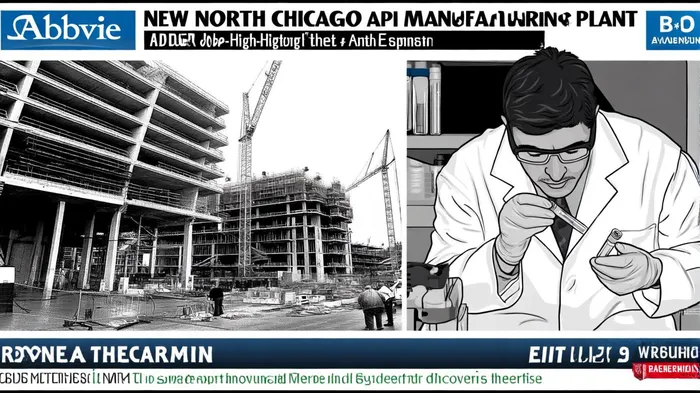





Comentarios
Aún no hay comentarios