
AbbVie's $100 Billion Gambit: Pricing, Tariffs, and the Path to 2028
AbbVie's agreement with the Trump administration is a classic quid pro quo, structured around a decade-long investment pledge in exchange for immediate regulatory relief. The core terms are clear: in return for a three-year exemption from tariffs and future pricing mandates, the company has committed to a $100 billion in U.S. research and development and capital investments, including manufacturing, over the next decade. This is not a one-off subsidy but a binding investment plan designed to anchor its innovation footprint in America. The strategic calculus here is straightforward. By locking in a decade of capital expenditure, AbbVieABBV-- secures a critical three-year window of operational and financial stability, shielding itself from the immediate threat of punitive tariffs and new federal price controls. It's a bet on long-term growth, using the investment commitment as a shield against near-term policy volatility.
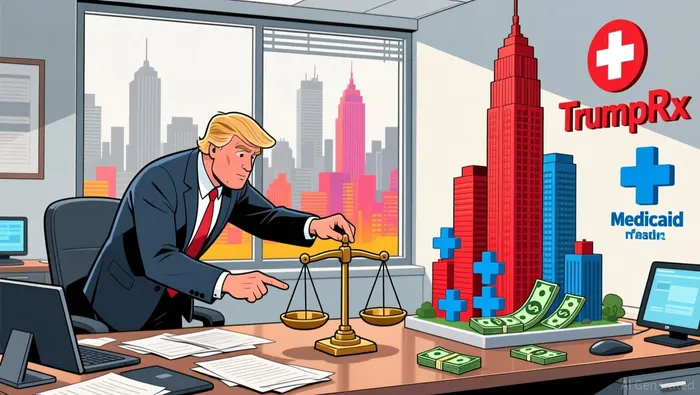
The agreement also mandates significant changes to patient access, directly addressing the administration's affordability agenda. AbbVie must provide low prices in Medicaid and expand affordable, direct-to-patient offerings through TrumpRx for key brands like HUMIRA. This dual requirement tackles two pain points: it reduces government spending on a major public program while simultaneously boosting the company's direct sales channel to cash-paying consumers. For a firm with a blockbuster portfolio, this is a strategic expansion into a new distribution and pricing model, potentially increasing market share and cash flow from a segment of the population often priced out of traditional channels.
Yet this deal follows a pattern that introduces its own layer of risk. As President Trump noted, this is part of a broader initiative, with 14 companies having signed confidential agreements with the administration. While these are voluntary, their political nature is inescapable. The agreements are built on a specific administration's priorities and leverage, creating a dependency on a particular policy framework. The confidential nature of the deals and the uncertainty about whether they will last beyond the current administration are the central vulnerabilities. For AbbVie, the $100 billion investment is a long-term commitment, but the regulatory benefits are a short-term reprieve. The strategic rationale hinges on the assumption that the political winds will remain favorable for a decade-a significant gamble given the cyclical nature of U.S. politics and the potential for a regulatory reset with a change in administration.
Financial and Operational Impact Assessment
The deal's financial footprint is substantial, with the $100 billion in U.S. R&D and capital investments representing a major capital allocation. This is not a trivial sum; it's a decade-long commitment that will divert cash from shareholder returns or other strategic initiatives. For a company with a market cap around $200 billion, this pledge consumes a significant portion of its equity value over ten years. The immediate benefit is a three-year reprieve from tariffs and pricing mandates, providing a clear window to execute this plan without near-term regulatory friction. Yet the long-term capital burden is a direct trade-off for that short-term stability.
A more immediate pressure point is the direct-to-consumer pricing model. The agreement mandates expanded offerings through TrumpRx for key brands like HUMIRA. Evidence from parallel deals shows this channel is designed for affordability, with one manufacturer agreeing to sell a GLP-1 drug for $350 per month on the platform-a 30% discount off its prior direct price. While AbbVie's specific HUMIRA price on TrumpRx is not yet public, the model is clear: this will be a lower-margin channel. For a blockbuster drug, this could erode gross margins on a segment of sales, even as it expands patient access and cash flow from a new distribution path. The financial impact here is a trade-off between volume and profitability.
The tariff exemption, however, delivers a tangible and immediate financial benefit. By shielding its products from tariffs, the company protects its export competitiveness and reduces input costs. This is a critical advantage given AbbVie's global revenue base. The savings directly improve the cost of goods sold and protect margins on international sales, providing a clear, near-term boost to cash flow. This operational protection is a key reason the investment pledge was made-securing a stable cost environment for a decade.
The bottom line is a complex balancing act. The deal provides a shield against policy volatility and a direct cost advantage, but it also commits vast capital and introduces a lower-margin sales channel. The profitability trajectory will depend on how successfully AbbVie can offset the margin pressure from TrumpRx with the cost savings from the tariff exemption and the long-term returns on its $100 billion investment. The initial financial impact is a mix of immediate relief and future constraint.
Market Context and Near-Term Catalysts
The deal's strategic promise now meets a market that is pricing in caution. AbbVie's stock trades at $220.08, a level that reflects a year-to-date decline of 3.68% and a significant 11.2% discount to its 52-week high of $244.81. This underperformance signals investor skepticism about the near-term path, even as they look ahead to the decade-long investment plan. The market is waiting for concrete financial proof that the regulatory shield and new sales channel will ultimately outweigh the capital commitment and margin pressure.
The immediate test arrives in just over a month. The company is scheduled to report its full-year and fourth-quarter 2025 financial results on February 4, 2026. This earnings release is a critical data point. It will provide the final financial snapshot for the period before the Trump administration agreement was announced, offering a baseline to measure the deal's impact. More importantly, it will detail the company's current financial health-its revenue growth, profitability, and cash flow-against the backdrop of a challenging year. Given the recent quarterly earnings have shown declines in adjusted EPS, the full-year report will be scrutinized for signs of stabilization or further pressure.
The accompanying earnings call will be the deal's first formal forum. Management will have a direct platform to explain the financial mechanics of the new agreement, detail how the $100 billion investment plan fits into capital allocation, and outline the strategic integration of the TrumpRx channel. This is where the narrative of long-term value creation must be translated into near-term credibility. The market will listen for specifics on how the tariff exemption and new pricing model are expected to affect margins and cash flow, and how the company plans to fund its massive commitment without sacrificing shareholder returns. The call's tone and guidance will be the immediate catalyst that either validates the deal's promise or deepens the current discount.
Catalysts, Risks, and Forward Scenarios
The path ahead for AbbVie is defined by two critical variables: the durability of its political shield and the commercial viability of its new sales channel. The primary catalyst for the stock is not the deal's announcement, but the confirmation that its benefits will last. The agreement provides a three-year reprieve, but the real value hinges on whether the administration's broader pricing framework, including the most-favored-nation (MFN) model, becomes entrenched. The key risk is that this framework, and the specific deals, are politically reversible. With 14 companies already under confidential agreements, the administration is signaling it will soon unveil more, including with Johnson & Johnson and other drugmakers. This expansion is a positive sign for the model's momentum, but it also raises the stakes. A change in administration in 2028 could see the entire policy architecture dismantled, leaving AbbVie with a decade of capital expenditure and a new, lower-margin channel without the promised regulatory protection.
A major operational risk is the effectiveness of the TrumpRx platform. The deal mandates expanded affordable offerings through this channel for key brands like HUMIRA. Evidence from the MFN agreements shows the model is designed for deep discounts, with one manufacturer agreeing to sell a GLP-1 drug for $350 per month on the platform-a 30% discount off its prior direct price. For AbbVie, the challenge is twofold. First, it must capture sufficient cash-paying patients to offset the erosion of higher-margin Medicaid prices. Second, it must do so without cannibalizing its existing, more profitable distribution channels. The success of this channel will determine whether the promised patient access translates into robust, sustainable cash flow or simply becomes a costly compliance burden.
Investors should watch for the administration's next moves, which will signal the model's staying power. The expansion of the MFN pricing model to other drug classes beyond GLP-1s is a critical indicator. If the administration begins demanding MFN pricing for other blockbuster categories, it will validate the model's long-term trajectory and reduce the perceived risk of reversal. Conversely, any retreat or delay would undermine the strategic rationale for AbbVie's investment. The company's stock performance will track this political and regulatory evolution more closely than any single quarterly earnings report. The forward scenario is one of patience: the stock may remain under pressure until the durability of the new pricing regime is clearer, and until AbbVie demonstrates it can successfully navigate its new, lower-margin sales channel without sacrificing its core profitability.





Comentarios
Aún no hay comentarios