
AB InBev's Strategic Expansion in the Live Events Sector: Assessing Long-Term Value Creation Through Brand Integration
In the evolving landscape of experiential marketing, Anheuser-Busch InBevBUD-- (AB InBev) has emerged as a trailblazer, leveraging live events and digital partnerships to forge deep consumer connections while driving long-term value creation. From 2020 to 2025, the company has strategically expanded its footprint in the live events sector through innovative brand integrations, co-branded campaigns, and technology-driven consumer engagement. This analysis evaluates AB InBev's approach, its financial and brand equity implications, and the sustainability of its strategies in a competitive market.
Strategic Partnerships: From Netflix to Sports Events
AB InBev's collaboration with NetflixNFLX-- represents a paradigm shift in brand integration. The global multi-year partnership, announced in September 2025, combines AB InBev's beverage portfolio with Netflix's entertainment content to create co-branded campaigns around titles like The Gentlemen and Brasil 70 - A Saga do Tri according to the announcement. This synergy extends beyond digital marketing: AB InBevBUD-- secured sponsorship rights for the 2025 Christmas Day NFL game on Netflix and plans to align with the 2027 Women's World Cup as part of the partnership. Such partnerships not only amplify brand visibility but also tap into Netflix's global audience, creating cross-industry value.
Similarly, AB InBev's sponsorship of high-profile sports events, such as the Canelo vs. Crawford boxing match in Mexico, underscores its focus on localized, culturally resonant activations according to company reports. These efforts align with the company's broader strategy to strengthen regional brand equity while capitalizing on the emotional pull of live events.
Experiential Innovation: Technology as a Brand Amplifier
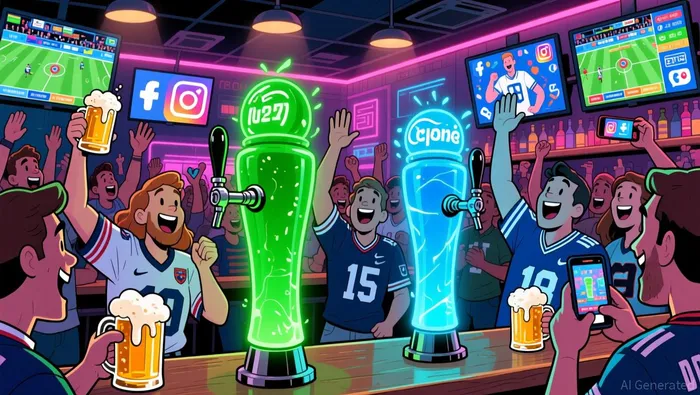
AB InBev's investment in interactive technology further exemplifies its commitment to immersive brand experiences. The "Social Tap" initiative, developed in partnership with Mesh Systems, transformed beer taps into real-time engagement tools during televised sports events. By lighting up in celebration of home team scores, the taps created a shared, celebratory atmosphere in bars and restaurants, while also enabling AB InBevBUD-- to track consumption metrics and promotional effectiveness as detailed in the case study. Deployed in over 12,000 U.S. locations, this innovation highlights the company's ability to merge physical and digital engagement, fostering deeper consumer loyalty.
Financial Performance and Market Position
AB InBev's strategic initiatives have translated into robust financial performance. From 2020 to 2024, the company's revenue grew from $46.9 billion to $59.8 billion, with net income surging from $1.4 billion to $5.9 billion according to Q2 2025 results. In 2025, despite a 1.9% volume decline in key markets like China and Brazil, EBITDA increased by 6.5% in the second quarter and 3.3% in the third quarter as reported. This resilience is attributed to premiumization strategies, such as the 33% revenue growth in its no-alcohol beer portfolio (led by Corona Cero) and the expansion of the BEES Marketplace, which generated $935 million in GMV in Q3 2025 according to financial data.
The company's brand equity remains a cornerstone of its success. Eight of the world's top ten most valuable beer brands-Budweiser, Corona, and Stella Artois among them-are under AB InBev's umbrella as stated in the report. These brands benefit from experiential marketing, with Corona contributing to a 7.7% revenue increase outside Mexico in 2025 according to the financial analysis.
Challenges and Long-Term Sustainability
While AB InBev's strategies have driven growth, challenges persist. Economic headwinds in China and Brazil, coupled with shifting consumer preferences toward moderation, necessitate ongoing adaptation. The company's Global Smart Drinking Goals (GSDG), a $1 billion, 10-year initiative, aim to address these trends by promoting responsible consumption and expanding lower-alcohol product lines as part of its sustainability strategy. A 2025 Georgetown University study noted that AB InBev's collaboration with public health stakeholders has enhanced its brand reputation and consumer trust, positioning it to navigate regulatory and societal pressures according to the study findings.
Conclusion: A Model for Value Creation
AB InBev's strategic expansion in live events and experiential marketing demonstrates a clear focus on long-term value creation. By integrating brands into culturally relevant moments-whether through Netflix partnerships, sports sponsorships, or interactive technology-the company has strengthened consumer engagement and diversified revenue streams. Financial metrics from 2020 to 2025 underscore the effectiveness of these strategies, even amid macroeconomic volatility. As AB InBev continues to innovate in digitization and responsible consumption, its ability to balance commercial success with societal impact will likely sustain its leadership in the global beverage market.







Comentarios
Aún no hay comentarios