
Aave News Today: Aave DAO Proposes "Poison Pill" as Governance Tensions Fuel Market Uncertainty
AAVE token holders have proposed a "poison pill" defense mechanism for the AaveAAVE-- DAO in response to ongoing disputes over revenue allocation. The contentious issue revolves around swap fees from the CoW Swap integration that previously accrued to the DAO being redirected to an address controlled by Aave Labs. The proposed measure aims to protect the DAO's interests as it faces allegations of "stealth privatization" of potential revenue according to critics.
The disagreement has deepened as community members accuse Aave Labs of rerouting approximately 45 to 50 ETH per week, translating to about $200,000 weekly and $10 million annually in lost revenue according to reports. Aave Labs defends its actions by stating that it maintains and builds the front-end interface and adapters, making it a proprietary product separate from the core protocol as per their position. The founder of Aave Chain Initiative (ACI), Marc Zeller, has criticized the move as harmful to AAVE token holders and a breach of trust according to his statement.
Aave founder Stani Kulechov has backed his team's position, stating it is reasonable for Aave Labs to monetize its products as they do not interfere with the core protocol according to his defense. The debate has highlighted a broader governance dilemma in the DeFi space, where the balance of power between token holders and development teams is in question. The community is calling for clearer definitions and revenue-sharing agreements to prevent future conflicts according to community members.
Why the Standoff Happened
The root of the dispute lies in the integration of CoW Swap as the default exchange on Aave's front-end interface, replacing ParaSwap according to reports. This change redirected fees that previously flowed to the DAO into a Labs-controlled address, raising accusations of value extraction. Aave DAO delegate EzR3aL first exposed the issue, sparking a wave of criticism from the community. The move has been seen as a breach of the unspoken agreement where DAO and Labs interests were previously aligned according to community analysis.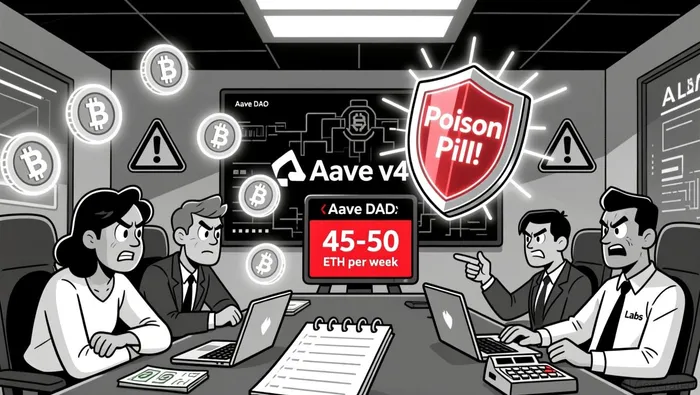
Aave Labs maintains that the front-end interface is a distinct product from the protocol itself, arguing that it is reasonable to monetize its own offerings according to their position. The DAO, however, views this as an erosion of its control and a threat to the long-term governance model. The lack of a clear revenue-sharing framework has led to confusion and mistrust, with both sides claiming to act in the best interests of the Aave ecosystem according to community reports.
How Markets Reacted
The controversy has not gone unnoticed in the broader DeFi space. Aave remains one of the leading lending protocols, but the dispute has raised questions about the sustainability of its governance model. Investors and market observers are watching closely to see how the community and Aave Labs will resolve the issue. The DAO's active and vocal token holder base has been a strength for Aave, but the current conflict could test that cohesion according to market analysis.
Analysts have drawn parallels to similar disputes in other DeFi projects, such as Uniswap's front-end fee debate. The outcome in Aave may set a precedent for how other projects handle the tension between decentralized governance and efficient execution according to industry experts. For now, the market appears to be in wait-and-see mode, with investors closely monitoring developments.
What Analysts Are Watching
Market observers are looking for signs of compromise or escalation in the Aave conflict. The introduction of a "poison pill" proposal suggests that the DAO is preparing for a worst-case scenario, but it remains to be seen whether such a measure will gain traction according to analysts. Analysts are also paying attention to the broader regulatory environment in DeFi, as the SEC's recent conclusion of its four-year investigation into Aave has removed one potential external pressure point according to regulatory updates.
The upcoming Aave v4 release is another focal point, as it is expected to introduce new layers of abstraction that could further shift the balance of power between the DAO and Labs according to product updates. If Aave v4 becomes the default user experience, it could serve as a bridge between Labs and the protocol, potentially enabling more value extraction according to product forecasts. The community's response to v4 will likely be a key indicator of how the current governance crisis is resolved.
Risks to the Outlook
The current standoff poses several risks for Aave. First, the erosion of trust between the DAO and Labs could lead to a governance stalemate, slowing down development and innovation according to community reports. If Aave Labs continues to act unilaterally on product decisions, the DAO could lose its influence over the protocol's future. This scenario could weaken Aave's competitive position, especially as other DeFi platforms continue to evolve.
Second, the lack of clear governance structures and revenue-sharing agreements makes the project vulnerable to future conflicts. The community has called for greater transparency and pre-announced policies to avoid similar disputes. Without such measures, the perception of Aave as a decentralized and community-driven project may be at risk according to governance experts.
Finally, the broader DeFi industry is watching this conflict closely. Aave's governance model has been seen as a benchmark, but the current crisis could expose weaknesses in the DAO model. If Aave fails to resolve the issue in a way that balances the interests of token holders and developers, it could discourage other projects from adopting similar governance structures according to industry analysis.
What This Means for Investors
For AAVE token holders, the dispute raises concerns about the long-term value of their holdings. If the DAO loses control of revenue streams, it could impact the treasury's ability to fund development and incentivize growth. Investors are also wary of potential regulatory scrutiny if the governance model is seen as lacking clarity or accountability according to investment reports.
On the other hand, a resolution that strengthens the DAO's governance power could boost confidence in the project. If Aave manages to set a clear precedent for balancing decentralized governance with operational efficiency, it could attract more institutional investors and further solidify its position in the DeFi space according to market sentiment.






Comentarios
Aún no hay comentarios