
Aave's Horizon RWA Market: A Strategic Play in Institutional DeFi Amid China's Regulatory Shifts
The DeFi landscape in 2025 has entered a new era of institutionalization, driven by the convergence of regulatory clarity and infrastructure innovation. At the forefront of this transformation is Aave's Horizon RWA Market, a protocol designed to bridge traditional finance (TradFi) and decentralized finance (DeFi) through tokenized real-world assets (RWAs). As China's 2025 regulatory crackdown on RWA tokenization reshapes global capital flows, Horizon's institutional-grade yield generation mechanisms and strategic focus on regulatory arbitrage position it as a compelling investment thesis for institutional players seeking to capitalize on the next phase of DeFi.
Institutional-Grade Yield Generation: AaveAAVE-- Horizon's Core Strengths
Aave's Horizon RWA Market, launched in 2025, represents a pivotal shift in DeFi by enabling institutions to tokenize and collateralize real-world assets such as U.S. government securities, crypto carry strategies, and Treasury bills. Built on Aave Protocol version 3.3, the platform supports stablecoins like USDCUSDC--, RLUSD, and GHO, offering a non-custodial infrastructure where borrowing and lending are executed via smart contracts. This design ensures transparency and compliance, critical for institutional adoption.
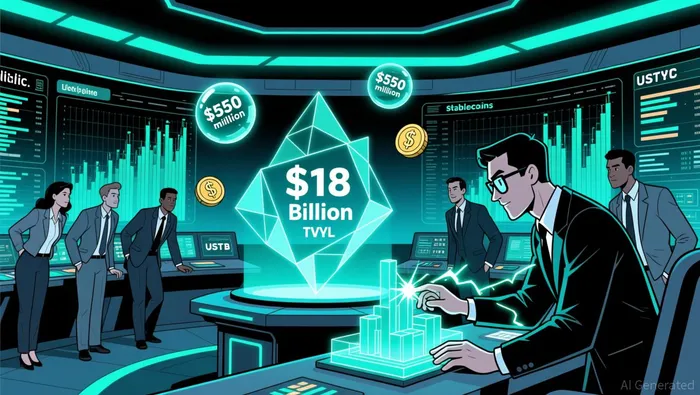
The market's TVL reached $18 billion in 2025, with Aave Horizon alone securing ~$550 million in net deposits. Key partnerships with firms like Superstate and CircleCRCL-- have introduced products such as Superstate's USTB (U.S. Treasury-backed tokens) and Circle's USYC (Treasury bill-linked stablecoins), which provide yields of 4–6% annually. These instruments are underpinned by ChainlinkLINK-- SmartData, which ensures accurate net asset value reporting and mitigates counterparty risk. For institutions, this creates a scalable, permissioned framework to access TradFi-grade yields while leveraging DeFi's efficiency and composability.
China's 2025 Regulatory Crackdown: A Double-Edged Sword
China's 2025 declaration of RWA tokenization as an "unauthorized financial operation" has significantly disrupted the global RWA ecosystem. Seven major financial associations, including the China Banking Association, warned of risks such as speculative trading and unverifiable assets, effectively banning domestic RWA projects and extending restrictions to Hong Kong-linked operations. This move aligns with China's broader strategy to prioritize state-backed digital finance, such as the digital yuan, over decentralized alternatives.
While the ban curtails domestic innovation, it inadvertently accelerates global RWA adoption. In 2025, the sector grew by 185%, driven by tokenized treasuries and regulated pilots in Western markets. For Aave Horizon, this regulatory divergence creates a strategic advantage: by focusing on jurisdictions with favorable frameworks, the protocol can capture capital flows displaced by China's restrictions.
Regulatory Arbitrage: The Rise of Pro-Innovation Jurisdictions
The contrast between China's restrictive policies and proactive regulatory environments in regions like Singapore and the UAE highlights the importance of regulatory arbitrage. Singapore's Monetary Authority of Singapore (MAS) has positioned the city-state as a global hub for RWA tokenization, with initiatives like Project Guardian testing tokenized bonds and foreign exchange. The Variable Capital Company (VCC) regime further supports blockchain-native structures, enabling real estate tokenization through fractionalized funds.
Similarly, Dubai has emerged as a key player, with enforceable regulations and integration with real estate registries. These jurisdictions offer a stark contrast to China's 2025 crackdown, creating fertile ground for Aave Horizon to expand. By aligning with Singaporean and Emirati frameworks, the protocol can attract institutional capital seeking compliance-friendly environments while avoiding the legal and operational barriers imposed in China.
Strategic Implications for Aave and Institutional Investors
Aave's Horizon RWA Market is uniquely positioned to capitalize on the structural shifts in 2025. Its non-custodial infrastructure, coupled with partnerships in regulated RWA sectors, addresses institutional concerns around custody and compliance. Meanwhile, the Chinese regulatory landscape, while restrictive, has accelerated the migration of capital to jurisdictions where innovation is permitted.
For institutional investors, Horizon offers a dual opportunity: access to high-yield RWAs through TradFi-grade collateral and the ability to hedge against regulatory risks by leveraging arbitrage between jurisdictions. As global RWA TVL is projected to grow further in 2026, particularly with the U.S. Market Structure Bill and EU MiCA regulations solidifying the legal framework, Aave's Horizon stands to benefit from both yield generation and regulatory tailwinds.
However, risks remain. The October 2025 flash crash and collapses of protocols like Stream Finance underscore the need for robust operational security. Aave's integration of Chainlink and its focus on permissioned RWAs mitigate these risks, but investors must remain vigilant.
Conclusion
Aave's Horizon RWA Market exemplifies the next phase of DeFi: a hybrid model that marries institutional-grade yield generation with regulatory adaptability. As China's 2025 crackdown reshapes the RWA landscape, the protocol's strategic focus on pro-innovation jurisdictions like Singapore and Dubai positions it as a key player in the global DeFi ecosystem. For institutions seeking to navigate regulatory uncertainty while accessing high-yield opportunities, Horizon represents a compelling, forward-looking investment.





Comentarios
Aún no hay comentarios