
Aave's Governance Turmoil: A Catalyst for Value Reallocation or DeFi Exile?
The recent $37.6 million AaveAAVE-- whale dump in late December 2025 has ignited a firestorm of debate about the protocol's governance structure, liquidity dynamics, and long-term value proposition. This event, coupled with a contentious governance vote and founder-driven decisions, has exposed deep fractures in Aave's decentralized ethos. To assess whether this turmoil will catalyze Aave's evolution or precipitate its decline, we must dissect the interplay of governance centralization, whale liquidity risks, and historical precedents in DeFi.
Governance Centralization: A Double-Edged Sword
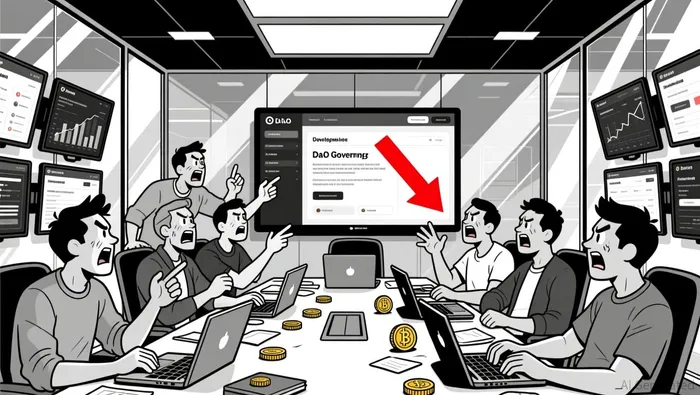
Aave's governance crisis began with a rushed proposal to transfer control of brand assets (domains, social media handles, etc.) to a DAO-controlled entity. Despite being authored by Ernesto Boado-Aave's former CTO-the proposal was submitted to a Snapshot vote by Aave Labs without his consent or notification. Boado publicly disavowed the move, calling it a "violation of trust," while founder Stani Kulechov defended the decision as necessary for resolution according to reports. This unilateral action, combined with the team's decision to redirect $10 million annually in transaction fees from the DAO treasury to Aave Labs according to analysis, has eroded community trust.
Such centralization risks are not unique to Aave. A 2025 study in the Journal of International Money and Finance found that wealth concentration in DeFi often leads to disproportionate control over governance, undermining decentralization ideals. For instance, MakerDAO's MKR token holders, despite community-driven governance rhetoric, have historically concentrated voting power among a small group of addresses. Aave's situation mirrors this pattern, where founder influence and institutional token holdings (e.g., the $12.6 million AAVE purchase by Kulechov during the price drop)) further skew decision-making.
Whale Liquidity Risks: A Systemic Threat
The November 2025 whale dump-liquidating 230,350 AAVE tokens-triggered a 10–12% price drop, exposing Aave's liquidity fragility. This event aligns with broader DeFi trends: a 2025 liquidity crisis saw $2 billion in positions liquidated, with thin order books amplifying volatility. Whale activity, as noted in a 2025 British Accounting Review analysis, can destabilize markets by executing large trades that disrupt equilibrium according to research. For Aave, the whale's exit was not merely a liquidity shock but a signal of waning confidence in governance transparency.
Historical parallels abound. In 2022, the collapse of Terra and Luna highlighted how concentrated token ownership and governance centralization can accelerate value erosion. Similarly, SushiSwap's contentious forks and token holder disputes underscored the fragility of community-driven governance when power is unevenly distributed. Aave's current turmoil suggests it is navigating similar crossroads: will the community reclaim control, or will centralization deepen?
Value Reallocation or Erosion? The Path Forward
The outcome hinges on Aave's ability to reconcile governance centralization with decentralized principles. On one hand, the DAO's recent push to institutionalize multi-protocol strategies-such as the $19 billion in institutional capital flows analyzed in 2025-demonstrates Aave's role as a critical DeFi infrastructure layer. Institutional adoption could mitigate whale risks by diversifying liquidity sources. On the other hand, the lack of transparency in Aave Labs' decisions such as the Cow Swap switch risks alienating retail and institutional investors alike.
A 2025 case study on Uniswap's governance overhaul offers a potential roadmap. The UNIfication proposal, which introduced protocol fees and a token burn mechanism, initially boosted UNI's price by 6%. However, the alignment of incentives between the UniswapUNI-- Foundation and key stakeholders also raised centralization concerns according to analysis. Aave must balance innovation with decentralization to avoid a similar fate.
Conclusion: A Defining Moment for DeFi
Aave's governance turmoil is emblematic of a broader struggle in DeFi: the tension between functional efficiency and ideological decentralization. While the recent whale dump and rushed governance vote have eroded trust, they also present an opportunity for Aave to redefine its governance model. If the community can enforce transparent, equitable decision-making-perhaps through DAO-led audits or token distribution reforms-Aave may emerge stronger. Conversely, continued founder centralization and liquidity risks could drive institutional and retail capital to more decentralized alternatives, relegating Aave to DeFi's periphery.
The coming months will test Aave's resilience. As one analyst noted, "DeFi's promise lies in its ability to self-correct. Whether Aave embraces this ethos or succumbs to centralization will determine its place in the next era of crypto." According to reports.






Comentarios
Aún no hay comentarios