
Aave's Governance Tensions and the Future of Token Value Capture in DeFi
Aave, one of decentralized finance's (DeFi) most prominent lending protocols, is currently navigating a high-stakes governance crisis that has sparked debates about token holder alignment, decentralization, and the long-term viability of its economic model. The recent controversy surrounding a contentious token alignment proposal submitted by BGD Labs-co-founded by former AaveAAVE-- CTO Ernesto Boado-has exposed deep fractures within the protocol's governance structure. This dispute, coupled with accusations of "governance attacks" and a sharp decline in AAVE token value, raises critical questions about how DeFi protocols can balance decentralization with operational efficiency while maintaining investor confidence.
The BGD Labs Proposal and Stani Kulechov's Opposition
The crisis began with a proposal to transfer ownership of Aave's key brand assets-such as the aave.com domain, social media accounts, and GitHub repositories-into a DAO-controlled legal framework. Proponents argued this move would align governance with token holders, who bear economic risk, and prevent unilateral control by private entities like Aave Labs according to analysis. However, the proposal was criticized for being rushed and lacking transparency. Stani Kulechov, Aave's founder, opposed the initiative, warning that it could disrupt the protocol's progress and create uncertainty. He emphasized the need for a structured, multi-stage process rather than a binary vote according to his statements.
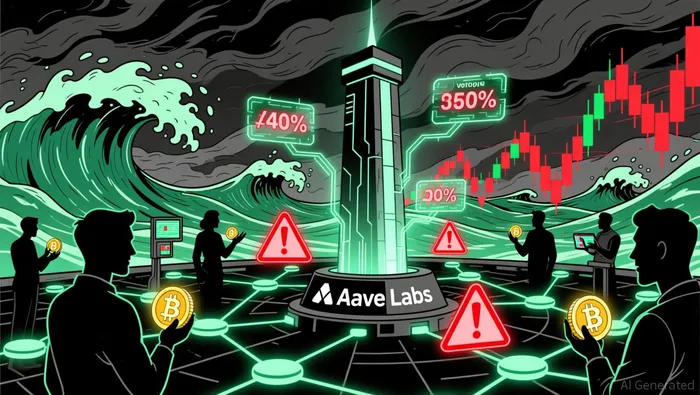
The controversy intensified when Kulechov purchased $10 million worth of AAVE tokens amid a 20% price drop, leading critics to accuse him of attempting to sway the vote. This move highlighted the concentration of voting power among a few large holders: the top three voters control over 58% of Aave's governance votes. Such centralization undermines the decentralized ethos of DeFi and raises concerns about whether token holders can truly influence protocol decisions.
Governance Fragmentation in DeFi: A Broader Challenge
Aave's governance tensions are not unique. DeFi protocols like UniswapUNI--, CompoundCOMP--, and SushiSwapSUSHI-- have faced similar challenges, including whale dominance in voting and governance fragmentation according to analysis. For instance, Compound's early governance model allowed large token holders to dominate proposals, sparking debates about fairness. Meanwhile, SushiSwap's revenue-sharing model, which distributes trading fees to token holders, has been praised for creating deflationary effects but criticized for its reliance on short-term liquidity incentives according to research.
Aave's situation, however, is distinct due to its high-stakes dispute over asset ownership. Unlike Curve or MakerDAO, which have maintained stable governance environments, Aave's conflict over brand control has created uncertainty about its long-term trajectory according to industry reports. MakerDAO, for example, prioritizes community-driven governance focused on maintaining the DAIDAI-- stablecoin's stability, avoiding direct disputes over brand assets according to research. Curve's governance stress, meanwhile, has centered on developer funding and treasury oversight, but its core operations remain unaffected according to market analysis.
Academic Insights: Governance Fragmentation and Token Value Sustainability
Academic research underscores the risks of governance fragmentation in DeFi. A 2025 study notes that governance assets within DAOs are highly vulnerable to external shocks, with 55% of crime events leading to significant price declines and 68% causing spikes in trading volumes. The indirect economic losses from these events-exceeding $1.3 billion-highlight the fragility of DeFi governance structures according to research. Another study emphasizes the need for hybrid governance models that balance decentralization with institutional-grade execution to foster long-term sustainability according to research.
Quantitative analysis from the State of DeFi 2025 report reveals a shift toward professionalized governance, with slower proposal cadences and increased delegation according to the report. However, this trend also signals a move toward centralized or semi-centralized models, which may conflict with DeFi's foundational ideals. The collapse of algorithmic stablecoins like TerraUSD (UST) further illustrates the risks of governance failures, as flawed mechanisms exacerbated volatility and eroded trust according to the report.
Assessing Aave's Long-Term Investment Viability
For investors, Aave's governance crisis presents both risks and opportunities. On one hand, the concentration of voting power and recent price volatility suggest structural weaknesses that could deter institutional adoption. On the other, Aave's historical innovation and market leadership-driven by Aave Labs-demonstrate its potential to adapt and evolve according to industry analysis. The outcome of the BGD Labs proposal will be pivotal: a rejection may reinforce Aave Labs' control, while passage could redefine the relationship between the DAO and builder teams, setting a precedent for other protocols according to expert commentary.
Comparative case studies offer further insight. MakerDAO's stable governance model has contributed to DAI's resilience, while Curve's focus on liquidity incentives has maintained TVL despite governance stress according to market analysis. These examples suggest that protocols prioritizing clear governance frameworks and aligned incentives are more likely to sustain token value. Aave's challenge lies in reconciling decentralization with the need for efficient execution-a tension that will shape its long-term viability.
Conclusion: Navigating the Governance-Value Capture Trade-Off
Aave's governance tensions reflect a broader dilemma in DeFi: how to balance ideological decentralization with practical governance efficiency. While the protocol's current crisis has eroded investor confidence, it also highlights the importance of robust governance design in capturing and retaining token value. For Aave to remain a viable long-term investment, it must address governance fragmentation, enhance transparency, and align incentives between token holders and builders. The lessons from other DeFi protocols and academic research suggest that hybrid models-combining community governance with professional execution-may offer the most sustainable path forward.
As the DeFi ecosystem matures, protocols that successfully navigate these challenges will likely emerge as leaders, while those unable to adapt risk being outpaced by more agile competitors. Aave's ability to resolve its governance tensions will be a critical test of its resilience-and a bellwether for the future of token value capture in decentralized finance.






Comentarios
Aún no hay comentarios