
Aave's Governance Crisis: A Warning Sign for Token-Driven DeFi Models?
The decentralized finance (DeFi) sector has long prided itself on its commitment to trustless systems and community governance. However, Aave's ongoing governance turmoil-marked by accusations of "invisible privatization," unilateral decision-making, and a fracturing of community trust-has exposed critical vulnerabilities in token-driven DAO-led protocols. As the AAVE token price dropped 11% in a single day following a contentious governance dispute, the crisis raises urgent questions about the sustainability of DeFi's governance models and their ability to balance innovation with decentralization.
The Power Struggle: AaveAAVE-- Labs vs. the DAO
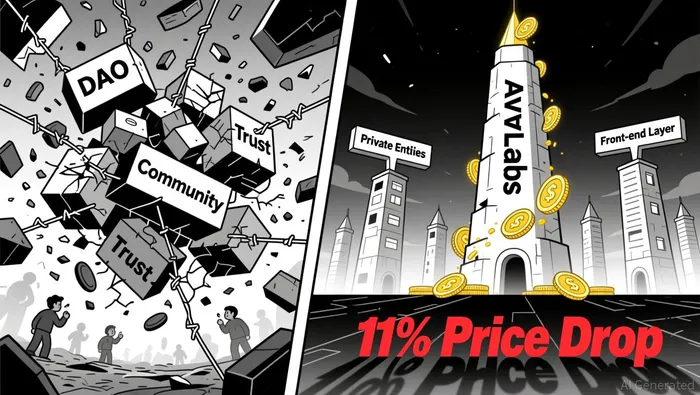
At the heart of Aave's crisis lies a fundamental conflict between Aave Labs, the protocol's founding team, and the Aave DAO. In 2025, Aave Labs integrated CoW Swap into the protocol, redirecting approximately $10 million in annual fees from the DAO treasury to a private address under its control. Critics argue this move circumvented the DAO's authority, as the community had previously funded Aave Labs' development. The founding team, however, defends the action by asserting that the fees originate from the "front-end and product layer," which they claim is separate from the protocol itself. This semantic distinction has sparked accusations of "value extraction at the expense of the DAO," with critics highlighting the lack of transparency in revenue allocation.
The tension escalated further when Aave CEO Stani Kulechov opposed a token alignment proposal to transfer control of Aave's brand assets (e.g., domains and social media handles) to the DAO. Despite the proposal receiving broad community support, Kulechov voted "no," arguing for a "structured process" instead of a direct vote. This decision, coupled with Aave Labs' unilateral submission of another proposal to a Snapshot vote without consulting its original author, Ernesto Boado, has deepened mistrust. The latter move alone triggered an 11% token price drop, as investors questioned the DAO's ability to govern itself.
Governance Flaws and Systemic Risks
Aave's crisis underscores three critical governance flaws in DAO-led protocols:
Ambiguous Revenue Distribution Mechanisms: The lack of clear boundaries between protocol governance and product monetization allows founding teams to extract value without accountability. As noted by Marc Zeller, this creates a "power imbalance where the DAO bears financial risks but has limited control over revenue streams."
Centralization of Decision-Making: Despite the DAO's theoretical decentralization, Aave Labs has repeatedly acted unilaterally. For instance, the CoW Swap integration and the unilateral proposal submission demonstrate how private entities can dominate governance processes, undermining the DAO's legitimacy.
Token Price Volatility as a Governance Indicator: The 10% drop in AAVE's price following the brand asset dispute and the subsequent 11% plunge highlight how governance conflicts directly impact investor confidence. Such volatility signals that token holders view governance instability as a material risk, potentially deterring long-term institutional adoption.
Broader Implications for Token-Driven DeFi
Aave's governance crisis is not an isolated incident but a symptom of systemic challenges in DeFi. Founding teams often retain private entities alongside public protocols, creating inherent conflicts of interest. This duality risks eroding the core principles of decentralization, as seen in Aave's case. For token-driven models, where governance rights are tied to token ownership, such conflicts can lead to:
- Erosion of Community Trust: When DAO members perceive governance as a "rubber stamp" for private interests, participation declines, weakening the protocol's resilience.
- Regulatory Scrutiny: Centralized control over revenue and brand assets may trigger regulatory challenges, particularly if authorities classify tokens as securities.
- Financial Losses: The $37.8 million in whale sell-offs following the brand asset dispute illustrate how governance disputes can trigger liquidity crises.
Conclusion: A Call for Governance Reform
Aave's governance turmoil serves as a cautionary tale for the DeFi ecosystem. While DAOs offer innovative governance frameworks, their success hinges on transparent revenue distribution, equitable power structures, and clear separation between protocol and product layers. For investors, the crisis underscores the importance of scrutinizing governance models before allocating capital. Protocols that fail to address these flaws risk becoming "decentralized in name only," with token prices and community trust paying the price.
As the DeFi space evolves, Aave's challenges highlight an urgent need for governance reforms-whether through on-chain voting mechanisms, revenue-sharing agreements, or third-party audits. Without such measures, the promise of decentralized finance may remain unfulfilled, leaving token-driven models vulnerable to the very centralization they seek to eliminate.






Comentarios
Aún no hay comentarios