
Aave's Governance Crisis and the Future of Token Holder Value in DeFi
The AaveAAVE-- governance crisis of 2025 has ignited a fierce debate at the heart of decentralized finance (DeFi): the tension between centralized execution and decentralized governance. At stake is not just the control of Aave's brand assets-such as trademarks, domain names, and social media accounts-but the broader question of how token holder value is preserved or eroded by governance structures. As the protocol's community votes on a proposal to transfer these assets from Aave Labs to the Aave DAO, the implications for Aave's token economics and valuation are profound. This analysis examines the long-term risks and opportunities posed by centralized control versus decentralized governance, drawing on historical precedents from other DeFi protocols and Aave's own evolving dynamics.
The Centralization vs. Decentralization Debate
Aave Labs, the entity behind Aave's development, has long been criticized for retaining operational control over key monetization points, including swap fees and brand assets. Proponents of decentralization argue that this centralization misaligns with the ethos of DeFi and weakens token holder sovereignty. Marc Zeller, a long-time Aave contributor, emphasized that the DAO-Aave's decentralized autonomous organization-should function as the protocol's engine, while Aave Labs acts merely as a service provider. By transferring control of soft assets to the DAO, token holders could gain greater influence over how the protocol is represented and monetized, potentially aligning value capture with economic participation.
Conversely, critics warn that decentralizing governance could stifle innovation. Nader Dabit, a prominent DeFi figure, argued that Aave Labs' ability to execute quickly and maintain developer incentives is critical to the protocol's dominance in the lending sector. Interface-level revenue, such as swap fees, functions as an R&D budget, enabling rapid development and competitive differentiation. Aave Labs defended its role by asserting that the community had already engaged in sufficient debate, framing the vote as a necessary step to resolve ambiguity. However, the procedural controversy-Aave Labs pushing the vote to the ballot while denying authorship of the proposal-has fueled accusations of governance overreach.
Historical Context: Governance Models in DeFi
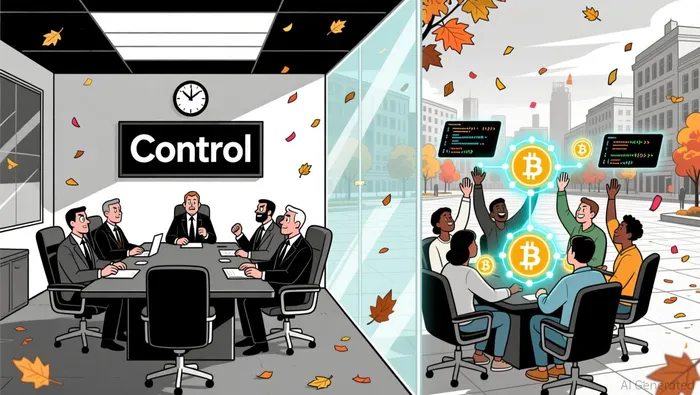 The Aave crisis mirrors broader debates in DeFi, where governance structures significantly influence token economics and valuation. MakerDAO, for instance, has faced similar tensions between its core development team and the MKRMKR-- token holder community. A 2023 study highlighted that decentralized governance models, while fostering transparency, often struggle with coordination costs and voter apathy. In contrast, centralized protocols like CompoundCOMP-- and UniswapUNI-- have demonstrated faster execution but at the expense of community trust.
Token valuation in DeFi is typically driven by metrics such as total value locked (TVL), user activity, and governance alignment. For example, Uniswap's Automated Market Maker (AMM) model achieved a TVL of over $200 billion in 2021 by prioritizing user-driven governance. Similarly, Aave's TVL has remained robust, with $53 billion in net deposits as of late 2025. However, governance disputes can introduce volatility. Aave's token price dropped 22% during the recent crisis, reflecting market concerns over unclear value capture and operational misalignment.
Impact on Aave's Token Economics and Valuation
The governance crisis has exposed a critical vulnerability in Aave's token economics: the disconnect between token holder ownership and operational control. When Aave Labs redirected swap fees to its own wallets, critics argued this undermined the AAVE token's economic claim, eroding trust. This misalignment has broader implications for token valuation. Governance tokens derive value from their utility in decision-making and their alignment with protocol growth. If token holders perceive governance as centralized or unresponsive, market confidence wanes, leading to price corrections.
Comparative analysis of other DeFi protocols underscores this dynamic. MakerDAO's MKR token, for instance, has seen valuation fluctuations tied to governance disputes over risk parameters and collateral types. Similarly, Compound's COMPCOMP-- token faced volatility during debates over fee distribution models. These cases suggest that governance transparency and community engagement are critical to sustaining token value.
Long-Term Implications and the Path Forward
The outcome of Aave's governance vote will set a precedent for how DeFi protocols balance decentralization with operational efficiency. If the DAO assumes control of soft assets, Aave could strengthen token holder alignment, potentially boosting long-term valuation through increased trust and participation. However, this shift may also slow development cycles, reducing the protocol's ability to innovate in a competitive market. Conversely, retaining centralized control risks governance fatigue and further price volatility, as seen in the recent 20% decline.
For investors, the key takeaway is the importance of governance structure in DeFi valuation. Protocols that achieve a balance-retaining agility in execution while ensuring token holder influence-may outperform peers. Aave's crisis highlights the need for governance frameworks that minimize coordination costs and maximize transparency, such as automated governance tools or hybrid models that delegate specific responsibilities to trusted entities.
Conclusion
Aave's governance crisis is more than a technical dispute; it is a microcosm of the broader challenges facing DeFi. The protocol's ability to reconcile centralized execution with decentralized governance will determine its long-term viability and token valuation. As the DeFi ecosystem matures, protocols that prioritize governance alignment-without sacrificing operational efficiency-will likely emerge as leaders. For Aave, the path forward hinges on whether the community can forge a governance model that honors both innovation and decentralization.






Comentarios
Aún no hay comentarios