
Aave's Expansion to Aptos: A Catalyst for DeFi Liquidity and Regulatory-Ready Asset Adoption
The DeFi landscape in 2025 is marked by a critical shift: the rise of non-EVM chains as viable alternatives to EthereumETH--. Among these, Aptos has emerged as a high-growth ecosystem, distinguished by its low fees, high throughput, and institutional-grade infrastructure. With a Total Value Locked (TVL) of $1 billion across 30+ protocols and a stablecoin market cap of $1.27 billion, Aptos has positioned itself as a scalable, developer-friendly chain. Now, Aave's strategic deployment of Aave V3 on Aptos—announced on August 21, 2025—threatens to accelerate this trajectory, deepening liquidity and legitimizing the chain as a hub for stablecoin and liquid staking token (LST) adoption.
Aptos: A High-Growth Ecosystem with Limited Competition
Aptos's appeal lies in its technical advantages. The chain processes 150,000 transactions per second (TPS) with sub-second finality, powered by the Move programming language and innovations like the Block-STM parallel execution engine. This infrastructure supports a diverse DeFi ecosystem, including:
- Stablecoins: USDTUSDC-- and USDCUSDC-- dominate, with USDT growing from $431 million to $850 million in six months.
- Liquid Staking Tokens (LSTs): Amnis Finance leads with $168.4 million in TVL, while sUSDe (Ethena's staked USDe) adds $45 million in value.
- Real-World Assets (RWAs): PACT's $420 million in tokenized assets and BlackRock's BUIDL ($47.7 million) highlight Aptos's role as the third-largest RWA chain.
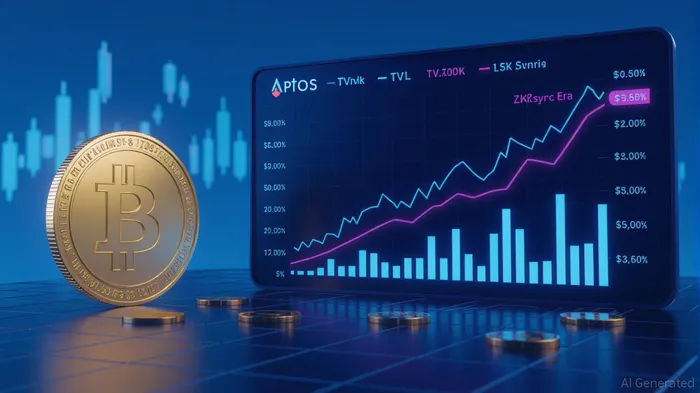
Despite Ethereum and ZKsync Era leading in TVL, Aptos's low gas fees (0.00011 APT, ~$0.00052) and developer incentives make it a compelling alternative. The Aptos Foundation's $200 million DeFi grant program and Gas Station initiative further reduce barriers to entry, attracting projects like Echelon (a $200 million TVL lending protocol) and Merkle Trade (a gamified DEX with $17 billion in lifetime volume).
Aave's Strategic Move: Liquidity Deepening and Regulatory Readiness
Aave's entry into Aptos is not a mere expansion—it's a calculated move to capitalize on a $1.27 billion stablecoin market and a nascent LST ecosystem. By rewriting AaveAAVE-- V3 in Move, the protocol aligns with Aptos's architecture while introducing four key assets: APT, sUSDe, USDT, and USDC. This selection is strategic:
- APT enhances the token's utility as collateral.
- sUSDe taps into the $45 million LST market, offering yield-bearing liquidity.
- USDT/USDC anchors Aave in a stablecoin-dominated ecosystem.
Aave's deployment is underpinned by institutional-grade security: four independent audits (Zellic, Ottersec, etcETC--.), a $500,000 GHO bug bounty program, and ChainlinkLINK-- oracles for real-time price feeds. These measures address regulatory concerns around smart contract risks and data integrity, positioning Aave as a compliance-ready protocol.
The Aptos Foundation's liquidity incentives—$2 million in APT rewards and gas subsidies—further amplify Aave's impact. Historical data from Aave's Arbitrum deployment (TVL surged 300% in six months) suggests a similar trajectory on Aptos. With conservative initial supply/borrow caps and governance-driven adjustments, Aave's TVL on the chain could reach $1.5 billion within a year.
Regulatory-Ready Assets and Institutional Adoption
Aave's expansion aligns with broader trends in regulatory alignment. The integration of WYST's RWA tokenization initiative—a $1.5 trillion market opportunity—positions Aave to bridge DeFi and traditional finance. Tokenized assets like PACT's real-world debt and BlackRock's BUIDL can now be lent and borrowed on-chain, attracting institutional capital.
Institutional interest is already evident. Plasma AI's $1.1 billion institutional fund, which targets DeFi assets, underscores confidence in Aave's cross-chain liquidity model. Meanwhile, Aave's governance model—led by the Aave DAO—ensures adaptability, with proposals like AIP-119 adjusting staking rewards to balance growth and decentralization.
Investment Implications: Aave and Aptos as a High-Conviction Play
For investors, Aave's Aptos deployment represents a synergistic opportunity:
1. Liquidity Deepening: Aave's TVL growth on Aptos could mirror its success on Arbitrum, driving fees and user adoption.
2. Regulatory Resilience: Aave's security-first approach and Chainlink integration mitigate risks in a tightening regulatory environment.
3. Token Utility: APT's price surged 5.2% post-announcement, reflecting optimismOP-- in its utility as collateral and governance asset.
Actionable Steps for Investors:
- Long Aave's TVL on Aptos: Allocate to Aave's liquidity pools on Aptos, prioritizing USDC and sUSDe for yield.
- Monitor APT's Utility: Track Aave's APT collateral adoption and governance proposals to assess token demand.
- Position in RWA Partnerships: Invest in WYST-aligned projects to capitalize on Aave's RWA integration.
Conclusion: Aave and Aptos as a Defining DeFi Narrative
Aave's expansion to Aptos is more than a technical achievement—it's a strategic pivot toward a multichain future. By leveraging Aptos's high-performance infrastructure and a $1.27 billion stablecoin base, Aave is poised to deepen liquidity, attract institutional capital, and set a precedent for regulatory-ready DeFi. For investors, this represents a high-conviction opportunity to participate in a chain and protocol that are redefining the boundaries of decentralized finance.






Comentarios
Aún no hay comentarios