
Aave's Evolution from Flash Loans to a Global DeFi Ecosystem
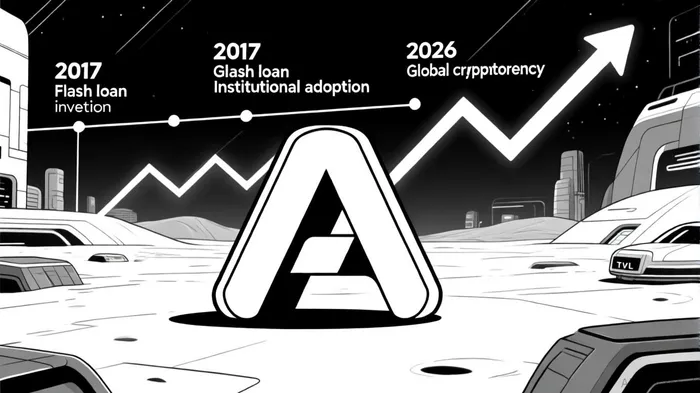
Aave's journey from a niche DeFi protocol to a cornerstone of decentralized finance is a testament to its relentless innovation. What began with the invention of flash loans in 2017 has evolved into a $41.1 billion Total Value Locked (TVL) ecosystem, positioning AaveAAVE-- as a critical bridge between traditional finance and decentralized systems[1]. As of August 2025, Aave's TVL places it among the top 2.5% of U.S. commercial banks by deposits[1], a metric that underscores its growing institutional relevance. This article examines Aave's strategic advancements—cross-chain expansion, real-world asset (RWA) integration, and institutional-grade infrastructure—to assess its long-term value proposition and blue-chip potential.
From Flash Loans to Cross-Chain Dominance
Aave's 2017 introduction of flash loans revolutionized DeFi by enabling trustless, instant borrowing without collateral. However, the protocol's true transformation began with its cross-chain ambitions. By 2025, Aave had expanded to non-EVM chains like Aptos, adding $1.3 billion in TVL within months[1]. The upcoming Aave V4 upgrade, set for Q4 2025, introduces a “Unified Liquidity Layer” and a Hub-Spoke architecture to streamline cross-chain liquidity[3]. This framework allows Aave to aggregate liquidity pools dynamically while tailoring risk parameters for specific use cases, such as institutional lending or RWA-backed borrowing.
Aave's cross-chain strategy is not merely technical but strategic. By integrating with chains like Avalanche, Gnosis, and Sonic, Aave is positioning itself to capture a broader user base and liquidity pools. As of mid-2025, Aave dominates 60–62% of the DeFi lending market[1], a share that could grow as its cross-chain infrastructure matures.
Real-World Assets: Bridging TradFi and DeFi
Aave's Horizon platform, launched in Q3 2025, represents its most ambitious step toward institutional adoption. Horizon enables institutions to borrow stablecoins (e.g., USDCUSDC--, RLUSD, GHO) against tokenized RWAs such as U.S. Treasuries, real estate, and institutional funds[4]. This initiative taps into the $26 billion tokenized asset market[1], unlocking liquidity for assets previously siloed in traditional finance.
Key to Horizon's success is its hybrid compliance model: permissioned borrowing for institutions coexists with permissionless lending for retail users. This structure ensures adherence to global regulations while preserving DeFi's composability. For example, Chainlink's SmartData provides real-time net asset value (NAV) updates for tokenized collateral, mitigating counterparty risks[4]. Launch partners like VanEck, Ripple, and WisdomTree further validate Horizon's institutional-grade utility[4].
Institutional Adoption: A Catalyst for Blue-Chip Status
Institutional interest in Aave has surged as tokenized RWAs gain traction. By early 2025, institutions held 15% of Bitcoin's supply, and nearly half of hedge funds allocated to digital assets[1]. Aave's Horizon platform has attracted $410 million in institutional inflows[1], with major asset managers piloting tokenized U.S. Treasury bills and real estate-backed assets[2].
The regulatory landscape, though still fragmented, is shifting in Aave's favor. The Trump administration's crypto-positive initiatives, including a SEC-CFTC-Treasury working group, aim to clarify rules for tokenized assets[4]. Meanwhile, the approval of U.S. spot BitcoinBTC-- and Ether ETFs in 2024 has normalized institutional crypto participation[1]. Aave's compliance-first approach—evidenced by its partnership with Chainlink and Securitize—positions it to benefit from this regulatory evolution.
Risks and Growth Catalysts
Despite its momentum, Aave faces headwinds. Regulatory uncertainty remains a significant barrier, particularly in the U.S., where tokenized securities lack a unified framework[1]. Technological integration challenges, such as ensuring KYC/AML compliance for tokenized assets, also persist[1]. Market volatility further complicates risk management for RWA-backed loans[1].
However, Aave's growth catalysts outweigh these risks. The Aave V4 upgrade, expected to launch in late 2025, will unify cross-chain liquidity and expand RWA support[3]. Expansion into non-EVM chains and partnerships with asset managers like Franklin Templeton and BlackRock[2] could drive TVL to new heights. Additionally, the tokenization of commodities and real estate—already generating $25 billion in on-chain liquidity[5]—offers a vast addressable market.
Conclusion: A Blue-Chip Investment in the Making
Aave's evolution from flash loans to a cross-chain, RWA-enabled ecosystem reflects its adaptability and foresight. With a 60–62% share of the DeFi lending market[1], a TVL exceeding $41 billion[1], and institutional partnerships accelerating tokenized asset adoption, Aave is well-positioned to become a blue-chip DeFi asset. While regulatory and technological risks persist, its strategic focus on compliance, liquidity aggregation, and institutional-grade infrastructure mitigates these challenges. For investors seeking exposure to the next phase of decentralized finance, Aave represents a compelling long-term opportunity.






Comentarios
Aún no hay comentarios