
Aave DAO's Governance Rejection: A Turning Point for DeFi Decentralization and Token Value Capture
The recent rejection of AaveAAVE-- DAO's proposal to transfer brand assets from Aave Labs to the DAO-controlled entity marks a pivotal moment in the evolution of decentralized finance (DeFi). With 58% of votes cast against the proposal and 37% abstained, the contentious vote has exposed deep fractures between the protocol's founding team and its token holders according to reports. This governance clash, occurring amid a 20% drop in AAVE's price over a week according to market data, underscores the fragility of aligning decentralization ideals with practical value capture in DeFi. For investors, the episode raises critical questions: Can DAOs reconcile governance sovereignty with operational efficiency? And how will token value capture evolve in protocols where power is increasingly concentrated among a few stakeholders?
The Aave Governance Conflict: A Microcosm of DeFi's Tensions
Aave's governance dispute centers on control of the protocol's brand assets, including domains, social media accounts, and codebases. Critics argue that Aave Labs' decision to redirect $10 million in annual fees from the DAO treasury to its own coffers constitutes "implicit privatization" of community-built value according to research. This move, coupled with the rushed holiday-season vote, has eroded trust in the founding team's commitment to decentralization. Meanwhile, Aave Labs founder Stani Kulechov's $5 million AAVE token purchase signals his belief in the project's long-term viability, even as the token's price reflects growing investor skepticism according to market analysis.
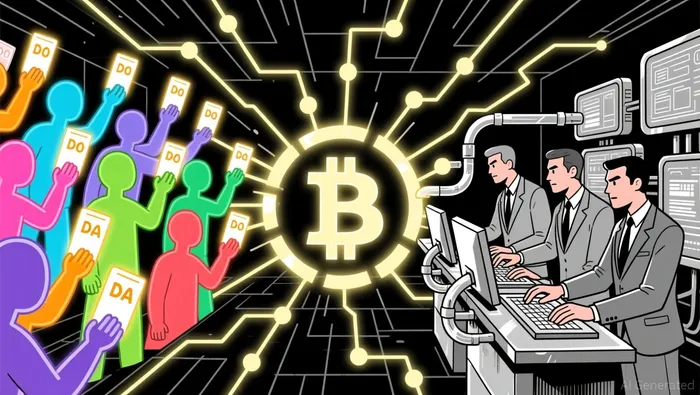
The community's response-proposals to transfer Labs' code and IP to the DAO-highlights a broader shift in DeFi governance. As one activist put it, "The DAO is no longer content with symbolic decentralization; it demands control over the protocol's soft assets" according to research. This push for sovereignty aligns with Ernesto Boado's "Phase One - Ownership" proposal, which seeks to establish a legal entity with anti-capture protections to manage Aave's brand according to institutional analysis. If implemented, such measures could strengthen token holders' governance rights and enhance AAVE's perceived value by solidifying its role as a true ownership token according to governance studies.
The centralization of value capture is further exacerbated by token distribution patterns. Research on DeFi governance shows that wealth concentration among early adopters and large stakeholders skews decision-making power, undermining the democratic ideals of DAOs according to academic research. For instance, Aave's 37% abstention rate in the recent vote suggests apathy or disillusionment among smaller token holders, who may feel their votes carry little weight according to community data. This dynamic mirrors historical disputes in protocols like MakerDAO, where governance tokens like MKRMKR-- have been criticized for enabling a "rich man's democracy" according to blockchain analysis.
Historical Precedents and Institutional-Grade Governance
Aave's governance crisis is part of a broader maturation of DeFi governance models. Between 2020 and 2025, protocols transitioned from speculative experiments to institutional-grade systems, with governance frameworks becoming more professionalized and slower-moving according to industry reports. For example, CompoundCOMP-- and BalancerBAL-- adopted delegation mechanisms to reduce the influence of individual token holders, prioritizing stability over direct democracy according to governance studies. While these changes improved operational efficiency, they also diluted the decentralization ethos that initially attracted users to DeFi.
The Aave case, however, represents a turning point. Unlike earlier disputes, where governance failures often led to token price volatility without structural reforms, the current conflict has spurred concrete proposals to institutionalize DAO control. Boado's "Phase One - Ownership" initiative, for instance, introduces legal safeguards against capture, a departure from the ad hoc governance models of the past according to institutional analysis. This shift toward institutional-grade governance-where DAOs are structured as legal entities with clear anti-capture provisions-could serve as a blueprint for other DeFi protocols seeking to balance decentralization with accountability.
Investment Implications: Navigating the New Normal
For investors, the Aave governance sagaSAGA-- highlights three key considerations:
Governance Alignment as a Value Driver: Protocols that institutionalize token-holder sovereignty-through legal entities, anti-capture mechanisms, or transparent revenue-sharing models-are likely to outperform peers in the long term. Aave's proposed legal entity for brand assets according to institutional analysis and MakerDAO's MKR governance model according to blockchain research exemplify this trend.
Token Price Sensitivity to Governance Risks: The 25% drop in AAVE's price following the governance dispute according to market data underscores the market's sensitivity to governance conflicts. Investors should monitor token holder concentration, abstention rates, and the frequency of contentious proposals as early warning signs of instability.
Regulatory Validation as a Double-Edged Sword: While the SEC's non-action on Aave validated its decentralized model according to research, regulatory scrutiny remains a wildcard. Protocols that fail to align governance with regulatory expectations-such as Tornado Cash's legal challenges according to regulatory analysis-risk existential threats.
Conclusion: A Defining Moment for DeFi
Aave's governance rejection is more than a technical dispute; it is a litmus test for DeFi's ability to reconcile decentralization with sustainable value capture. For protocols like Aave, the path forward lies in institutionalizing governance frameworks that empower token holders while ensuring operational efficiency. Investors who recognize this shift-prioritizing protocols with robust anti-capture mechanisms and aligned incentives-will be better positioned to navigate the next phase of DeFi's evolution.






Comentarios
Aún no hay comentarios