
Aave's On-Chain Risk Innovation and DeFi Lending Growth
The Aave Umbrella: Turning Risk into Yield
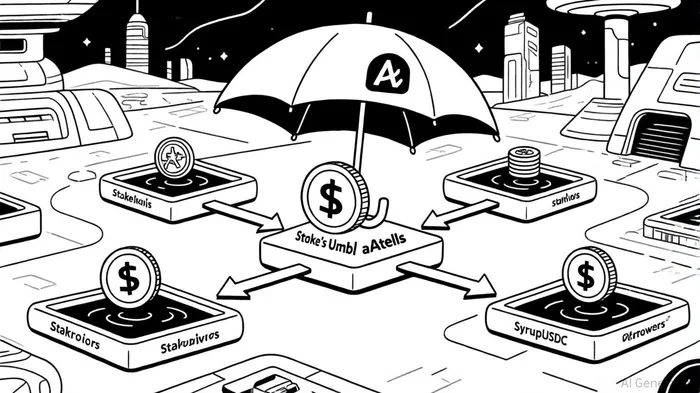
Aave's Umbrella system is a groundbreaking mechanism that transforms risk into yield opportunities while enhancing capital efficiency. By allowing users to stake aTokens (such as aUSDC or aUSDT) into asset-specific staking pools, the system creates a first line of defense against bad debt. If a borrower defaults, the protocol automatically deploys these staked aTokens to cover losses, eliminating the need for governance intervention, as explained in Aave Umbrella: Turning risk into yield. This not only stabilizes the platform but also incentivizes liquidity providers to earn additional rewards through dynamic emission curves tied to liquidity levels.
The system's design is particularly compelling for institutional investors. For example, Aave's partnership with Maple FinanceSYRUP-- has introduced institutional-grade stablecoins like syrupUSDC and syrupUSDT as collateral options, according to Aave Umbrella documentation. These yield-bearing assets diversify liquidity sources and stabilize borrowing demand, addressing a key pain point in DeFi markets. According to Exponential.fi, the Umbrella system's S-curve reward structure ensures that capital is directed to where it's most needed, avoiding overpayment for idle liquidity. This optimization is critical as DeFi lending grows from $36.5 billion in TVL to potentially $100+ billion in the next two years, according to AAVE V4 Release Fuels Market Momentum.
V4 Upgrade: A Unified Liquidity Layer
Aave's V4 upgrade, launched in late 2025, introduces a Unified Liquidity Layer (ULL) that reduces transaction costs and optimizes liquidity across multiple chains. This upgrade is a game-changer for cross-chain DeFi strategies, enabling seamless borrowing and lending between EthereumETH--, ArbitrumARB--, and other Layer 2s. Data from Yahoo Finance indicates that Aave now controls 82% of Ethereum's total outstanding lending debt, managing $25 billion in active loans with 1,000 unique borrowers daily. The ULL's ability to aggregate liquidity across chains not only lowers slippage but also makes Aave a more attractive option for institutional players seeking global capital efficiency.
The upgrade also includes the Cross-Chain Lending and Liquidation (CCLL) system, which allows users to collateralize assets on one chain to borrow on another, as noted in a CoinMarketCap report. This innovation aligns with Aave's vision of becoming a "global liquidity bank," as outlined in its roadmap. By reducing friction between chains, Aave is effectively creating a single, interoperable market for DeFi lending-a critical step toward mainstream adoption.
Institutional Integration and Real-World Assets
Aave's ambitions extend beyond crypto-native assets. Through initiatives like Aave Horizon, the protocol is integrating real-world assets (RWAs) into its lending framework, targeting institutional investors with permissioned markets for assets like commercial real estate and government bonds. Data published by Yahoo Finance highlights these moves as part of V4-driven market momentum. This move is part of a broader trend: institutional capital now accounts for 19.74% of funds retained in Aave as part of multi-protocol DeFi strategies, according to the 19B institutional capital analysis. By bridging the gap between traditional finance and DeFi, Aave is positioning itself as a hybrid infrastructure layer that can scale with regulatory demands.
To further strengthen its financial sustainability, Aave DAO has proposed a $50 million annual token buyback program, as reported by CoinMarketCap. This initiative, coupled with the growing utility of Aave's native stablecoin GHO, creates a flywheel effect where token value accrues to long-term holders while reducing reliance on external markets.
Academic Insights and Risks
While the Umbrella system's capital efficiency is lauded, it's not without risks. An audit by Ackee Blockchain highlighted a medium-severity issue related to potential shares inflation due to the slashing mechanism, detailed in the Aave Umbrella Audit Summary. If misconfigured, this could lead to a denial-of-service state. However, the audit recommends off-chain monitoring and configuration adjustments to mitigate this risk. For investors, this underscores the importance of Aave's governance and operational resilience in maintaining trust.
Investment Thesis
Aave's innovations in risk management and capital efficiency are reshaping DeFi lending. With the Umbrella system, V4 upgrade, and institutional-grade integrations, the protocol is capturing a disproportionate share of the $36.5 billion TVL market. As DeFi lending grows from 2023 to 2025, Aave's ability to balance scalability, security, and user incentives will be a key differentiator. For investors, this translates to a compelling long-term play on the infrastructure layer of Web3 finance.







Comentarios
Aún no hay comentarios