
AAVE's Bullish Reversal Amid Ecosystem Challenges: A Strategic Buy Opportunity?
In the ever-shifting landscape of decentralized finance (DeFi), contrarian value investing demands a sharp focus on dislocation between fundamentals and market sentiment. AaveAAVE-- (AAVE), the leading decentralized lending protocol, presents a compelling case for such an approach. Despite macroeconomic headwinds and regulatory uncertainty, Aave's on-chain metrics, institutional adoption, and governance-driven value accrual suggest a mispricing that could catalyze a bullish reversal.
On-Chain Metrics: A Protocol in Expansion Mode
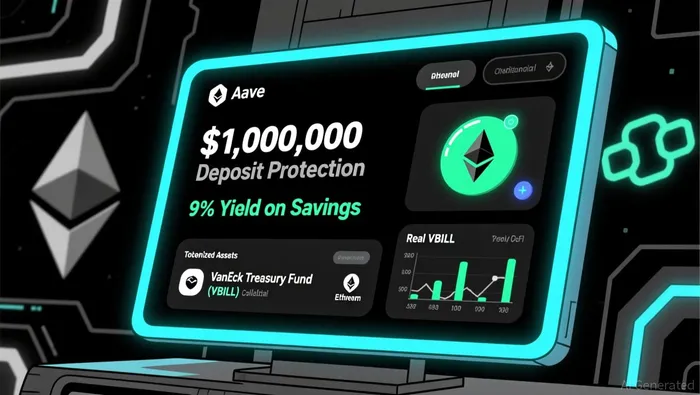
Aave's Total Value Locked (TVL) has surged to over $56 billion as of late 2025, with weekly revenue hitting $3 million-a 52% increase in Q2 2025 alone, outpacing the broader DeFi sector's 26% growth according to research. This growth is not merely quantitative but qualitative: Real-World Asset (RWA) deposits have expanded by 268% in 30 days, with the Horizon RWA market now valued at $540 million. The inclusion of tokenized assets like the VanEck Treasury Fund (VBILL) as collateral underscores Aave's role in bridging traditional finance and DeFi as on-chain growth indicates.
Aave's multi-chain strategy, while phasing out underperforming chains, has also sharpened its focus on EthereumETH-- mainnet, enhancing capital efficiency and aligning with institutional-grade security demands according to market analysis. These metrics suggest a protocol that is not only surviving but thriving in a maturing DeFi ecosystem.
Institutional Adoption: The New DeFi Infrastructure
Institutional capital is increasingly treating Aave as foundational infrastructure. $19 billion in institutional funds now leverage Aave as a core component of multi-protocol strategies, with 50.66% of SparkSPK-- borrowings flowing to Aave and 41.21% of Aave borrowings returning to Spark. This symbiotic relationship highlights Aave's role in enabling cross-protocol capital deployment, a critical factor in DeFi's transition from speculative experimentation to institutional-grade utility as data shows.
The launch of the Aave App-a consumer-focused neobank offering up to 9% yield and $1 million deposit protection-further signals Aave's ambition to capture mainstream users. By simplifying DeFi's complexity, the protocol is positioning itself to benefit from broader retail adoption, a demographic that has historically driven crypto cycles according to market analysis.
Governance and Tokenomics: A Self-Reinforcing Flywheel
Aave's governance structure has strengthened its tokenomics. The Aave DAO recently approved a permanent $50 million annual token buyback program, directly enhancing token scarcity and treasury optimization according to market reports. This mechanism, combined with Aave's 82% market share in Ethereum-based lending, creates a flywheel where increased usage and revenue drive token value, which in turn attracts further adoption as growth data shows.
Historically, Aave has traded at a discount to its on-chain fundamentals. As of mid-November 2025, the token was priced at $218, despite TVL and revenue figures that suggest a fair value significantly higher. Technical indicators point to a potential rally toward $450 by year-end, with some analysts projecting $370 by 2025 and $1,700 by 2030 according to price analysis.
Challenges and Contrarian Rationale
DeFi's broader challenges-regulatory scrutiny, competition, and market volatility-remain valid concerns. However, Aave's dominance (60% of the DeFi lending market and 20% of all DeFi TVL) and its focus on Ethereum's institutional-grade security position it as a relative safe haven within a volatile sector as market research indicates. The protocol's ability to innovate in RWA and cross-chain solutions also provides a moat against competitors.
For contrarian investors, the key question is whether Aave's current price reflects these fundamentals. With TVL and revenue growth outpacing the market, and institutional capital increasingly allocating to Aave, the token appears undervalued. The $50 million buyback program and Aave App's consumer appeal further reinforce this thesis.
Conclusion: A Strategic Buy in a Dislocated Market
Aave's ecosystem developments and governance-driven value accrual suggest a protocol that is not only weathering DeFi's challenges but redefining its trajectory. While the path to $450 or higher is not without risk, the alignment of on-chain growth, institutional adoption, and tokenomics creates a compelling case for a strategic buy. For investors willing to look beyond short-term volatility, Aave represents a rare opportunity to capitalize on DeFi's next phase of institutionalization.







Comentarios
Aún no hay comentarios