
AAUC: Sadiola Phase 1 Start - The Known Catalyst and What to Watch Next
The catalyst is now live. Allied GoldAAUC-- officially commenced processing ore through its new fresh ore comminution circuit at Sadiola on December 21, 2025. This marks the operational start of Phase 1, a key step in the company's plan to boost output and cut costs. The market has already reacted, with the stock up 8.21% year-to-date as of January 6, 2026.
That move reflects the event being largely priced in. The stock's strong performance this year suggests investors have already bet on the expansion's success. The immediate financial impact, however, will be felt starting in the first full quarter of 2026. That period will be the first to see the full benefit of feeding a higher proportion of the more abundant, higher-grade fresh ore into the mill, with throughput targeted at 5.7 million tonnes annually.
The setup now is clear. The known milestone is complete. The next catalyst is the first quarterly production report from this expanded operation, which will show whether the promised output ramp-up and cost savings are translating into real numbers.
Financial Impact: The Cash Flow Levers at Work
The operational start is the first step. The real test is how this expansion moves the financial needle. The math here is straightforward: more gold at lower cost equals stronger cash flow. Phase 1 is expected to boost Sadiola's annual output to 200,000 to 230,000 ounces, a 17% to 30% jump from 2023 levels. That production surge is the primary lever for top-line growth.
The second lever is cost. The shift to more fresh ore is designed to lower Sadiola's mine-site AISC. 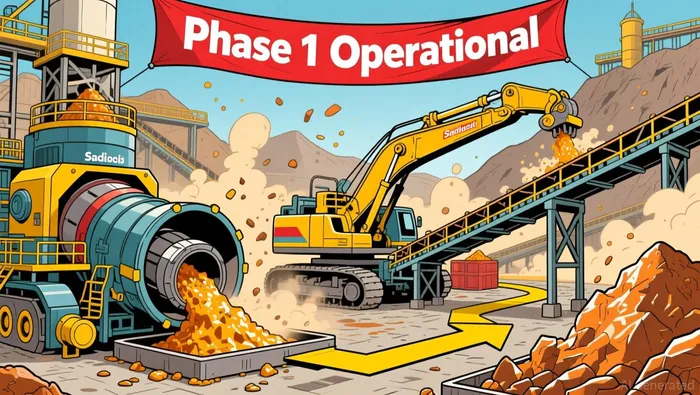 The company's 2025 guidance for the site puts that metric at $1,690 to $1,790 per ounce. While this is a range, the expansion's core promise is to drive costs toward the lower end, or even below, that target by improving the ore mix. Lower AISC directly boosts the profit margin on each ounce produced.
This isn't just about one mine. The Sadiola expansion is a linchpin in Allied's broader strategy to increase total company production to 375,000 to 400,000 gold ounces annually. The first full quarter of 2026 will be the first to show the combined effect of Sadiola's ramp-up and the robust output from other operations like Bonikro. The company expects quarterly output to exceed 113,000 ounces, a 30% year-over-year increase.
The bottom line is a clearer path to higher, more efficient earnings. The catalyst has been delivered; the financial impact will be measured in the next quarterly report.
Catalysts and Risks: The Setup for Q1 2026
The immediate next catalyst is clear. The first full-quarter production and cost report for 2026 will show whether the operational start translates into the promised financial impact. This report, expected in late March, will detail the actual output from Sadiola's fresh ore feed and the realized AISC. The market will be watching for confirmation that the annual output is targeted between 200,000 and 230,000 ounces and that costs are moving toward the lower end of the company's guidance.
The key near-term risk is execution on the modular Phase 2 expansion. While Phase 1 is live, Phase 2 is still in the research phase, with the company finalizing plans for a progressive, modular, and organic development of current facilities. Any delay or change in this trajectory could impact the longer-term growth story. Investors should look for an update on the preferred growth path early next year.
This sets up a potential mispricing scenario. The stock's strong performance this year suggests the market is focused on the growth narrative. If operational delays or cost overruns materialize in the first quarter, the stock could face a sharp correction. Conversely, if the report shows a smooth ramp-up and cost savings, the recent gains may be just the beginning. The setup is a classic event-driven trade: the known catalyst is complete, and the next report will reveal if the story holds.





Comentarios
Aún no hay comentarios