
A320 Fleet Grounding: Implications for Global Airlines and Aerospace Suppliers
The aviation industry is grappling with unprecedented volatility following the November 2025 grounding of Airbus A320 family aircraft,
triggered by a mid-air incident involving uncommanded altitude drops linked to solar radiation-induced data corruption in flight-control systems. This emergency directive from the European Union Aviation Safety Agency (EASA) has
forced airlines to implement urgent software and hardware updates, disrupting operations during a critical travel season and exposing vulnerabilities in aircraft resilience to environmental factors. For investors, the fallout underscores a complex interplay of operational, financial, and regulatory risks across airlines and aerospace suppliers.
Operational Disruptions and Airline Vulnerabilities
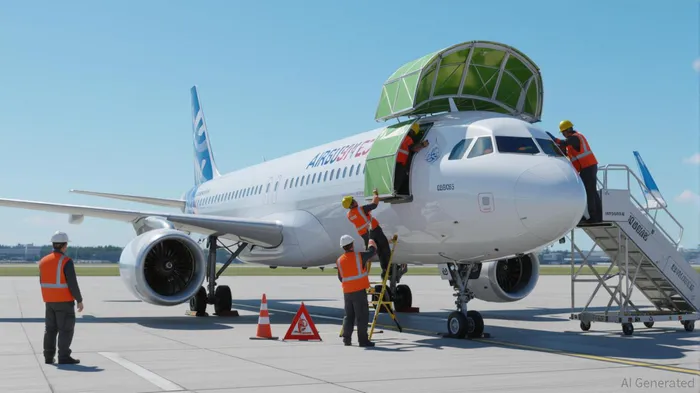
The grounding of over 6,000 A320 aircraft-used by carriers such as American Airlines-has
created immediate capacity constraints, with some operators requiring extended out-of-service periods for hardware modifications. Airlines reliant on A320 Neo and A321 Neo models, particularly those with Pratt & Whitney GTF engines, face compounding challenges. Air Astana, for instance,
reported a $23.7 million EBITDA loss in Q3 2025 due to unplanned engine removals, highlighting the financial toll of maintenance bottlenecks. Analysts warn that such disruptions could erode customer confidence and pressure yields,
particularly for airlines with high A320 fleet exposure.
Financial Market Reactions and Stock Valuations
The grounding has sent ripples through financial markets. American Airlines' stock, which fell 28% in 2025, has seen mixed analyst ratings, with TD Cowen and JPMorgan upgrading price targets to $18 and $20, respectively, on improved earnings guidance and capacity discipline. However, structural challenges persist, as evidenced by Susquehanna's cautious "Neutral" rating. For aerospace suppliers, the impact is equally pronounced. Pratt & Whitney, already managing a 250–300 day repair timeline for GTF engines,
faces heightened demand for spare parts amid constrained supply. CFM International, supplying Leap engines for A320 Neo variants, is similarly navigating supply chain strains,
with Airbus delaying production rate increases due to engine shortages.
Regulatory and Technological Risks
The EASA directive underscores a rare but critical vulnerability: the susceptibility of flight-control systems to solar radiation.
Airbus' emphasis on safety has prioritized hardware updates, but the incident raises questions about the adequacy of current design standards for space weather events. For investors, this highlights the potential for future regulatory interventions and retrofit costs, which could further strain airline balance sheets and supplier margins.
Long-Term Industry Outlook
Despite short-term turbulence, long-term projections for the aerospace sector remain robust.
Airbus forecasts a $290 billion commercial aircraft services market by 2043, while Boeing anticipates $4.4 trillion in support revenue over two decades. However, these forecasts hinge on resolving production bottlenecks and workforce challenges. The grounding has accelerated demand for maintenance, repair, and overhaul (MRO) services, benefiting suppliers with strong technical capabilities but exacerbating risks for those with limited flexibility.
Investment Risk Assessment
For airlines, the key risks lie in fleet utilization and cash flow stability. Carriers with diversified fleets or access to alternative aircraft (e.g., through leasing) may mitigate grounding impacts more effectively. Aerospace suppliers, meanwhile, face dual pressures: short-term profit margins from spare parts demand versus long-term reputational risks tied to quality control. Investors should closely monitor production timelines, regulatory updates, and carrier hedging strategies.
In conclusion, the A320 grounding exemplifies the aviation industry's susceptibility to exogenous shocks, from solar events to supply chain fragility. While the sector's long-term growth trajectory remains intact, near-term volatility demands a nuanced risk assessment, balancing operational resilience with strategic adaptability.





Comentarios
Aún no hay comentarios