
Why 93% of AI Investors Are Bullish-And How to Position for the Next Decade
The AI revolution is no longer a speculative narrative-it is a structural shift in global technology and finance. According to the Motley Fool's 2026 AI Investor Outlook Report, 93% of AI investors remain confident in the long-term returns of AI companies, even as concerns about an "AI bubble" persist. This optimism is not blind faith but a calculated response to the accelerating adoption of artificial intelligence across industries, driven by companies like Nvidia and Alphabet. For investors seeking to position for the next decade, the key lies in identifying high-conviction holdings that combine secular growth with robust financial fundamentals.
Structural Demand: The Engine of AI's Long-Term Growth
The surge in AI adoption is underpinned by two irreversible trends: data center modernization and generative AI integration. Enterprises are racing to upgrade infrastructure to handle AI workloads, creating a sustained demand for advanced hardware. NvidiaNVDA--, which dominates 90% of the AI GPU market, has capitalized on this shift. Its Blackwell architecture, designed for next-generation AI training and inference, has already secured $500 billion in confirmed orders through 2026. AlphabetGOOGL--, meanwhile, is leveraging its Tensor Processing Units (TPUs) and Gemini AI models to embed AI into core services like Google Search and YouTube, driving user engagement and revenue growth.
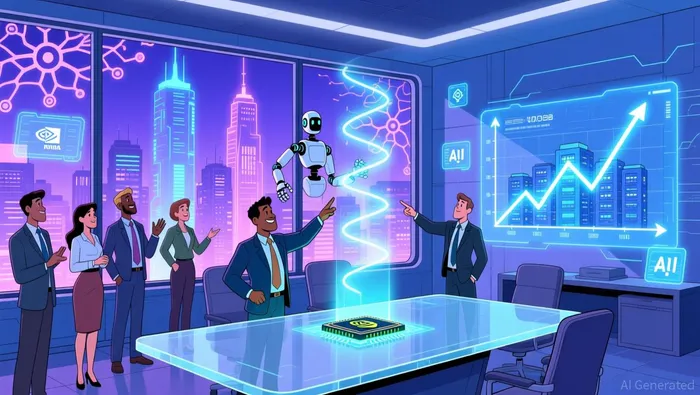 Generative AI is further amplifying demand. Alphabet's CEO Sundar Pichai noted that generative AI has not cannibalized Google Search but instead increased usage, contributing to a 16% year-over-year revenue jump in 2025. Similarly, Nvidia's Jensen Huang has dismissed bubble fears, emphasizing that the transition from CPUs to GPUs-and the explosion of AI applications in healthcare, finance, and robotics- will sustain demand for decades.
Financial Fortitude: Why Nvidia and Alphabet Are Defensible Bets
Investors bullish on AI are not merely chasing hype-they are backing companies with proven financial resilience. Nvidia's Q3 2026 revenue hit $57 billion, a 62% year-over-year increase, with its Data Center segment accounting for 90% of total revenue. The company's gross margin of 73.6% underscores its pricing power and operational efficiency. Alphabet, with a market cap of $3.88 trillion in early 2026, is equally compelling. Its Google Cloud division grew 34% year-over-year, while digital advertising revenue rose 15%, funding AI R&D and next-generation chip development (e.g., Ironwood).
Both companies are also managing risk effectively. Nvidia's debt levels remain low relative to its cash flow, and Alphabet's AI investments are funded by profits from its advertising empire. This financial discipline allows them to weather short-term volatility while maintaining long-term innovation cycles.
Risk Mitigation: Balancing Optimism with Prudence
While the 93% bullish statistic is striking, it is not without caveats. The Motley Fool survey also revealed that 62% of investors- rising to 71% among high-income earners-believe AI's long-term returns are secure. This suggests that optimism is concentrated among those with skin in the game, who understand the sector's structural advantages. For risk-averse investors, the solution lies in high-conviction, diversified holdings in companies with dominant market positions and recurring revenue streams.
Nvidia and Alphabet exemplify this approach. Nvidia's Blackwell and Rubin systems are locked into multi-year contracts with hyperscalers and enterprises, while Alphabet's AI-driven ecosystem creates network effects that are hard to replicate. Both companies are also investing in vertical integration-Nvidia with its AI software stack, Alphabet with its custom chips- reducing reliance on third-party suppliers and enhancing margins.
Positioning for the Next Decade
The next ten years will be defined by AI's integration into every facet of life. For investors, the priority is to align with companies that are not just riding the wave but shaping its trajectory. Nvidia's hardware dominance and Alphabet's full-stack AI strategy position them as cornerstones of this future. As Jensen Huang and Sundar Pichai have both argued, the "bubble" narrative overlooks the fundamental shift from speculative hype to enterprise-scale adoption.
In a market where volatility is inevitable, the best defense is to own assets with structural demand, financial strength, and visionary leadership. The 93% bullish figure is not a consensus-it is a signal that the most informed investors are already betting on AI's long-term potential.







Comentarios
Aún no hay comentarios