
5G Infrastructure Expansion in Retail and Food Service: Strategic IoT Partnerships as a Catalyst for Long-Term Value Creation
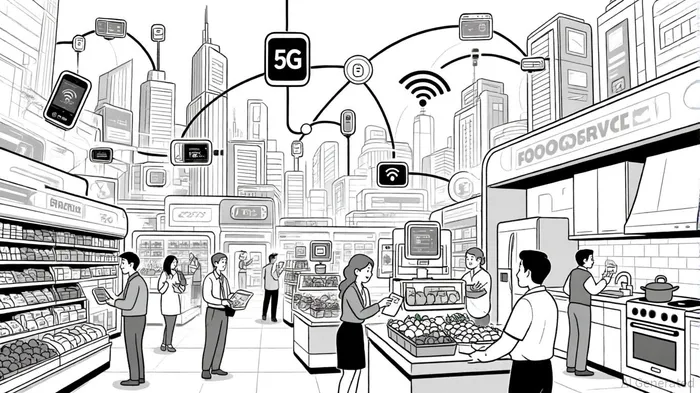
The convergence of 5G and IoT technologies is reshaping the retail and food service sectors, unlocking unprecedented operational efficiencies and customer-centric innovations. For tech enablers like TransActTACT-- Technologies, strategic IoT partnerships are not just a competitive advantage—they are a blueprint for long-term value creation in an increasingly connected world.
The 5G-IoT Synergy: A New Era for Retail and Food Service
According to a report by Grand View Research, the global IoT in retail market was valued at USD 66.44 billion in 2024 and is projected to grow at a compound annual growth rate (CAGR) of 24.5%, reaching USD 488.53 billion by 2033[2]. This surge is driven by the integration of 5G networks, which enable faster data transmission, lower latency, and seamless connectivity for IoT devices. For instance, WalmartWMT-- has leveraged IoT sensors to remotely control HVAC systems in stores, reducing energy consumption and utility costs without compromising customer experience[3]. Similarly, smart shelves and RFID tags are enabling real-time inventory tracking, predictive demand forecasting, and automated reordering, minimizing stockouts and waste[2].
In the food service sector, IoT innovations are streamlining back-of-house operations. TransAct Technologies' BOHA!® ecosystem, for example, has been deployed across 131 hospitals to automate date code labeling, temperature monitoring, and food safety compliance[1]. By reducing repetitive manual tasks, the platform allows staff to focus on customer service and food quality, directly aligning with the sector's need for operational agility.
TransAct Technologies: A Case Study in Strategic IoT Partnerships
TransAct's strategic partnerships underscore its role as a key player in 5G-driven IoT adoption. The company has secured contracts with major franchises, including a sushi chain with 2,108 locations, which deployed 596 BOHA! Terminal 2 LTE units to modernize operations[3]. These devices, powered by 5G connectivity, enable real-time data synchronization for inventory management and service delivery. Additionally, a national convenience store chain upgraded all 1,400 of its existing BOHA! units to the Terminal 2 model, demonstrating the platform's scalability and adaptability[3].
TransAct's expansion into international markets further highlights its growth potential. The company has secured its fifth international market for the BOHA! Terminal 2 within a quick-service restaurant (QSR) customer, with opportunities in several other countries[5]. This global footprint positions TransAct to capitalize on the broader 5G infrastructure boom, as telecom operators invest heavily in next-generation connectivity. By 2025, the telecommunications industry is projected to generate $1.53 trillion in revenue, with 5G adoption accelerating four times faster than 4G[4].
Long-Term Value Creation: Beyond Connectivity
For tech enablers like TransAct, the value of 5G and IoT lies in their ability to address industry-specific pain points. In healthcare foodservice, for example, the BOHA! ecosystem's integration of sensors and gateways ensures compliance with stringent food safety regulations while reducing labor costs[1]. In retail, 5G-enabled IoT solutions are transforming cold chain logistics, ensuring product freshness and delivery efficiency[2].
Moreover, the evolution of 5G-Advanced and standalone (SA) networks is unlocking new capabilities, such as AI-native network automation and enhanced positioning services[4]. These advancements are critical for enterprise applications like industrial automation and logistics, where low-latency, high-reliability connectivity is non-negotiable. TransAct's focus on IoT partnerships aligns with this trajectory, as its solutions are designed to integrate with private 5G networks and edge computing architectures[1].
Investment Implications and Future Outlook
The financial impact of 5G and IoT adoption is already evident. A case study by EricssonERIC-- highlights how its NetCloud Service for IoT reduced operational costs and improved food safety compliance for grocery retailers[1]. Similarly, TransAct's partnerships have demonstrated measurable ROI, with clients reporting reduced waste, lower labor expenses, and enhanced customer satisfaction[3].
Looking ahead, the monetization of 5G in enterprise markets will hinge on scalable, tailored solutions. As Deloitte Insights notes, telecoms must balance cost-cutting with innovation to improve returns[4]. TransAct's ability to adapt its BOHA! platform to diverse sectors—healthcare, QSR, and retail—positions it as a versatile enabler of digital transformation.
Conclusion
The integration of 5G and IoT in retail and food service is not merely a technological shift—it is a strategic imperative for enterprises seeking to thrive in a data-driven economy. For investors, companies like TransAct Technologies exemplify how strategic IoT partnerships can drive long-term value by addressing operational inefficiencies, enhancing customer experiences, and future-proofing infrastructure. As 5G-Advanced and AI-native networks mature, the winners will be those who, like TransAct, prioritize innovation, scalability, and sector-specific solutions.





Comentarios
Aún no hay comentarios