
The S&P 500's Strong Finish in 2025: Rally or Overvaluation?
The S&P 500's late 2025 performance has sparked a critical debate: Is the index's year-end surge a classic Santa Claus rally, or a warning sign of growing overvaluation risks for 2026? This question is not merely academic-it has profound implications for investors navigating a market shaped by shifting macroeconomic dynamics, speculative fervor, and structural imbalances.
A Volatile December: Rally or Resilience?
As of November 2025, the S&P 500 closed December with a modest 0.25% gain for the month, a figure that belies the turbulence beneath the surface. A government shutdown disrupted economic data releases, while shifting Federal Reserve expectations and sector rotation created pronounced volatility. The index's technical rebound in late December-marked by a 0.8% rise on December 18 after soft inflation data-suggested a seasonal rally was in motion. This technical rebound on December 18 suggested a seasonal rally was in motion. However, the broader context reveals a more nuanced picture. The forward price-to-earnings (P/E) ratio for the S&P 500 stood at 21.5 as of November 2025, above both its 5-year average (20.0) and 10-year average (18.7). By year-end, this metric had climbed to 22.5, a level 13.1% higher than the five-year average and 21% above the 10-year average.
This divergence between technical momentum and valuation metrics raises a key question: Is the December rally a reflection of market fundamentals, or a temporary reprieve from deeper imbalances? Historically, the Santa Claus rally has occurred in 72–73% of years since 1980, with an average return of 1.1%. In 2025, the S&P 500's December performance aligned with this pattern, albeit amid a backdrop of thin trading volumes and macroeconomic uncertainty. Yet, the index's reliance on a narrow group of megacap stocks -the so-called "Ten Titans," which account for 39% of the index-casts doubt on the sustainability of this rally. 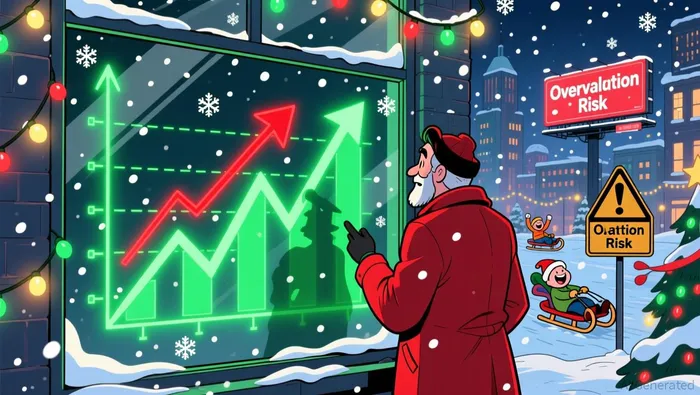
Overvaluation Risks: A Structural Concern
The S&P 500's valuation metrics in late 2025 suggest growing risks of overvaluation. The forward P/E ratio of 22.5, while lower than the 22.8 level seen in September 2025, remains significantly above historical averages. This premium is largely driven by speculative bets on future earnings, particularly in the technology sector, where the Information Technology sector is projected to lead gains by 26.6% in 2026. While proponents argue that strong fundamentals-such as a 20% return on equity, expanding profit margins, and the transformative potential of AI-justify these valuations, critics caution that such multiples are disconnected from current earnings realities. For instance, the S&P 500's equal-weight index lagged significantly behind its cap-weighted counterpart, highlighting uneven performance across the index.
The dominance of the "Ten Titans" further exacerbates these risks. These stocks, valued primarily on aspirational growth narratives rather than current cash flows, have created a structural imbalance in the index. If their earnings growth fails to meet expectations-or if macroeconomic headwinds, such as the economic impact of tariffs, materialize-the broader market could face a correction.
Balancing Optimism and Caution
The Santa Claus rally of December 2025 appears to have been fueled by a mix of seasonal factors and macroeconomic optimism. Federal Reserve rate cuts and easing liquidity constraints provided a tailwind, while year-end bonuses and fund manager rebalancing amplified buying pressure. However, the rally's sustainability hinges on two critical variables: the ability of U.S. corporations to deliver on earnings projections and the resilience of global liquidity conditions.
Analysts project blended earnings growth of 7.5% for Q4 2025 and 11.8% for the full year, with the technology sector expected to drive much of this growth. If these forecasts materialize, the S&P 500's current valuation could be justified. Yet, the index's forward P/E rose from 18.0x in April 2025 to 22.3x by June 2025, a trajectory that suggests a growing disconnect between fundamentals and investor sentiment.
Implications for 2026 Investors
For investors entering 2026, the key challenge lies in distinguishing between a genuine rally and a speculative bubble. The S&P 500's strong finish in 2025 may reflect a combination of both-a seasonal surge supported by macroeconomic tailwinds but underpinned by structural overvaluation risks. Those with a long-term horizon may find opportunities in undervalued sectors or equities, while those with shorter time horizons should remain vigilant about liquidity shifts and geopolitical risks. For investors entering 2026, the key challenge lies in distinguishing between a genuine rally and a speculative bubble.
Ultimately, the Santa Claus rally of December 2025 serves as a reminder that markets are as much about psychology as they are about fundamentals. While the index's late-year surge may appear to be a gift from the season, investors must ask whether it is a sustainable trend or a harbinger of volatility in the months ahead.







Comentarios
Aún no hay comentarios