
The S&P 500's Record High and Market Correction Risks Ahead of 2026
The S&P 500 has reached record highs in 2025, driven by robust tech earnings, trade policy optimism, and a cooling inflation environment. However, beneath the surface, the market faces mounting risks of near-term volatility and potential corrections as valuations stretch to historically elevated levels. For investors, the challenge lies in balancing the allure of the Santa Claus rally-a seasonal phenomenon historically tied to year-end gains-with the realities of a fragile macroeconomic backdrop.
Elevated Valuations and Earnings Dynamics
The S&P 500's price-to-earnings (P/E) ratio currently stands at 21.7x, placing it in the 93rd percentile of historical valuations. This premium reflects strong demand for large-cap stocks, particularly in the tech sector, where the Magnificent 7 (M7) continue to dominate. Goldman Sachs Research projects the M7 will outperform the S&P 493 by 7 percentage points in 2025, a narrowing gap from 30 percentage points in 2024. While this suggests a more balanced market, it also highlights the fragility of the current rally: if the M7's growth slows or faces regulatory headwinds, the broader index could face downward pressure.
Earnings growth itself is a mixed signal. The S&P 500 is expected to see 11% earnings growth in 2025 and 7% in 2026, supported by 5% sales growth and a projected 2.5% real GDP expansion. However, these forecasts hinge on the Federal Reserve's ability to maintain a "Goldilocks" scenario-moderate inflation and steady growth-without triggering a policy misstep. J.P. Morgan Research warns that volatility could intensify in the second half of 2025 as markets grapple with the implications of Trump-era trade policies, including tariffs on autos and Chinese imports.
The Santa Rally: Opportunity or Mirage?
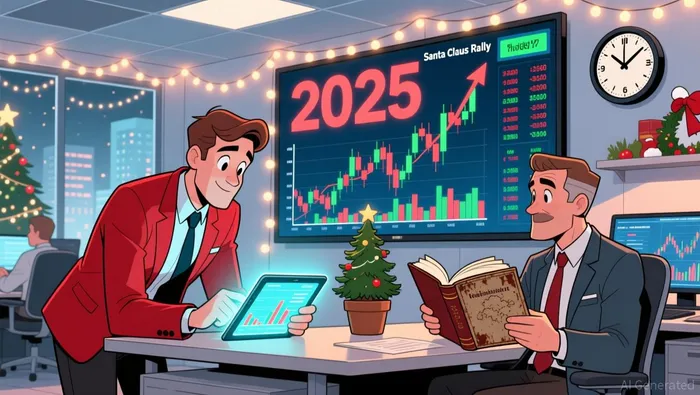 Historically, the Santa Claus rally-a period spanning December 24 to January 5-has delivered an average 1.6% gain for the S&P 500 since 1928. In 2025, the rally appears to be gaining momentum, with the index up 1.2% by mid-December. This performance is buoyed by thin liquidity, which amplifies the impact of modest trades, and a Fed poised to cut rates in 2026. However, the rally's success is far from guaranteed.
Past corrections during the Santa period-such as the 9% drop in 2018 and 6% declines in 2002 and 2022-serve as cautionary tales. These downturns were driven by macroeconomic shocks (e.g., the 2018 trade war) and geopolitical tensions. In 2025, the risk of a similar disruption looms, particularly if inflation reaccelerates or trade policy debates escalate. Schwab's Center for Financial Research notes that sectors like Communication Services and Health Care are well-positioned to benefit from AI adoption, but investors must remain wary of overexposure to high-valuation tech stocks.
Positioning for 2025-2026: Strategies and Sector Focus
For those seeking to capitalize on the Santa rally, several strategies emerge from the data. First, mid-cap stocks-represented by the S&P 400-offer an attractive alternative to stretched large-cap valuations. These stocks have historically outperformed during periods of market rotation and are currently trading at a discount to their long-term averages. Second, undervalued S&P 500 stocks in sectors like Industrials and Financials could benefit from year-end portfolio rebalancing.
Sectoral positioning is also critical. Retail and Consumer Discretionary stocks, driven by holiday spending and e-commerce demand, are expected to outperform. Meanwhile, the Nasdaq Composite-historically a Santa rally favorite-remains a focal point, though investors are advised to temper expectations given recent AI-related fatigue. Gold, inversely correlated to the U.S. dollar, could also play a role in diversified portfolios, especially as the dollar index hits multi-year lows.
Risks and the Road Ahead
The key risks for 2026 include a sharper-than-expected slowdown in earnings growth, a Fed pivot that lags market expectations, and geopolitical shocks. The S&P 500's current 3% discount to fair value estimates suggests some room for correction, but the index's reliance on the M7 means a broad-based selloff could be severe. Investors should prioritize diversification, hedging, and a focus on sectors with strong fundamentals rather than chasing momentum.
In conclusion, while the Santa rally offers a compelling opportunity, it must be approached with caution. The S&P 500's record high is a testament to resilience, but history reminds us that elevated valuations and policy uncertainty can quickly turn a rally into a correction. As the calendar flips to 2026, the market's ability to navigate these challenges will define its trajectory.





Comentarios
Aún no hay comentarios