
Can the S&P 500 Reach 8000 in 2026? The Role of Rate Cuts, AI, and Earnings Growth
The S&P 500, a barometer of U.S. equity market performance, has surged to record highs in recent years, driven by a confluence of technological innovation, accommodative monetary policy, and resilient corporate earnings. As of late 2025, the index hovers near 6,800, raising a critical question for investors: Is 8,000 a realistic target by 2026? The answer hinges on three pivotal forces-Federal Reserve rate cuts, artificial intelligence (AI)-driven earnings growth, and the broader economic context.
The Arithmetic of 8,000
To reach 8,000 by year-end 2026, the S&P 500 would need to grow by approximately 19% from its current level. While this exceeds the 11–15% growth projected by most analysts, it is not inconceivable. Morgan StanleyMS--, for instance, forecasts the index could hit 7,800 by December 2026, a 14% gain, with further upside if the Fed adopts a more dovish stance and inflation continues to decline. RBC Global Asset Management notes that the 2026 consensus profit forecast for the S&P 500 is 12.8% year-over-year growth, suggesting earnings momentum could fuel price appreciation.
AI as the Catalyst 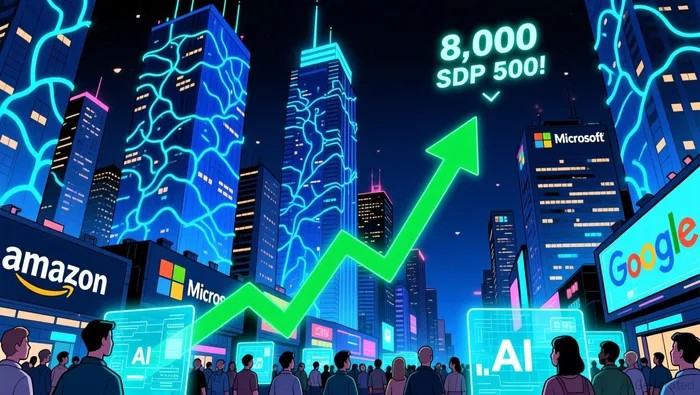
The AI revolution is reshaping the economic landscape, with hyperscalers like AmazonAMZN--, MicrosoftMSFT--, and GoogleGOOGL-- leading the charge. These firms are projected to increase capital expenditures significantly to support AI infrastructure, including data centers and energy systems. The "Magnificent 7" tech giants, which dominate the S&P 500, are expected to achieve roughly 20% earnings per share (EPS) growth in 2026, outpacing the index's broader 13–15% EPS growth. This concentration of innovation in a handful of stocks-accounting for nearly 30% of the index's market capitalization-could amplify the S&P 500's trajectory if AI-driven productivity gains materialize.
Moreover, AI-related spending is anticipated to exceed $500 billion in 2026, creating a ripple effect across semiconductor and software sectors. Companies like NVIDIA, which supply critical chips for AI applications, are already benefiting from this surge, and their success could further buoy the index.
The Fed's Dovish Pivot
The Federal Reserve's policy trajectory will be a linchpin for equity markets in 2026. With inflation showing signs of moderation and the labor market cooling, the Fed is expected to initiate rate cuts as early as January 2026, potentially reducing the federal funds rate to 3.0–3.25% by midyear. These cuts would lower borrowing costs for corporations and consumers, spurring investment and consumption.
Rate cuts also historically support equity valuations by reducing the discount rate used to value future cash flows. A report by JPMorgan Chase suggests that a more aggressive easing cycle-should Fed leadership shift toward a dovish stance-could catalyze a prolonged bull market. However, the Fed's actions are not without risks. Persistent inflation or a sudden economic downturn could force a reversal, introducing volatility.
Valuation Risks and Macroeconomic Headwinds
Despite the optimistic outlook, the S&P 500's current valuation remains a point of contention. The index trades at a price-to-earnings (P/E) ratio of 28x, well above its 10-year average of 22x. This premium reflects high expectations for AI-driven growth but also raises concerns about a potential correction if earnings fail to meet forecasts.
Additionally, the AI boom itself carries risks. A "valuation bubble" in AI-related stocks could burst if the technology's commercial applications fall short of hype. Schwab analysts caution that a fragmented economy and slowing labor market could exacerbate these risks, creating a "balance of risk that tilts modestly downward".
Conclusion: A Plausible but Uncertain Path
The S&P 500 reaching 8,000 by 2026 is plausible but contingent on several moving parts. If the Fed delivers meaningful rate cuts, AI infrastructure spending translates into tangible productivity gains, and corporate earnings continue to outperform, the index could surpass 8,000. However, investors must remain vigilant about valuation extremes, macroeconomic shifts, and the inherent unpredictability of technological adoption.
As RBC Global Asset Management aptly notes, the market's ability to sustain momentum will depend on whether AI transitions from "infrastructure investment to tangible productivity gains". For now, the stage is set for a high-stakes test of innovation, policy, and investor psychology.







Comentarios
Aún no hay comentarios