
The S&P 500 Index Inclusion and Its Implications for Robinhood and Digital Asset Firms
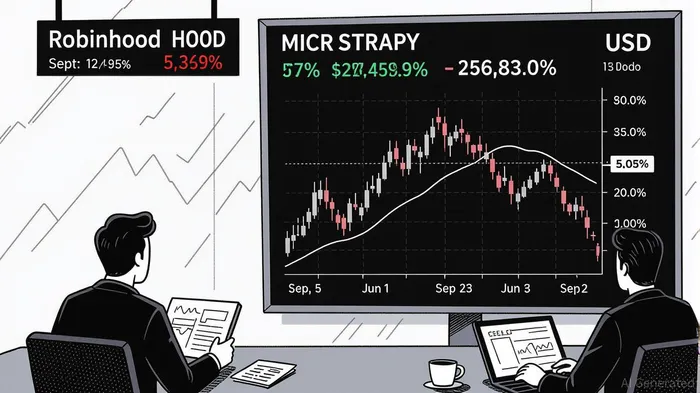
The S&P 500 index rebalancing on September 22, 2025, marked a pivotal moment for digital assetDAAQ-- firms, with Robinhood MarketsHOOD-- (HOOD) securing inclusion while MicroStrategy (MSTR) faced an unexpected exclusion. This divergence offers critical insights into the evolving institutional and regulatory stance toward crypto-related equities, as well as the valuation dynamics shaping market momentum in the post-inclusion era.
Robinhood’s Inclusion: A Validation of Crypto-Driven Retail Investing
Robinhood’s addition to the S&P 500 was driven by its strategic positioning as a bridge between retail investors and digital assets. According to a report by Yahoo Finance, the company’s Q2 2025 financial results underscored its growing influence: total revenue reached $989 million, with a net profit of $386 million and earnings per share (EPS) of $0.42 [1]. Notably, crypto trading revenue surged 98% year-over-year to $160 million, despite a QoQ decline amid market volatility [1].
The inclusion catalyzed immediate market momentum. Robinhood’s share price rose 7% in after-hours trading, closing near $101 and surging past $108 post-announcement [1]. This reaction reflects heightened institutional and retail confidence in Robinhood’s role as a mainstream gateway to crypto. However, valuation concerns persist. With a price-to-earnings (P/E) ratio of 60.63 and a discounted cash flow (DCF) intrinsic value of $3.50—far below its market price—analysts caution that the stock is overvalued [3]. Despite this, a median price target of $82 suggests a “Hold” rating, balancing optimism about earnings growth against technical resistance [3].
MicroStrategy’s Exclusion: Macro Factors Over Micro Metrics
In contrast, MicroStrategy’s exclusion, despite robust Q2 2025 results—$14 billion in operating income, $10 billion in net income, and an EPS of $32.60 [2]—highlights the S&P 500 committee’s emphasis on macroeconomic alignment. As noted by Mexc, the firm’s exclusion was attributed to its heavy BitcoinBTC-- exposure (628,791 BTC, valued at $112 billion) and the committee’s focus on market competition and sector representation [1]. Analysts like Jeff Park of ProCapPCAP-- BTC argued that the decision prioritized broader index stability over individual performance [1].
The market reacted swiftly: MSTR’s stock fell 2% in after-hours trading, signaling disappointment over missed institutional inflows typically tied to S&P inclusion [1]. Yet, some experts, including Jeff Walton, argue that MicroStrategy’s financials—bolstered by Bitcoin’s June 2025 price surge—could still position it for future inclusion [4]. This duality underscores the S&P 500’s cautious approach to crypto-linked firms, balancing innovation with systemic risk.
Strategic Implications for Investors
Robinhood’s inclusion versus MicroStrategy’s exclusion reveals a nuanced institutional narrative. While the former is celebrated as a “mainstream enabler” of crypto adoption, the latter’s exclusion signals lingering skepticism about pure-play crypto firms. For investors, this dichotomy presents a strategic opportunity: Robinhood’s S&P 500 status ensures increased liquidity and institutional ownership, amplifying its potential as a leveraged play on the crypto-to-mainstream transition.
Data from StockInvest indicates that Robinhood’s post-inclusion momentum aligns with its Q2 earnings strength, despite valuation headwinds [3]. The stock’s 7% surge post-announcement suggests that market participants are pricing in long-term growth, even as technical indicators caution against overextension. For risk-tolerant investors, RobinhoodHOOD-- offers exposure to the crypto ecosystem without the volatility of direct crypto holdings, leveraging its S&P 500 status to attract diversified portfolios.
Conclusion
The S&P 500 rebalancing of September 2025 underscores a pivotal shift in institutional attitudes toward digital assets. Robinhood’s inclusion validates its role as a bridge between traditional finance and crypto, while MicroStrategy’s exclusion highlights the index’s cautious approach to pure-play crypto firms. For investors, Robinhood’s post-inclusion momentum and Q2 financials present a compelling case for strategic entry, particularly as the crypto-to-mainstream transition gains institutional traction. However, valuation metrics demand careful monitoring, balancing optimism with prudence in this high-growth, high-volatility sector.
**Source:[1] Robinhood Set to Join S&P 500 as Bitcoin Giant Strategy ..., [https://finance.yahoo.com/news/robinhood-set-join-p-500-212855353.html][2] Microstrategy Q2 2025 Financial Results - Jaunt, [https://jaunt.com/j/microstrategy-q2-2025-financial-results-3245][3] Robinhood Markets Displays Strong Momentum Amid High ..., [https://stockinvest.us/stock-news/robinhood-markets-displays-strong-momentum-amid-high-valuation-and-technical-resistance-challenges][4] Are MSTR's Perpetual Preferred Stocks STRK, STRF ..., [https://www.coindesk.com/markets/2025/07/01/strategys-perpetual-preferred-stocks-may-be-front-running-sp-500-inclusion]





Comentarios
Aún no hay comentarios