
The S&P 500's Impending 5% Pullback and Strategic Buying Opportunity at 6,100
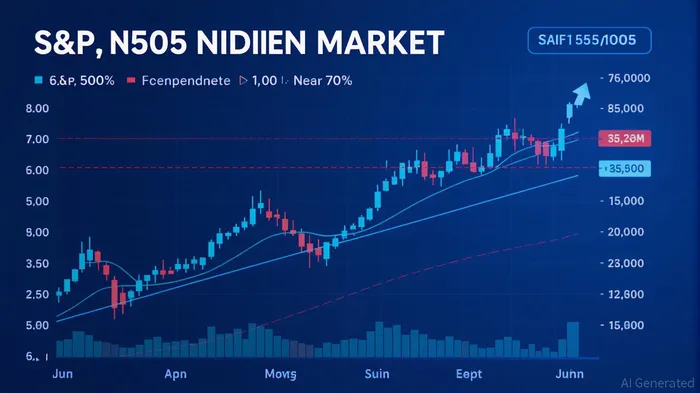
The S&P 500 has long been a barometer of global economic health, but its current trajectory tells a story of fragility beneath the surface. While the index has surged past critical resistance levels in 2025, technical indicators and macroeconomic vulnerabilities are flashing red. A 5% pullback appears increasingly likely, with the 6,100 level emerging as a strategic entry point for disciplined long-term investors. Let's dissect the evidence.
Technical Analysis: A Market Overbought and Overextended
The S&P 500's recent rally has been driven by a handful of mega-cap stocks, but the broader technical picture is far less bullishBLSH--. The WealthUmbrella Margin Risk Indicator is at 13, a level historically associated with trend reversals. Meanwhile, the Relative Strength Index (RSI) has lingered near 70 for weeks, a classic overbought condition. Historically, such readings in strong uptrends often precede corrections when the index fails to break through key resistance zones.
Moving averages also paint a cautionary tale. The 50-Day and 100-Day moving averages (currently at 6,177.75 and 5,886.15, respectively) are critical support levels. A breakdown below the 50-Day would confirm a near-term bearish shift. Worse still, market breadth is deteriorating. The Advance-Decline Line, a measure of broad market participation, has weakened despite the S&P 500 hitting new highs. This divergence is a textbook warning sign of a topping process.
Macro Warning Signs: Four Red Flags
1. Consumer Weakness and Eroding Purchasing Power
U.S. consumers, the backbone of the economy, are showing cracks. In Q1 2025, purchasing power fell to 31.00, a -2.52% annual decline. Despite low unemployment, 75% of consumers reported trade-down behaviors—switching to private-label brands, delaying purchases, or cutting back on discretionary spending. Food prices, in particular, remain a drag, with 51% of low-income households reducing meat and dairy consumption.
2. Semiconductor Sector Underperformance
The semiconductor industry, a linchpin for AI and tech innovation, is faltering. Geopolitical tensions—U.S. export controls on advanced chips, Chinese restrictions on gallium and germanium, and supply chain bottlenecks—have created a perfect storm. Even as demand for AI hardware surges, production delays and regulatory uncertainty are weighing on margins. Only three of the “Mag 7” stocks (Nvidia, MicrosoftMSFT--, and Meta) have surpassed 2024 highs, signaling fading leadership.
3. Widening Credit Spreads and Tariff Uncertainty
Corporate credit spreads have widened sharply since the April 2025 tariff announcements. Investment-grade spreads hit 120 basis points, while high-yield spreads reached 461 basis points—a 10-year high. These widening spreads reflect investor anxiety over corporate earnings and the potential for a slowdown. The VIX, meanwhile, has moved in tandem with the S&P 500, a rare phenomenon that often precedes major volatility.
4. Tech Stock Profit-Taking
The “Mag 7” stocks have driven the S&P 500's gains, but their dominance is unsustainable. With fund manager cash positions at a 12-year low (3.9%), investors are dangerously overexposed to tech. Profit-taking in these stocks is inevitable, especially as earnings growth moderates and valuations stretch. A rotation out of tech into value sectors could accelerate a near-term correction.
The 6,100 Level: A Strategic Entry Point
Despite the risks, the 6,100 level represents a compelling buying opportunity for long-term investors. Historically, this zone has acted as a strong support level, and a retest here would likely see a rebound if the broader economy avoids a recession. The key is to wait for confirmation: a close above 6,100 after a pullback would signal renewed bullish momentum.
Investors should also consider the broader macroeconomic context. While tariffs and credit spreads remain concerns, the U.S. economy's resilience—bolstered by corporate earnings and AI-driven growth—suggests a full-blown bear market is unlikely. A 5% pullback would be a buying opportunity, not a crisis.
Conclusion: Discipline in the Face of Volatility
The S&P 500's technical and macroeconomic signals point to a near-term correction, but this is not a reason to panic. Instead, it's an opportunity to buy into a market that remains fundamentally sound. By focusing on the 6,100 level and maintaining a disciplined approach, investors can position themselves to capitalize on the next leg of the bull market. As always, patience and a clear-eyed view of the data are the best tools in navigating this volatile landscape."""







Comentarios
Aún no hay comentarios