
The S&P 500's High Valuation and Tariff Risks: Are 2026 Returns Already Priced In?
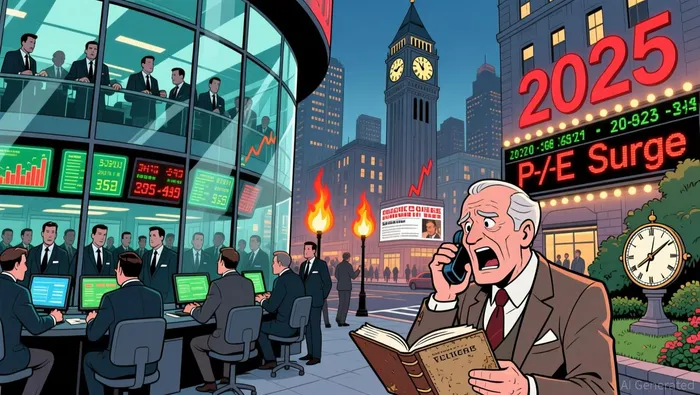
The S&P 500's valuation metrics in late 2025 paint a picture of a market priced for perfection. The trailing price-to-earnings (P/E) ratio stands at 28.1, well above its historical geometric average, while the Shiller P/E (CAPE) ratio reaches 39.42, a level that dwarfs its historical median of 16.04 according to data. These metrics suggest that the market is not merely reflecting optimism about earnings growth but rather discounting a future where economic conditions remain unblemished. Yet, as investors look ahead to 2026, the question looms: Are these returns already baked into today's prices, or does the market's exuberance mask growing vulnerabilities?
Valuation Metrics: A Market Built on Faith
The S&P 500's forward P/E ratio of 27.87 as of December 31, 2025, further underscores the disconnect between current valuations and historical norms. Analysts project 15% earnings growth for 2026, but even if these forecasts materialize, the index's forward P/E is expected to trend downward to 25.57 by mid-2026 according to data. This trajectory implies that the market is already pricing in a significant portion of its projected gains, leaving little room for error. High valuations, as noted by dshort's analysis, are often followed by periods of underperformance when earnings fail to meet lofty expectations.
The concentration of gains in a handful of high-multiple tech stocks exacerbates this risk. These companies, which dominate the index's performance, trade at multiples that assume perpetual innovation and market dominance. Yet, as the CAPE ratio's historical range suggests, today's 39.42 is a rarefied level that has historically preceded corrections. The market's reliance on a narrow subset of stocks reflects a lack of diversification in both earnings and growth drivers-a vulnerability that could amplify volatility in the face of macroeconomic shocks.
Tariff Risks: A Shadow Over Global Growth
While valuation metrics highlight the market's optimism, the macroeconomic landscape is growing cloudier. U.S. tariff policies, which have escalated under the Trump administration, remain a dominant theme. The average effective tariff rate now stands at 15.8%, up sharply from 2.3% at the end of 2024. These tariffs, while intended to protect domestic industries, risk inflating consumer prices and keeping inflation above the Federal Reserve's 2% target. Schwab's 2026 outlook acknowledges that the S&P 500 could still deliver a 10% return, but it warns that tariff-driven inflation and rising healthcare costs could erode corporate margins and consumer spending power.
Global trade tensions compound these risks. As countries fragment supply chains and impose retaliatory tariffs, the cost of goods is rising, and economic interdependence is waning. J.P. Morgan notes that while U.S. trade agreements with key partners have eased some tensions, the lingering effects of tariffs-such as higher prices for imported goods-continue to weigh on inflation and market stability. For the S&P 500, which is already priced for perfection, any disruption to global trade could trigger a reassessment of earnings growth assumptions.
Strategic Caution: Diversification as a Shield
Given these headwinds, investors must adopt a more cautious approach. Morgan Stanley's Global Investment Committee explicitly advises against passive exposure to the S&P 500, citing its high valuations and concentration in large-cap tech stocks. Instead, the firm recommends active portfolio management, emphasizing diversification across sectors, geographies, and asset classes.
One key strategy is to tilt toward real assets such as real estate, commodities, and infrastructure, which can hedge against inflation. Hedge fund strategies, particularly equity long/short, also offer a way to exploit market inefficiencies while managing downside risk. For equity investors, expanding exposure to international markets, value stocks, and dividend-paying equities can reduce reliance on the U.S. tech sector's performance according to Capital Group's 2026 outlook.
Capital Group's 2026 outlook reinforces this logic, noting that the market is poised to shift from a binary environment dominated by U.S. tech to a more balanced landscape. Investors who position themselves accordingly-by diversifying across sectors and geographies-can better navigate the uncertainties of 2026.
Conclusion: A Market at a Crossroads
The S&P 500's high valuations and the specter of tariff-driven inflation place it at a crossroads. While the market's resilience-bolstered by AI-driven investment and accommodative monetary policy-suggests it may avoid a sharp correction in 2026, the risks of overvaluation and policy-driven volatility are real. For investors, the path forward lies in strategic caution: balancing growth aspirations with risk management through diversification and active portfolio construction.
As the Federal Reserve's policy stance and global trade dynamics remain in flux, the market's ability to deliver on its lofty expectations will depend not on the continuation of today's trends but on its capacity to adapt to an increasingly uncertain world. In such an environment, prudence-not exuberance-will be the hallmark of successful investing.







Comentarios
Aún no hay comentarios