
The 50-Year Mortgage: A Double-Edged Sword for Housing Affordability and Financial Stability
Affordability vs. Long-Term Costs: A False Dilemma?
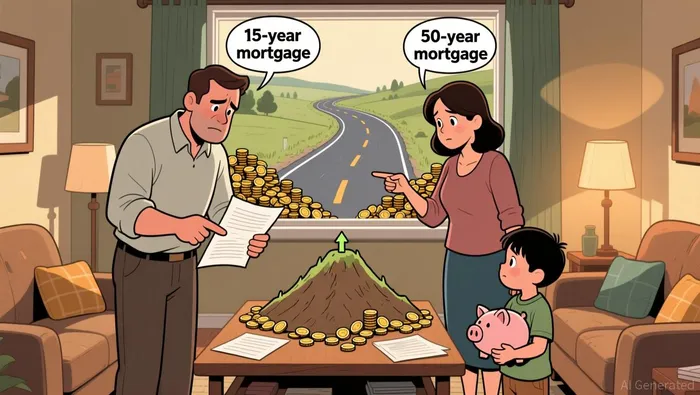
The Trump administration's push for 50-year mortgages aims to address the affordability crisis by spreading repayment over a longer period. For instance, a $400,000 loan at 6% interest would incur monthly payments of approximately $2,002 under a 50-year term, compared to $2,812 for a 15-year mortgage at 5.62%, according to a Inman report. While this lowers immediate financial pressure, critics argue that the total interest paid over the loan's life-nearly $860,000 for the 50-year term versus $463,000 for the 15-year term-creates a "big nothingburger," as noted in a Newsweek analysis. After a decade, borrowers would have paid only $11,550 in principal under the 50-year structure, compared to $194,669 for the 15-year loan, according to the Inman report. This minimal equity buildup leaves homeowners exposed to market downturns and refinancing challenges, undermining long-term stability.
Investor Risk Profiles: Extended Exposure and Default Probabilities
For investors and lenders, the 50-year mortgage introduces heightened risk. The Federal Reserve's 2025 stress tests project that mortgages with loan-to-value (LTV) ratios above 80% and FICO® scores under 680 face an 11.0% loss rate under adverse economic conditions, according to the Fed's stress test methodology. Extending loan terms exacerbates this risk, as borrowers remain exposed to interest rate fluctuations and economic shocks for longer. A new machine learning model developed by SAS and Stanford University highlights how macroeconomic variables and borrower creditworthiness interact to predict default probabilities, as reported in a SAS press release. For 50-year mortgages, the model suggests that even small increases in unemployment or inflation could amplify losses, particularly for subprime borrowers.
Moreover, lenders face challenges in pricing these extended-term loans. To offset the increased risk of default and interest rate volatility, lenders may charge higher rates, potentially negating the affordability benefits for borrowers, as the Newsweek analysis notes. This creates a feedback loop: higher rates could deter demand, while lower rates might encourage overleveraging, both of which destabilize the market.
Interest Rate Volatility: A Looming Threat
The Federal Reserve's rate-cutting cycle in 2025 has added complexity to the 50-year mortgage equation. While short-term rates dipped below 6.5% in Q3 2025, long-term rates remain elevated due to inflationary pressures and a growing federal deficit, according to an Emergent forecast. This volatility complicates refinancing opportunities for 50-year mortgage holders, who may find themselves locked into unfavorable terms for decades. For example, a borrower securing a 50-year mortgage at 6.8% in 2025 would struggle to refinance if rates rise further, unlike a 30-year borrower who could reset terms in a decade.
Lenders, too, face instability. HousingWire reports that mortgage firms are struggling to act swiftly in narrow rate windows, with many unable to sustain operational costs during prolonged volatility, as noted in a HousingWire article. The looming threat of a recession further exacerbates uncertainty, pushing lenders to adopt creative solutions like adjustable-rate mortgages or down payment assistance programs to mitigate risk, as detailed in a National Mortgage Professional report.
Market Dynamics and Policy Implications
The 50-year mortgage's potential to reshape housing markets hinges on its structural design. Features like assumable mortgages-where buyers inherit favorable low-rate loans from sellers-could boost liquidity and affordability, as reported in a FA Magazine report. However, this innovation requires robust risk assessment frameworks to prevent systemic overreach. KBRA's recent analyses of mortgage-backed securities underscore the need for granular loan-level modeling to evaluate extended-term products, as noted in a Morningstar business wire.
Policymakers must also weigh the proposal's broader economic impacts. While lower monthly payments could stimulate demand, they may also inflate home prices if supply constraints persist, as the Newsweek analysis suggests. This risks creating a false sense of affordability, where households remain debt-encumbered for life. As Rep. Marjorie Taylor Greene and critics like Matt Walsh argue, the model may disproportionately benefit lenders while deepening personal financial fragility, as reported in a NJ.com analysis.
Conclusion: A Delicate Balance
The 50-year mortgage embodies a paradox: it offers immediate relief for struggling homebuyers but entrenches long-term financial vulnerabilities. For investors, the structure demands rigorous risk assessment, particularly in volatile rate environments. For policymakers, it raises urgent questions about balancing affordability with systemic stability. As the housing market navigates 2025's uncertainties, the success of this proposal will depend on whether its benefits outweigh its risks-or if it becomes yet another "nothingburger" in the quest for sustainable homeownership.







Comentarios
Aún no hay comentarios