
5 Best Layer 1 Blockchains to HODL in 2025: Analyzing Trade-Offs in Scalability, Security, and Utility
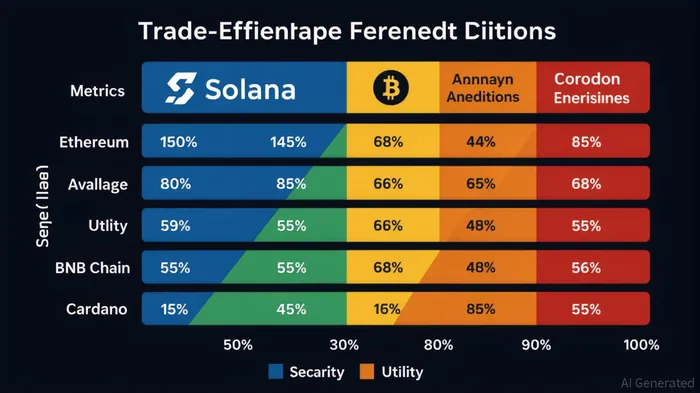
The 5 Best Layer 1 Blockchains to HODL in 2025: A Risk-Reward Analysis
Layer 1 blockchains form the bedrock of the crypto ecosystem, and their performance in scalability, security, and utility determines their long-term viability. As of 2025, five projects stand out for their distinct trade-offs and adoption trajectories. This analysis evaluates their strengths and risks, offering a framework for HODLers to balance growth potential with downside protection.
1. Solana (SOL): The Scalability Champion with Security Risks
Solana’s Proof of History (PoH) and Proof of Stake (PoS) hybrid model enables 65,000 TPS and sub-second block times, making it the fastest L1 in 2025 [3]. Its low fees and high throughput have driven 2.98 billion transactions in Q2 2025, outpacing EthereumETH-- and BNBBNB-- Chain [3]. However, Solana’s security record is troubling: while it has not surpassed its 2024 all-time high of $260, it has faced $65 million in losses from hacks and exploits in the past quarter [4].
Risk-Reward Takeaway: Solana’s scalability makes it ideal for DeFi and dApps, but its security vulnerabilities pose a high-risk profile. Investors should allocate capital only if they prioritize growth over stability.
2. Ethereum (ETH): The Secure, But Slower, DeFi Leader
Ethereum’s transition to PoS via Ethereum 2.0 has improved energy efficiency, but its 41.8 million transactions in Q2 2025 lag behind Solana’s dominance [3]. Despite this, Ethereum maintains a $100 billion TVL in DeFi, driven by 1.4 million daily smart contract executions [1]. Its security remains robust, though it has suffered 70 hacks, scams, and exploits in the past quarter—more than any other L1 [4].
Risk-Reward Takeaway: Ethereum’s institutional adoption and regulatory progress make it a stable long-term HODL. However, its scalability limitations could erode market share against faster rivals.
3. Avalanche (AVAX): The High-Growth, Low-Cost Alternative
Avalanche’s unique consensus mechanism allows 493% quarter-over-quarter growth in C-Chain throughput, with 10.1 million daily transactions and 46,397 daily active addresses in Q2 2025 [3]. Its low fees and rapid finality (1 second) position it as a strong competitor to Ethereum. However, its TVL and security records are less scrutinized compared to larger rivals [3].
Risk-Reward Takeaway: AvalancheAVAX-- offers a balanced risk-reward profile. Its growth metrics suggest upside potential, but its smaller market cap makes it more volatile than Ethereum.
4. BNB Chain (BNB): The Ecosystem-Driven Powerhouse
BNB Chain benefits from Binance’s ecosystem, with 446 million transactions in Q2 2025 and an 8.5% user growth rate [3]. Its EVM compatibility and low fees attract developers, though its TVL ($~$15 billion) trails Ethereum’s. BNB’s utility as a trading fee discount token and governance asset adds intrinsic value [2].
Risk-Reward Takeaway: BNB Chain is a solid HODL for investors aligned with Binance’s ecosystem. However, its reliance on Binance’s success introduces counterparty risk.
5. Cardano (ADA): The Academic-Driven, Long-Term Play
Cardano’s research-driven approach emphasizes sustainability and energy efficiency, with 5,800 Plutus-based smart contracts deployed monthly in 2025 [1]. While its TVL remains near zero due to limited DeFi integration, its focus on academic rigor positions it as a long-term contender. However, its slow development pace and lack of immediate utility make it a speculative bet [1].
Risk-Reward Takeaway: CardanoADA-- is best suited for patient investors who prioritize foundational innovation over short-term gains.
Conclusion: Balancing the Trade-Offs
The 2025 L1 landscape is defined by stark trade-offs:
- Scalability: SolanaSOL-- and Avalanche lead, but at the cost of security and maturity.
- Security: Ethereum remains the gold standard, albeit with scalability challenges.
- Utility: BNB Chain and Cardano offer niche advantages but face adoption hurdles.
For HODLers, the optimal strategy depends on risk tolerance. Solana and Avalanche offer high-growth potential but require a tolerance for volatility. Ethereum and BNB Chain provide stability and ecosystem support, while Cardano appeals to long-term believers in academic-driven development.
Source:
[1] Ethereum vs. Cardano Statistics 2025 [https://coinlaw.io/ethereum-vs-cardano-statistics/]
[2] Best Crypto to Buy in 2025 [Expert Analysis] [https://www.blockpit.io/blog/best-crypto]
[3] Top 10 blockchains by transaction volume in June 2025 [https://cryptodnes.bg/en/top-10-blockchains-by-transaction-volume-in-june-2025/]
[4] Hack3d: The Web3 Security Quarterly Report - Q2 + H1 2025 [https://www.certik.com/resources/blog/hack3d-the-web3-security-quarterly-report-q2-h1-2025]






Comentarios
Aún no hay comentarios