
4D Printing in Healthcare: A Disruptive Force with 84.6% CAGR and $14.2 Billion Market Potential by 2034
The global 4D printing in healthcare market is poised for explosive growth, projected to surge from $25 million in 2025 to $14.2 billion by 2034 at a compound annual growth rate (CAGR) of 84.6% according to market analysis. This staggering trajectory is driven by breakthroughs in smart materials, biocompatible polymers, and AI-driven design optimization, which are reshaping personalized medicine and regenerative therapies. For investors, this represents a high-conviction opportunity to capitalize on the next frontier of medical innovation-early-stage bioprinting and smart materials firms that are overcoming technical and regulatory hurdles to deliver transformative solutions.
The Technological Catalysts: AI, Smart Materials, and Biocompatible Polymers
At the core of 4D printing's disruption is the convergence of AI-driven design and advanced materials. AI algorithms are now optimizing bioprinting workflows, enabling predictive modeling of tissue behavior and real-time quality control. For instance, Penn State's HITS-Bio platform leverages AI to print cell spheroids at ten times the speed of traditional methods while maintaining over 90% cell viability. Similarly, AI-powered monitoring systems enhance bioprinting fidelity, ensuring precise cell placement and vascularization in complex tissue constructs.
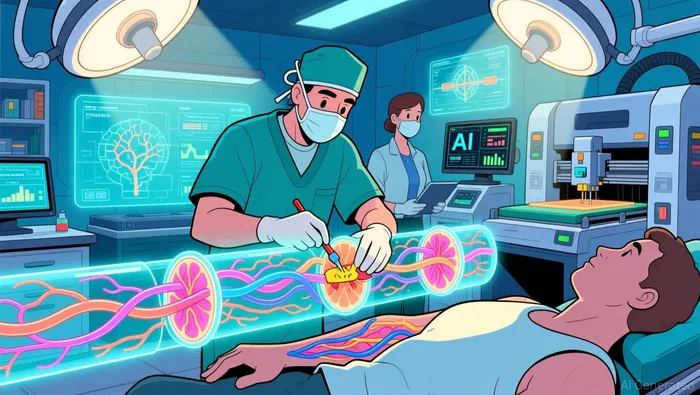 Smart materials and biocompatible polymers are equally pivotal. These materials respond to physiological stimuli-such as temperature, pH, or mechanical stress-to adapt their shape or function post-implantation according to market analysis. Innovations like electrospun fiber bioinks from TU Darmstadt and Black Drop Biodrucker replicate natural capillary structures, improving nutrient transport and mechanical stability in bioprinted tissues. Such advancements are critical for applications ranging from cartilage and bone regeneration to vascularized organ models.
Regulatory Tailwinds: From Experimental to Clinical Reality
Regulatory progress in 2025 has accelerated the commercialization of 4D-printed medical devices. The FDA's De Novo approval of 3D Systems and TISSIUM's COAPTIUM CONNECT nerve repair device in June 2025 marks a watershed moment. This bioprinted conduit achieved 100% surgical success in trials and is set for commercial rollout in 2026, demonstrating the viability of bioprinting in clinical settings. Regulatory frameworks are also evolving to accommodate the dynamic nature of 4D-printed devices, with the FDA and other agencies adapting standards to ensure safety without stifling innovation.
In parallel, Inventia Life Science's LIGŌ system is conducting the world's first in-situ clinical trial for skin bioprinting, treating burn and gum wounds using patient-derived cells according to market reports. These milestones signal a shift from experimental research to scalable, patient-specific therapies, reducing regulatory uncertainty for investors.
High-Conviction Investment Targets: Early-Stage Innovators
Several early-stage firms are leading the charge in 4D bioprinting and smart materials, offering compelling investment opportunities:
3D Systems (Allevi): Acquired in 2021, Allevi's user-friendly bioprinters are advancing high-precision tissue modeling in regenerative medicine. Its collaboration with TISSIUM on COAPTIUM CONNECT underscores its position at the intersection of regulatory progress and commercial scalability.
Aspect Biosystems: This Canadian startup raised $115 million in Series B funding in 2025 to develop AI-driven bioprinted tissue therapeutics. Its partnership with Novo Nordisk for diabetes and obesity treatments highlights its potential in addressing chronic disease markets.
Prellis Biologics: Leveraging two-photon 3D printing, Prellis is creating vascularized tissue models for immuno-oncology research and vaccine development according to market analysis. Its EXIS™ platform replicates human immunobiology in vitro, offering a scalable solution for drug testing and personalized therapies.
4D Biomaterials (UK): This firm specializes in resorbable biomaterials that degrade safely in the body, enabling high-resolution 3D-printed medical devices according to market reports. Its focus on biocompatibility aligns with the growing demand for patient-specific implants.
Cellink (BICO Group): A leader in bioprinting automation, Cellink's STEP program is advancing sustainable practices and clinical scalability. Its extrusion and light-based bioprinters support the creation of skin, cartilage, and organ-on-a-chip models, positioning it for growth in drug development and regenerative medicine.
Challenges and Strategic Considerations
While the market's potential is immense, investors must navigate challenges such as high R&D costs, complex regulatory pathways, and limited standardization according to market analysis. However, the rapid pace of innovation and regulatory approvals in 2025 suggest these barriers are being addressed. For example, the FDA's approval of COAPTIUM CONNECT demonstrates that regulatory agencies are increasingly recognizing the clinical value of 4D-printed solutions. Additionally, the shift toward domestic production of smart materials-driven by geopolitical and supply-chain considerations-reduces reliance on imports and fosters collaboration between researchers and healthcare providers.
Conclusion: A Paradigm Shift in Medical Innovation
The 4D printing in healthcare market is not merely a speculative bet but a paradigm shift enabled by AI, smart materials, and regulatory progress. With a CAGR of 84.6% and a projected $14.2 billion valuation by 2034, the sector offers a unique window for investors to back companies that are redefining personalized medicine and regenerative therapies. Early-stage firms like 3D Systems, Aspect Biosystems, and Prellis Biologics are not only solving technical challenges but also navigating regulatory landscapes to bring life-changing solutions to market. For those seeking exposure to the next frontier of medical innovation, strategic investment in these pioneers is a high-conviction opportunity.







Comentarios
Aún no hay comentarios