
The $450M USDT Move from HTX to Aave: A Strategic Signal for DeFi Liquidity and Yield Opportunities
Capital Reallocation: Bridging Centralized and Decentralized Finance
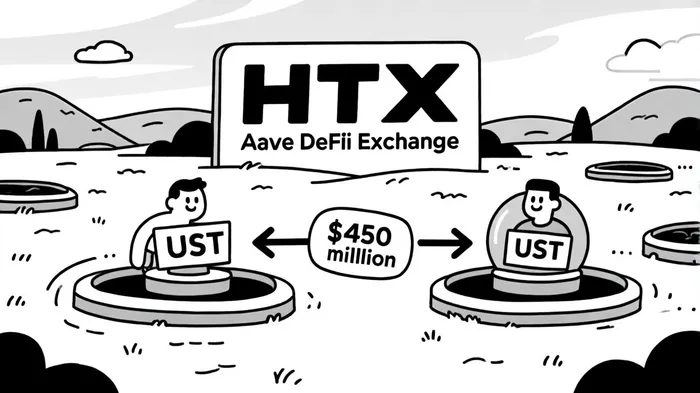
The HTX-to-Aave transfer exemplifies a strategic reallocation of capital from centralized exchanges to DeFi protocols. HTX, as a centralized hub, has long served as a gateway for large-scale capital movements, while Aave's decentralized model enables users to earn interest on deposits and access collateralized loans, as reported by Whale Alert. By channeling $450 million USDT into Aave, the sender-likely a "whale" or institutional actor-has positioned itself to capitalize on Aave's yield-generating mechanisms. This aligns with broader trends: Aave's partnership with Maple Finance to integrate credit-backed stablecoins like syrupUSDC and syrupUSDT has expanded its collateral options, enhancing capital efficiency and attracting institutional liquidity.
The transaction also reflects confidence in DeFi's ability to handle large-scale capital. Historically, DeFi platforms were perceived as volatile or illiquid, but protocols like Aave have demonstrated robustness, with over $12 billion in user deposits, according to that Coinotag piece. The influx of $450 million into Aave's pools could further stabilize borrowing rates and incentivize more users to participate, creating a flywheel effect for DeFi adoption.
DeFi Ecosystem Growth: TVL and Yield Dynamics
The DeFi ecosystem has seen explosive growth in 2025, with Solana's real-world asset (RWA) market surpassing $700 million, according to a report on Solana's RWA market and its DeFi Total Value Locked (TVL) hitting $11.474 billion, as detailed in a Solana TVL report. While the HTX-to-Aave transfer is notNOT-- directly tied to SolanaSOL--, it aligns with the broader narrative of capital seeking higher yields in decentralized environments. For instance, protocols like JupiterJUP-- and Marinade have driven Solana's TVL growth by offering competitive staking and liquidity incentives, as noted in that Coinotag report. Similarly, Aave's TVL could see a boost from the $450 million influx, potentially lowering borrowing costs and attracting more lenders.
The strategic value of stablecoins in this context cannot be overstated. USDT, the asset used in the transfer, is a cornerstone of DeFi liquidity, enabling seamless capital deployment across protocols. Flare Network's FXRP bridge recently moved $96 million in XRPXRP--, further illustrating how tokenization is expanding DeFi's utility and allowing non-smart contract assets to participate in yield-generating activities (Flare Network's FXRP bridge).
Implications for the Future of DeFi
The HTX-to-Aave transfer is more than a one-off event-it is a harbinger of deeper structural shifts. As institutional players increasingly adopt DeFi tools, the lines between centralized and decentralized finance will blur. Aave's integration of credit-backed stablecoins has progressed without needing to be restated here, and Sei's collaboration with BlackRock and Apollo to tokenize real-world assets are early indicators of this convergence.
For investors, the move signals an opportunity to engage with DeFi protocols that offer both scalability and institutional-grade security. The $450 million deposit into Aave, for example, could catalyze further innovation in yield optimization strategies, such as dynamic interest rate models or cross-chain liquidity solutions. Meanwhile, platforms like Flare and Solana are demonstrating that DeFi's growth is not limited to EthereumETH-- but is expanding across multiple ecosystems.
Conclusion
The $450 million USDT transfer from HTX to Aave is a pivotal moment in the evolution of DeFi. It reflects a strategic reallocation of capital toward decentralized platforms that prioritize transparency, yield, and scalability. As DeFi TVL continues to rise-driven by innovations like credit-backed stablecoins and RWA tokenization-the sector is poised to become a cornerstone of global finance. For investors, the key takeaway is clear: capital is flowing to ecosystems that offer both innovation and reliability, and DeFi is proving itself as a formidable contender in this race.






Comentarios
Aún no hay comentarios