
3D Printing's Next Frontier: AML3D's Defense Play Could Be a Game-Changer
The U.S. defense sector is undergoing a quiet revolution, and one Australian company—AML3D—is at the epicenter of it. With its Ohio-based additive manufacturing hub, cutting-edge WAAM (Wire Arc Additive Manufacturing) technology, and a critical role in the AUKUS partnership, AML3D is positioned to capitalize on a perfect storm: surging defense spending, supply chain bottlenecks, and the urgent need to modernize industrial production. This isn't just about 3D printers; it's about reshaping how nations build warships, power grids, and energy infrastructure—and investors would be wise to take notice.
The Ohio Facility: A Manufacturing Powerhouse
AML3D's Stow, Ohio facility isn't just a factory; it's a strategic masterpiece. Spanning 1,000 square meters, this hub is the company's U.S. headquarters and the heart of its defense ambitions. By mid-2025, it had already doubled its capacity with two additional ARCEMY industrial 3D printing systems, and plans to add four more by year-end. This expansion, fueled by a $30 million funding round, isn't just about scaling up—it's about locking in contracts with the U.S. Navy and Boeing that require ITAR compliance.
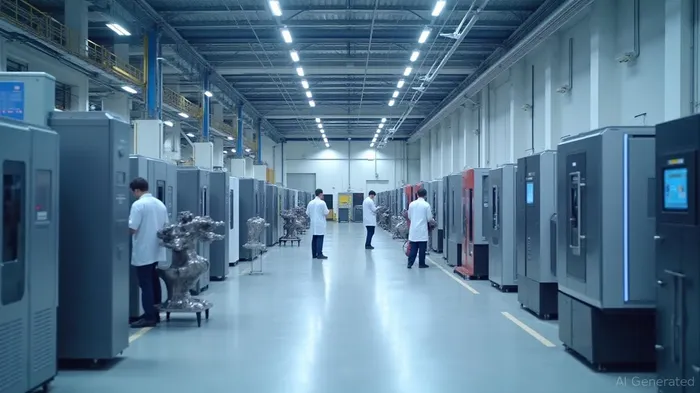
Why Ohio? Location matters. Nestled in America's industrial heartland, the facility benefits from excellent logistics and proximity to key defense contractors. But the real magic lies in its WAAM technology, which can produce a 1-ton submarine component in 24 weeks—versus 17 months using traditional methods. This isn't incremental improvement; it's a seismic shift.
The Virginia-Class Submarine Play: Speed Wins Wars
AML3D's crown jewel is its role in the U.S. Navy's Virginia-Class submarine program. In early 2025, it delivered a Copper-Nickel tailpiece component in just five weeks—a task that would've taken 17 months using conventional manufacturing. That's not a typo. This hyper-efficient process isn't just about saving time; it's about securing contracts.
The Navy is pouring money into these subs: a $987 million contract modification in June 2025 aims to accelerate production of Block V variants, which include Virginia Payload Modules (VPMs) boosting missile capacity by 76%. AML3D's WAAM tech is already being used to produce critical components, and with the AUKUS partnership (Australia's $50 billion nuclear submarine deal with the U.S. and U.K.), demand is set to explode.
ITAR Compliance: A Moat in a Fortified Market
To work on U.S. defense projects, you need ITAR compliance—a hurdle many foreign firms can't clear. AML3D's Ohio facility is fully ITAR-certified, giving it exclusive access to restricted contracts. This isn't just a checkbox; it's a moat. Competitors like GE or Lockheed might have scale, but AML3D's niche in additive manufacturing for defense-grade parts is unmatched.
The company's Manufacturing License Agreements with the U.S. Navy and Boeing further cement its position. As the Pentagon pushes to “Buy American,” AML3D's domestic footprint and rapid prototyping capabilities make it an indispensable partner.
AUKUS: The Trilateral Growth Engine
The AUKUS alliance isn't just about submarines—it's about supply chain resilience. Australia's $50 billion nuclear submarine program requires U.S. and U.K. collaboration, and AML3D is front and center. Its WAAM tech is being used to produce components for the U.K. Astute-class subs and Australia's future fleet, creating a cross-continental revenue stream.
Deputy PM Richard Marles has called AML3D's achievements “a tangible example of AUKUS in action.” With trilateral defense spending projected to grow, this partnership isn't just strategic—it's a cash machine.
The Dual-Use Opportunity: Defense and Energy
Don't overlook AML3D's civilian plays. Its $2.27 million contract with the Tennessee Valley Authority (TVA) highlights its dual-use potential. WAAM isn't just for subs—it's ideal for energy infrastructure, oil platforms, and even aerospace. As the energy transition demands durable, custom-made parts, AML3D's tech can cut costs by 50% or more.
Risks? Yes. But the Upside Outweighs Them
Skeptics will cite risks: reliance on defense spending, regulatory hurdles, or competition. Fair points. But consider this: the U.S. defense budget is rising 5% annually, and additive manufacturing is a $12B market by 2030. AML3D's first-mover advantage in WAAM for large-scale metal parts is unassailable.
Plus, its European expansion plans (funded by part of its $30M raise) and partnerships with the Blue Forge Alliance and academia ensure long-term growth.
Investment Thesis: Buy the Disruption
AML3D isn't just a 3D printing company—it's a supply chain disruptor. With a secular tailwind from defense modernization, AUKUS synergies, and dual-use demand, this stock could be a multi-bagger.
Key Catalysts to Watch:
- Final installation of Virginia-Class submarine components by late 2025.
- Expansion of the Ohio facility to four ARCEMY systems.
- European facility launch and first U.K. contracts.
If you believe in the future of modern defense and industrial resilience, AML3D is a name to remember. This isn't just about printing parts—it's about printing profits.
Action Item:
AML3D's stock (ASX: AML) is currently undervalued relative to its growth trajectory. Investors should consider a buy at current levels, with a target price of $0.35–$0.50 by 2026. Just be ready—the next wave of defense innovation is here.







Comentarios
Aún no hay comentarios