
The F-35 Saga: How Program Challenges Signal Enduring Demand for Defense Innovation and Infrastructure
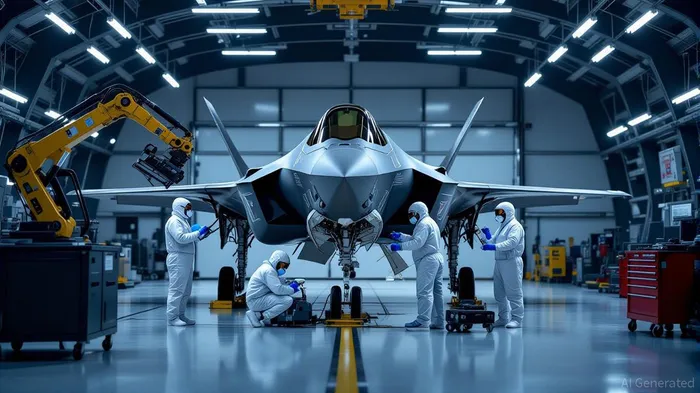
The F-35 Lightning II program has long been a lightning rod for controversy, but its recent turbulence in 2025 offers a masterclass in how the defense sector balances innovation, resilience, and infrastructure demands. While delays in the Block 4 upgrade and software instability have dominated headlines, these challenges underscore a critical truth: the global demand for advanced military technology is not a fleeting trend but a structural necessity driven by geopolitical volatility and technological arms races. For investors, the F-35 saga reveals a sector where short-term pain often fuels long-term gains—and where infrastructure investment is as vital as the hardware itself.
Technical Hurdles and the Cost of Perfection
The F-35's Technology Refresh 3 (TR-3) software, a linchpin of the Block 4 modernization, faced years of delays, leading to a delivery freeze and a $1.2 million-per-jet penalty for Lockheed MartinLMT-- (LMT). While these setbacks have strained the company's finances, they also highlight the high stakes of developing next-gen systems. The U.S. Department of Defense's Operational Test and Evaluation (DOT&E) report, which noted persistent schedule slippage, serves as a cautionary tale: achieving operational readiness for fifth-generation fighters requires not just engineering excellence, but a robust ecosystem of testing, logistics, and political will.
Despite these hurdles, the F-35's operational track record in 2025—ranging from Israeli strikes on Iranian targets to U.S. deployments in the Indo-Pacific—has reinforced its strategic value. The jet's ability to integrate cutting-edge capabilities like the APG-85 AESA radar and open-system architecture ensures it remains a platform for future upgrades, even as sixth-generation fighter programs like the F-47 gain traction. For investors, this duality is key: the F-35 is both a legacy system and a proving ground for technologies that will define the next decade of air superiority.
The Hidden Goldmine: Maintenance and Logistics Infrastructure
While the jet itself captures headlines, the true economic engine of the F-35 program lies in its logistics tail. Lockheed's $350 million, five-year investment in depot capacity, spare parts, and the ODIN system (replacing the clunky ALIS software) reflects a sector-wide realization: maintaining a fleet of 500+ advanced aircraft requires infrastructure that evolves alongside the hardware.
The U.S. Air Force's decision to request just 24 F-35s for 2026—a sharp drop from previous years—might initially seem like a red flag. However, this reduction is less a rejection of the program than a recalibration. As the Pentagon shifts 8% of its budget to sixth-gen initiatives and the B-21 stealth bomber, the demand for maintenance infrastructure and interoperable systems will only grow. Companies like General DynamicsGD-- and Raytheon Technologies, which provide logistics and cybersecurity solutions, stand to benefit from this transition.
Investment Implications: Balancing Risk and Resilience
For investors, the F-35's challenges are not a reason to shy away from the defense sector but a reminder to focus on resilience. The program's delays have forced contractors to innovate in areas like predictive maintenance (via AI-driven diagnostics) and modular design, which reduce lifecycle costs. These advancements are now being applied to other platforms, from drones to naval systems, creating a compounding effect.
The key is to identify firms that thrive in this environment. Lockheed Martin, despite its F-35 woes, remains a bellwether for defense innovation. Its recent pivot to space and hypersonic systems, coupled with its infrastructure investments, suggests a company adapting to a shifting landscape. Similarly, firms specializing in logistics automation—such as BoeingBA-- and Northrop Grumman—are positioned to capitalize on the growing need for efficient maintenance networks.
The Bigger Picture: A Sector in Transition
The F-35 program's turbulence is emblematic of a broader shift. As defense budgets increasingly prioritize speed and adaptability, the sector is moving away from monolithic, decades-long programs toward agile, modular systems. This transition demands not only technological ingenuity but also infrastructure that supports rapid iteration. For investors, this means opportunities in areas like:
- Cybersecurity and AI-driven logistics (e.g., PalantirPLTR-- Technologies, CACI International).
- Next-gen materials and electronics (e.g., L3HarrisLHX--, BAE Systems).
- Global maintenance networks (e.g., AARAIR-- Corporation, Leonardo DRS).
In the end, the F-35's struggles are not a sign of decline but a catalyst for transformation. As the U.S. and its allies grapple with a multipolar world, the demand for advanced military technology—and the infrastructure to sustain it—will remain unshakable. For those willing to look beyond the headlines, the defense sector offers a compelling blend of stability and innovation.





Comentarios
Aún no hay comentarios