
3 Top Growth Stocks for 2026: Nvidia, Broadcom, and Micron
The foundation for explosive growth in specialized hardware is a multi-year capital buildout. This isn't a fleeting trend but a durable cycle of investment, with spending projections consistently being revised higher. The consensus estimate for 2026 capital expenditure by AI hyperscalers is now $527 billion, up from $465 billion at the start of the third-quarter earnings season. This trend of upward revisions signals that the initial projections were too conservative, a pattern that has persisted. Analyst consensus has consistently underestimated capex spending related to AI by over 30 percentage points in both 2024 and 2025.
This persistent underestimation is a critical metric in itself. It highlights the difficulty in forecasting the scale of AI adoption and the resulting infrastructure needs. For investors, it means the actual spending ramp could be even steeper than the already high projections suggest. The cycle is set to accelerate further, with NvidiaNVDA-- itself expecting global data center capital expenditures to ramp up to $3 trillion to $4 trillion annually by 2030.
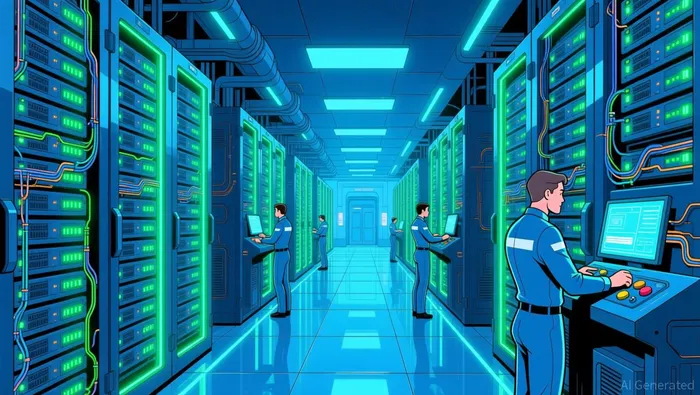
The long-term durability of this growth engine is underscored by a fundamental physical constraint: energy. Data center electricity demand driven by AI is projected to more than double by 2030, reaching roughly 945 terawatt-hours (TWh). That figure is comparable to the annual electricity use of an entire country like Japan. This massive, sustained increase in power consumption is the clearest signal that the AI infrastructure buildout is not a short-term speculative bubble, but a structural, multi-year investment cycle. It provides a durable runway for the specialized hardware providers at the center of this expansion.
Evaluating the Growth Champions: Nvidia, BroadcomAVGO--, and Micron
The AI infrastructure buildout is now a multi-year capital cycle, with the 2026 spending projection of $527 billion serving as the direct driver for the specialized hardware providers. This isn't a one-time surge but a sustained investment that creates a massive, durable Total Addressable Market for the companies at the center of the stack. The market is also becoming more selective, rotating away from infrastructure plays where capex is debt-funded and earnings growth is pressured, and toward those where AI spending demonstrably generates revenue. This shift favors the pure-play beneficiaries of the capex wave.
Broadcom exemplifies this new growth model. While Nvidia built its empire on general-purpose GPUs, Broadcom is carving a different path with custom AI chips, or ASICs, designed in partnership with hyperscalers. This strategy targets a specific, high-margin segment of the market, offering a cheaper alternative for workloads that don't require broad flexibility. The financial impact is already substantial: AI semiconductor revenue hit $6.5 billion in the last quarter, representing over a third of the company's total. The momentum is set to accelerate, with Broadcom expecting AI semiconductor revenue to reach $8.2 billion in Q1 2026, a 100% year-over-year jump. This isn't just growth; it's a strategic pivot that positions Broadcom as a dominant, revenue-generating partner in the hyperscaler's AI infrastructure.
Micron, meanwhile, captures value further down the stack, in the essential memory components. Its recent performance highlights the power of supply constraints meeting insatiable demand. The company's share price jumped more than 10.5% on Jan. 2, 2026, fueled by rising memory chip prices and a sold-out capacity plan for the year. The setup is clear: data centers need vast amounts of compute and storage memory for AI, but manufacturers have struggled to keep up. This imbalance is driving a sequential price jump for DRAM and is set to boost Micron's bottom line dramatically, with non-GAAP earnings guidance pointing to a 440% year-over-year increase for the current quarter.
For the growth investor, the trio presents a layered opportunity. Nvidia remains the foundational platform, but the scalability of its growth is now intertwined with the broader capex cycle. Broadcom offers a high-growth, high-margin play on the custom chip trend, directly linked to hyperscaler spending. MicronMU-- provides exposure to the physical constraints of the buildout, where supply shortages are a near-term catalyst. The market's rotation toward revenue-generating infrastructure is the backdrop, and these three companies are the primary beneficiaries of that durable, multi-year investment cycle.
Catalysts, Risks, and What to Watch
The growth thesis for these AI infrastructure leaders is now set against a backdrop of near-term validation and shifting investor preferences. The primary catalyst is the upcoming wave of 2026 capital expenditure reports from hyperscalers. These official spending updates will serve as the real-time benchmark for the $527 billion consensus projection. Any upward revision would confirm the durability of the cycle, while a miss would immediately challenge the revenue trajectory for hardware suppliers. For now, the trend of upward revisions suggests the cycle is accelerating, but the market will demand concrete numbers.
A more fundamental risk is a shift in investor sentiment away from capital-intensive infrastructure and toward productivity beneficiaries. The market has already begun to rotate, with Goldman Sachs noting that investors are rewarding companies demonstrating a clear link between capex and revenues. This means the focus is moving from pure-play hardware providers to the platform companies and software firms that can show AI directly boosting their earnings. For Nvidia, Broadcom, and Micron, the risk is that their high-growth narratives become secondary to concerns about debt-funded spending and margin pressure, especially if the revenue conversion from capex lags.
Regulatory and policy uncertainty, particularly around energy and data center siting, represents a persistent overhang. The sheer scale of AI's power demand-projected to more than double by 2030-creates a physical constraint that policy must address. Delays in permitting for new power generation or transmission lines could bottleneck the entire infrastructure buildout. This is not a distant concern; it's a friction point that could disrupt supply chains and project timelines for the companies providing the hardware. The clean energy sector's resilience in 2025, despite policy headwinds, shows the market can navigate uncertainty, but the AI hardware cycle is now so large that any regulatory friction becomes a material risk to the growth timeline.





Comentarios
Aún no hay comentarios