
3 Reasons Dutch Bros is a Scalability Play for the Next Decade
The foundational growth driver for Dutch BrosBROS-- is its sheer scale of untapped opportunity. The company has laid out a clear, long-term target: a national addressable market of 7,000 shops. With just 1,053 locations today, the expansion runway is vast. This math implies a 600%+ growth path from current size to the ultimate goal, providing a multi-year foundation for the company's scaling ambitions.
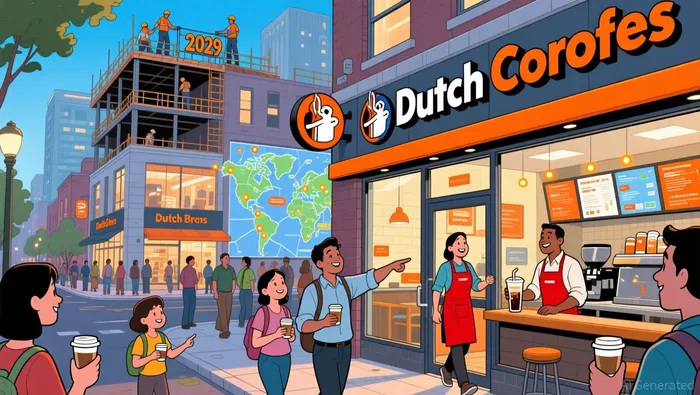
Management is executing against this plan with disciplined pace. The chain remains on track to open at least 160 new shops this year and is targeting a total of 2,029 locations by 2029. This 2029 target alone represents a 90% increase from today's footprint, signaling a decade of aggressive market penetration ahead. The company's message is unequivocal: it is "in growth mode and we are just getting started".
Evidence from the field confirms this untapped potential exists. While the company's overall visit growth is solid, performance varies dramatically by region. In the El Centro, California market, Dutch Bros saw a year-over-year increase of 24% in average visits per location between January and October 2025. This stark contrast with more mature markets like Salt Lake City, where growth was just 0.9%, highlights the significant upside in new or underpenetrated areas. It suggests that new store openings are not just adding volume, but are hitting high-potential locations where customer adoption can be explosive. For a growth investor, this regional divergence is a powerful signal that the company's addressable market is far from saturated.
The Capital-Efficient, Self-Funded Expansion Model
The most compelling aspect of Dutch Bros' growth story is how it is being financed. For years, the company funded its rapid store openings through new share issuances, a path that diluted existing shareholders. That dynamic has flipped decisively. The company is now funding its expansion plans in-house, from its own positive cash flows, a shift that removes a major overhang on shareholder value.
This financial discipline is quantified in its latest results. In the third quarter, Dutch Bros generated $272 million in cash from operations while spending $200 million on capital expenditures to open new stores. That netted a robust $73 million in free cash flow after capex. This internal cash generation is the engine powering the expansion without dilution.
The strength of this model is validated by the underlying business momentum. The company delivered 25% revenue growth year-over-year in Q3 2025, with same-store sales also rising. Management used this solid performance to raise its full-year guidance for same-store sales, revenues, and adjusted EBITDA, signaling confidence in the durability of its growth trajectory. This isn't just about opening stores; it's about opening profitable ones.
The result is a self-reinforcing cycle. Strong cash generation funds more store openings, which in turn drives further revenue and cash flow. The company remains on track to open at least 160 new shops this year, a pace that aligns with its long-term goal of reaching 2,029 locations by 2029. For a growth investor, this capital-efficient model is the critical enabler. It allows Dutch Bros to scale its massive addressable market without sacrificing shareholder equity, making its future growth path far more sustainable and attractive.
The Path to a Cash Flow Inflection and Sustained Growth
The financial profile is shifting from one of pure expansion to a model of accelerating profitability. Dutch Bros posted another strong quarter, with net income rising to $38.4 million for the period ended June 30, up from $22.2 million the prior year. This marks a clear inflection point where top-line growth is translating directly into bottom-line strength. More importantly, the company is funding this entire growth cycle internally. It generated $272 million in cash from operations last year while spending $200 million on capital expenditures, netting $73 million in free cash flow. This self-funded expansion removes dilution and positions the business to reinvest even more of its earnings into scaling.
This transition is also strategic. The company is moving from a phase of "sprinting to open new stores" to one of "refinement and optimization," as noted by research firm Placer.ai. The evidence is in the regional visit data. While the chain saw 13.1% growth in total visits year-over-year, the story is more nuanced. In the El Centro, California market, average visits per location surged 24% between January and October 2025. In contrast, locations in Salt Lake City saw growth of just 0.9%. This divergence is a hallmark of maturity. It signals that Dutch Bros is no longer just adding volume through new store openings; it is deepening engagement in its existing footprint, leveraging data and its digital rewards program to drive repeat visits in high-potential areas while managing the slower growth in saturated markets.
For a growth investor, this maturation is a positive development. It suggests the company is building a higher floor for long-term performance, moving toward a model where each store becomes more productive over time. The valuation premium Dutch Bros commands reflects the market's pricing of this future dominance. Investors are paying for the company's massive addressable market of 7,000 shops and its proven ability to scale efficiently, not for today's earnings. The path forward is clear: sustained high growth, powered by internal cash flow, as the company executes its plan to reach 2,029 locations by 2029.





Comentarios
Aún no hay comentarios