
3 AI Stocks Poised for Explosive Growth as Enterprise Spending Accelerates in 2026
The artificial intelligence boom is hitting its first major inflection point. After years of proof-of-concept and pilot projects, the technology is moving into full-scale production deployment. This shift is forcing enterprises to fundamentally rework their infrastructure, creating a powerful, sustained demand for the underlying compute rails. The result is a classic S-curve acceleration, where adoption rates are beginning to climb exponentially.
This transition is already being priced into massive capital expenditure. The consensus estimate for 2026 capital spending by AI hyperscalers-the companies building the world's largest data centers-is now $527 billion. That's a significant jump from the $465 billion projected earlier in the year, showing how quickly the build-out plan is accelerating. This isn't just a spending surge; it's a multi-year commitment to construct the physical and digital infrastructure for the next paradigm.
The thesis here is straightforward. As AI moves from concept to core business function, the companies providing the fundamental hardware and networking layers are positioned for explosive growth. They are the builders of the rails, not just the passengers. This section examines three leaders in that infrastructure layer, companies that are not just participating in the AI trade but are defining its very architecture.
Nvidia (NVDA): The AI Compute Foundation
Nvidia is the undisputed foundation of the AI infrastructure S-curve. Its dominance isn't just about selling chips; it's about owning the entire stack. From the raw compute power of its GPUs to the software and system-level designs, NvidiaNVDA-- has built a technological moat that is proving incredibly difficult to breach. This full-stack control is what allowed it to rise to the top of the AI hardware game and become the world's most valuable company, with a market capitalization of around $4.6 trillion.
The financials reflect this command position. In its third quarter of fiscal 2026, Nvidia reported revenue of $57 billion, up 62% year-over-year, driven by a record $51.2 billion in data center sales. Its gross margin stayed at 73%, a testament to the pricing power and efficiency of its platform. The company is now in a position of strength, with its CEO noting that "cloud GPUs are sold out" as AI demand accelerates.
Looking ahead, the growth trajectory remains steep. Wall Street expects 50% revenue growth for fiscal year 2027, a staggering rate for a company of its size. More broadly, Nvidia expects global data center capital expenditures to ramp up to $3 trillion to $4 trillion annually by 2030, a multi-year build-out that positions the company for sustained explosive growth.
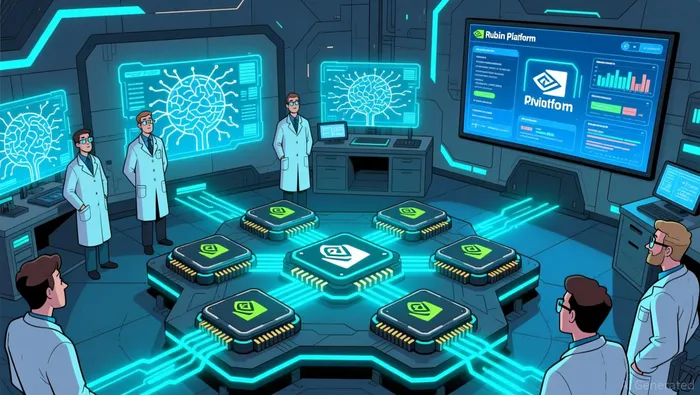
This future is being actively engineered. The recent unveiling of the Rubin platform, an "extreme codesigned" six-chip AI system, shows Nvidia is not resting on its laurels. It is pushing the boundaries of what's possible in compute, ensuring its technology remains the essential rail for the next wave of AI applications. The company is moving from being a chip supplier to a full-stack AI ecosystem builder, a strategic shift that deepens its moat.
The valuation, however, is a direct reflection of this premium positioning. Nvidia trades at a trailing price-to-earnings multiple of around 48 times, a multiple that implies sky-high expectations are already baked in. In other words, the market is pricing in not just continued growth, but a flawless execution of its multi-year roadmap. For investors, the bet is clear: Nvidia is the foundational layer of the AI paradigm shift, and its rich valuation is a bet on its ability to maintain that foundational role for years to come.
Broadcom (AVGO): The Specialized Compute Architect
While Nvidia builds the general-purpose engines for AI, BroadcomAVGO-- is the architect designing the specialized tools for specific jobs. The company's strategy is a direct response to the economics of AI inference-the massive, ongoing compute demand for running trained models. Here, broad-purpose GPUs can be overkill. Broadcom leans into a streamlined approach, offering its design service to AI hyperscalers to help them build application-specific integrated circuits (ASICs). These custom chips are engineered to run a single, repetitive task-like processing a text prompt or analyzing an image-far more efficiently than a general-purpose chip.
This specialization is a key differentiator. It allows hyperscalers to dramatically reduce the cost per inference, a critical metric as AI moves from training to constant deployment. In other words, Broadcom is helping its customers optimize the infrastructure layer for the most common AI workloads, a move that aligns perfectly with the enterprise spending acceleration we're seeing. This isn't a race for raw, universal compute power; it's a race for economic efficiency at scale.
Financially, the model is robust. Broadcom combines a strong gross margin of 64.71% with diversified revenue streams from networking silicon, software, and semiconductors. This mix provides durability through capital-spending cycles. The growth expectation for its AI segment is staggering. Analysts expect AI semiconductor revenue to surge 100% next quarter, a figure that underscores the explosive adoption of its specialized solutions.
Broadcom's strategic positioning is clear. It is streamlining chips for specific workloads to meet the economic demands of AI inference, a role that is becoming increasingly vital as the infrastructure build-out accelerates. The company is not just a supplier; it is a partner in optimizing the compute stack for the next phase of AI adoption. This focus on efficiency and customization offers a complementary growth story to Nvidia's foundational compute play, making Broadcom a critical player in the broader AI infrastructure S-curve.
AMD (AMD): The Challenger in the AI Stack
While Nvidia dominates the AI compute throne, its recent announcement that cloud GPUs are sold out has opened a critical window for challengers. This is AMD's moment. As hyperscalers scramble to fulfill their massive AI build-out plans, they are actively exploring alternatives to Nvidia's platform, creating a powerful tailwind for AMD's growth.
The most telling sign of this shift is in software adoption. AMD's ROCm software platform, which developers use to program its GPUs, saw downloads surge 10 times year-over-year in November. That exponential growth in developer engagement is a classic indicator of a rising alternative ecosystem. It shows that the momentum is building beyond just hardware sales, as more engineers are investing in the AMD stack.
Financially, AMD is positioned for a steep climb. The company expects its data center division to deliver a 60% compounded annual growth rate over the next five years. That's a staggering rate for a division of its scale, signaling a major inflection point. On a broader basis, AMD's overall growth rate is projected to be around 35%, supported by a solid gross margin of 44.33% and a market capitalization of $331 billion.
The bottom line is that AMD is the primary alternative to Nvidia in the AI hardware stack. As the foundational compute layer expands, AMD is not just a supplier but a challenger actively capturing market share. Its growth story is directly tied to the acceleration of enterprise AI spending and the need for diversified supply. For investors, AMD represents a bet on a more competitive AI infrastructure landscape, where the company is proving it can deliver not just performance, but a viable, growing ecosystem.
The Enterprise Spending Engine: Why 2026 is Different
The year 2026 marks a clear inflection. The AI infrastructure build-out is no longer a speculative bet; it's a multi-year capital commitment being written in real-time. The consensus estimate for 2026 capital expenditure by AI hyperscalers has climbed to $527 billion, a significant jump from the $465 billion projected earlier in the year. This isn't just a number; it's the market's best guess at the physical and digital rails required to support the next paradigm. The divergence in stock performance among hyperscalers now shows investors are being selective, rotating away from infrastructure plays where growth is under pressure and capex is debt-funded. The focus is shifting to those where the link between spending and future revenue is clear.
What's driving this acceleration? It's the painful math of production-scale AI. As the technology moves from concept to core business function, enterprises are discovering their existing infrastructure is misaligned. The problem isn't just cost-it's a confluence of economic, regulatory, and operational demands. The economics of inference are forcing a fundamental rethink. While the cost per AI calculation has plummeted, the sheer volume of usage is driving spending higher. For many, the tipping point is near: on-premises deployment may become more economical than cloud services for consistent, high-volume workloads. This creates a powerful tailwind for the companies building the specialized compute and networking layers.
Beyond cost, several critical factors are accelerating infrastructure modernization. Data sovereignty is a major driver, with regulatory and geopolitical concerns pushing organizations to repatriate computing services. Latency sensitivity is another, as real-time AI applications in manufacturing or autonomous systems demand processing power close to the source. Resilience and intellectual property protection also require a closer look at where AI workloads run. The solution isn't a simple cloud-versus-on-prem switch, but a sophisticated build-out of infrastructure that leverages the right compute platform for each specific workload.
This is the engine for exponential growth. The $527 billion capex projection is the direct result of these enterprise pressures converging. It funds the construction of data centers, the deployment of specialized chips, and the expansion of power and networking grids. For the infrastructure companies we've examined-Nvidia, Broadcom, and AMD-this spending is the fuel for their S-curve acceleration. Their growth is no longer tied to a single product cycle; it's tied to the multi-year, multi-trillion-dollar build-out of the AI paradigm. The spending is rising because the needs are becoming non-negotiable.
Risks and Counterpoints: Navigating the Bubble Debate
The explosive growth narrative is undeniable, but it comes with a clear set of risks that investors must weigh. The most immediate is valuation. After a powerful run, the market is pricing in near-perfect execution for years. Nvidia trades at a trailing price-to-earnings multiple of around 48 times, a premium that leaves little room for error. Even Amazon, a major cloud infrastructure operator, carries a forward P/E of about 31x. These are not cheap valuations for a sector where growth is expected to slow.
That slowdown is a tangible risk. Analysts project that the blistering pace of capital expenditure growth will decelerate from an expected 75% this year to roughly 25% by the end of 2026. This is the classic S-curve: the steepest part of the climb is ahead, but the rate of ascent will inevitably flatten. The timing of this deceleration poses a direct risk to the valuations of companies whose stock prices have soared on the promise of endless spending.
A more nuanced risk is investor rotation. The market is becoming increasingly selective. As noted, investors have rotated away from AI infrastructure companies where operating earnings growth is under pressure and capex spending is debt-funded. This divergence is already visible, with the average stock price correlation among large public AI hyperscalers dropping from 80% to just 20% since June. The focus is shifting to companies where the link between massive capex and future revenue is clear and sustainable.
Viewed another way, this selectivity is a healthy sign of maturation. The initial phase of the AI trade was a broad infrastructure rally, with the average stock in a basket of infrastructure companies returning 44% year-to-date. But as the build-out progresses, the debate is shifting from "who is spending?" to "who is profiting?" This is the natural evolution of any paradigm shift. The bubble debate isn't about whether AI infrastructure is needed-it's about which specific companies will capture the value as the spending curve flattens.
The bottom line is that the current setup is a high-stakes bet on the continuation of the S-curve. For all the enterprise pressures driving modernization-cost, data sovereignty, latency-the market is now demanding proof that the spending is translating into durable earnings. The companies we've examined are well-positioned, but their rich valuations mean they must deliver flawless execution through the coming slowdown. The risk is not that the AI infrastructure boom will end, but that the market's patience for companies that fail to show a clear path to profitability may be shorter than its patience for the build-out itself.
Conclusion: Building the Rails for the Next Paradigm
The investment thesis for AI infrastructure is now clear and powerful. We are in the early, explosive phase of a technological S-curve. As AI moves from concept to core business function, the demand for its underlying compute rails is accelerating exponentially. The consensus for 2026 capital expenditure by hyperscalers is now $527 billion, a figure that represents not just spending, but the multi-year construction of the physical and digital infrastructure for the next paradigm. This is the engine that will drive the explosive growth of the companies building those rails.
For investors, the implication is straightforward. The focus should be on the infrastructure layer-the builders of the fundamental compute and networking platforms. Nvidia, Broadcom, and AMD are not just beneficiaries of this spending; they are the architects and suppliers defining the architecture. Nvidia provides the foundational compute, Broadcom specializes in efficient inference chips, and AMD offers a critical competitive alternative. Together, they are positioned to capture the value as the $527 billion capex projection fuels their growth trajectories.
The bottom line is that we are witnessing the technological singularity of compute power. The exponential growth in AI adoption is creating a non-linear demand for infrastructure that no existing system can meet. The companies leading this build-out are not just selling products; they are constructing the essential rails for a new era. The 2026 inflection point is real, marked by rising capex, enterprise pressure, and a maturing market that is becoming selective. The investment opportunity is to back the companies that are not just participating in this paradigm shift, but are actively building its foundation.







Comentarios
Aún no hay comentarios