
The $243M Whale Short in BTC, ETH, and SOL: Bear Market Catalyst or High-Risk Speculation?
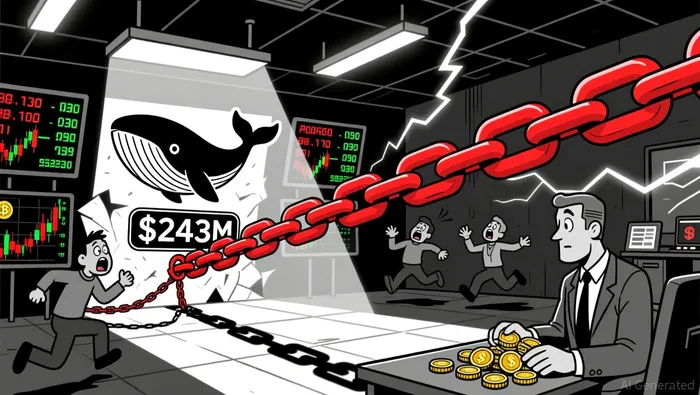
The cryptocurrency market in late 2025 is a theater of extremes, where leveraged short positions and volatile investor sentiment collide to create both opportunity and peril. A single whale's $243 million bet against BitcoinBTC-- (BTC), EthereumETH-- (ETH), and SolanaSOL-- (SOL) has ignited debate: is this a calculated bear market catalyst or a reckless gamble in a market already teetering on the edge of panic?
The Whale's Bearish Bet: Leverage and Exposure
According to a report by Coingape, a prominent Bitcoin whale has amplified its short exposure across BTCBTC--, ETH, and SOLSOL-- using aggressive leverage. The whale sold 255 BTC in early December to fund a portfolio of 1,899 BTC (15x leverage), 18,528 ETH (15x leverage), and 151,209 SOL (20x leverage). This move underscores a deeply bearish outlook, particularly as Bitcoin and Solana trade near critical average entry levels, leaving the whale vulnerable to upward price shocks. Meanwhile, Ethereum shorts are currently in unrealized profit, suggesting the whale's positioning may be partially hedged.
The scale of this bet is not isolated. The broader Bitcoin futures market has seen a surge in short liquidation, with bearish positions being mechanically closed as prices fluctuate. This dynamic has created buying pressure, complicating the whale's strategy. Analysts note that such concentrated shorting, especially at high leverage, can backfire if market conditions shift unexpectedly-a risk amplified by the inherent volatility of crypto assets.
Market Impact: November 2025's Perfect Storm
The whale's actions align with a broader bearish trend that gripped the market in November 2025. As stated by Reuters, leveraged ETFs tied to cryptocurrencies and companies like Strategy, which holds substantial Bitcoin reserves, lost nearly 85% of their value in 2025. Bitcoin's 23% price drop during the month exacerbated losses for long positions while short sellers reaped over $2.5 billion in profits from Strategy stock alone.
This downturn was fueled by a confluence of factors: uncertainty around Federal Reserve policy, a 43-day government shutdown distorting economic data, and the selling pressure from older Bitcoin holders who had held their coins for over seven years. The result was a market environment where leveraged products-both long and short-acted as accelerants, magnifying gains and losses alike.
Market Psychology: Fear, Greed, and the Role of Retail vs. Institutional Actors
The psychological undercurrents of this period are critical to understanding the whale's risk profile. The Crypto Fear and Greed Index, a widely tracked sentiment indicator, plummeted to "Extreme Fear" levels (10-15) in mid-November as Bitcoin fell below $100,000. Such extreme readings often signal market bottoms, as panic-driven selling exhausts itself. However, they also highlight the fragility of investor confidence, particularly among retail traders who tend to overreact to volatility.
In contrast, institutional actors and large holders ("sharks") have shown a more disciplined approach. On-chain data reveals that sharks are accumulating Bitcoin during dips, suggesting a long-term bullish stance despite short-term turbulence. This divergence between retail panic and institutional accumulation creates a tug-of-war that could either stabilize the market or deepen the downturn, depending on which force prevails.
The role of leveraged shorts in this dynamic is particularly fraught. Negative funding rates in perpetual futures markets indicate bearish sentiment, but they also hint at the potential for a short squeeze if prices unexpectedly rebound. Such scenarios are not uncommon in crypto, where retail-driven speculation and algorithmic trading can create sudden, sharp reversals.
Is This a Bear Market Catalyst or High-Risk Speculation?
The whale's $243 million short bet sits at the intersection of these forces. On one hand, its aggressive leverage and the broader market's bearish momentum suggest a calculated attempt to capitalize on a potential bear market. On the other, the whale's exposure to upward price swings-particularly in Bitcoin and Solana-makes it a high-risk proposition. If institutional buyers continue to accumulate during dips, as on-chain data suggests, the whale's positions could face mounting losses.
Moreover, the market's psychological state adds another layer of uncertainty. While extreme fear often precedes rebounds, the presence of leveraged shorts and ETFs amplifies the risk of a self-fulfilling prophecy. If the whale's shorting triggers further selling, it could accelerate a bear market. Conversely, if the market stabilizes or rebounds, the whale's positions could collapse under the weight of margin calls and short squeezes.
Conclusion: A Delicate Balance
The $243 million whale short in BTC, ETH, and SOL is emblematic of the crypto market's current fragility. It reflects both the allure of leveraged speculation and the perils of overexposure in a landscape defined by volatility and psychological extremes. While the whale's bearish bet may align with short-term market trends, its long-term viability hinges on factors beyond price movements-namely, the interplay of institutional discipline, retail sentiment, and macroeconomic shifts.
As the market navigates this precarious phase, investors must weigh the risks of leveraged shorting against the potential for mechanical buying pressure and psychological rebounds. In a space where fear and greed drive as much as fundamentals, the whale's bet is as much a test of strategy as it is a gamble against the unpredictable nature of crypto itself.






Comentarios
Aún no hay comentarios