
Why 2026 Is the Year to Reallocate to Small-Cap Stocks: A Strategic Case for Outperformance
The investment landscape is shifting, and small-cap stocks are poised to reclaim their place as a cornerstone of outperformance in 2026. A confluence of market structure realignments, earnings momentum, and policy tailwinds is creating a fertile environment for small-cap equities to outperform their large-cap counterparts. This analysis synthesizes data from the S&P 600 and Russell 2000 indices, expert commentary from Bank of America (BofA) and Royce, and fiscal/economic catalysts to build a compelling case for rebalancing portfolios toward small-cap value and growth.
Market Structure Shifts: Undervaluation and Quality Screens
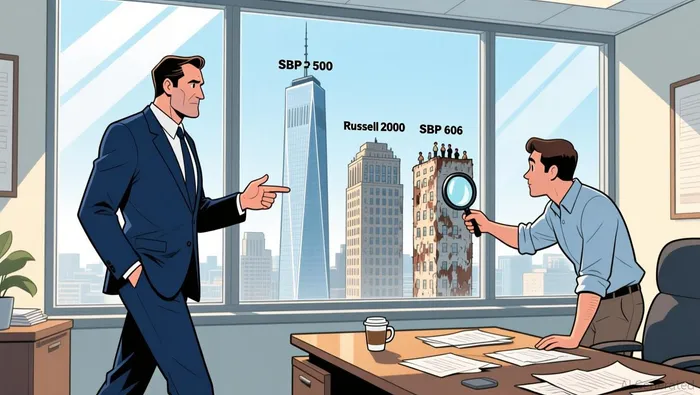
The S&P 600, a high-quality small-cap index, has historically outperformed the Russell 2000 in 80% of three-year periods, thanks to its rigorous inclusion criteria-only companies with consistent earnings are eligible according to Frontier Asset. While the S&P 500 has outpaced both the S&P 600 and Russell 2000 year-to-date in 2025 (17.8% vs. 6.1% and 13.5%, respectively), the Russell 2000's stronger short-term performance (1.0% monthly return in November 2025) hints at a reversion to mean. Crucially, the S&P 600 trades at a forward P/E of 16x, significantly cheaper than the S&P 500's 24x, suggesting small-caps are undervalued relative to large-caps-a recurring precursor to outperformance cycles according to Frontier Asset.
Earnings Momentum: AI, Onshoring, and Fiscal Policy
Small-cap earnings growth is accelerating, driven by AI-driven productivity gains and onshoring initiatives. BofA's Jill Carey Hall highlights 30 "smid-cap" stocks with 12-month price targets implying an average upside of 30%, underpinned by 23% median earnings growth projections according to Investopedia. These include names like Alaska Air Group (ALK), Birkenstock (BIRK), and Duolingo (DUOL), which are positioned to benefit from AI adoption and industrial policy. Royce analysts Miles Lewis and Chip Skinner echo this, noting that sectors like consumer staples, packaging, and business services are set to rebound as investors shift toward quality models with strong cash flows according to Royce Insights.
Fiscal catalysts further amplify this momentum. The "One Big Beautiful Bill Act" and tax incentives are expected to spur capital expenditures, particularly in industrials and energy, while falling interest rates reduce refinancing costs for small-cap companies according to Bank of America. BofA's Chris Hyzy emphasizes that three anticipated Fed rate cuts in 2026 will disproportionately benefit small-caps, which carry higher debt loads and are more sensitive to borrowing costs according to Investopedia.
Policy Tailwinds: Tariffs, Tax Refunds, and Capex Cycles
Monetary and fiscal policies are aligning to supercharge small-cap performance. BofA forecasts that tariff reductions and accommodative monetary policy will create a "Goldilocks" environment for earnings growth according to Yahoo Finance. Additionally, tax policy changes, such as expanded 2026 tax refunds, are expected to boost consumer spending and e-commerce demand, benefiting companies like Wayfair (W) and e.l.f. Beauty (ELF) according to Bank of America.
On the industrial front, onshoring and infrastructure spending are driving demand for small-cap firms in manufacturing and energy. Royce analysts highlight that sectors like packaging and insurance are particularly well-positioned to capitalize on these trends according to Royce Insights. Meanwhile, BofA's Vivek Arya anticipates a 30% surge in global semiconductor sales, with small-cap suppliers like Lam Research (LRCX) and KLA (KLAC) leading the charge according to Yahoo Finance.
Expert Commentary: A Consensus for Rebalancing
The case for small-caps is further reinforced by expert consensus. Royce's Lewis and Skinner argue that 2026 will see a "flight to quality" as speculative AI-driven momentum unwinds, favoring traditional value models with strong balance sheets according to Royce Insights. BofA's Savita Subramanian forecasts robust earnings growth for small-caps, particularly in sectors tied to productivity gains and capital expenditures according to Merrill Edge.
Notably, BofA's list of 30 smid-cap stocks includes beaten-down names like Acadia Realty Trust and Bath & Body Works, which are viewed as undervalued bargains with strong fundamentals according to AOL. These picks reflect a broader theme: small-caps are being priced for pessimism but are poised to deliver outsized returns as macroeconomic conditions normalize.
Conclusion: A Strategic Reallocation Opportunity
The convergence of undervaluation, earnings momentum, and policy tailwinds makes 2026 a pivotal year for small-cap stocks. The S&P 600's historical outperformance, BofA's curated 30-stock list, and expert commentary from Royce and BofA all point to a compelling case for rebalancing portfolios toward small-cap value and growth. As the market shifts from speculative AI-driven momentum to earnings-driven fundamentals, investors who reallocate now stand to capture the upside of a sector primed for a renaissance.







Comentarios
Aún no hay comentarios