
Is the 2026 Stock Market Set for a Four-Year Bull Run?
The 2026 stock market's trajectory hinges on a critical question: Can AI-driven gains sustain a four-year bull run, or will valuation risks unravel the current frenzy? As the AI sector transitions from speculative hype to practical implementation, investors must weigh the transformative potential of the technology against the fragility of its financial underpinnings.
The AI Valuation Paradox: Efficiency vs. Speculation
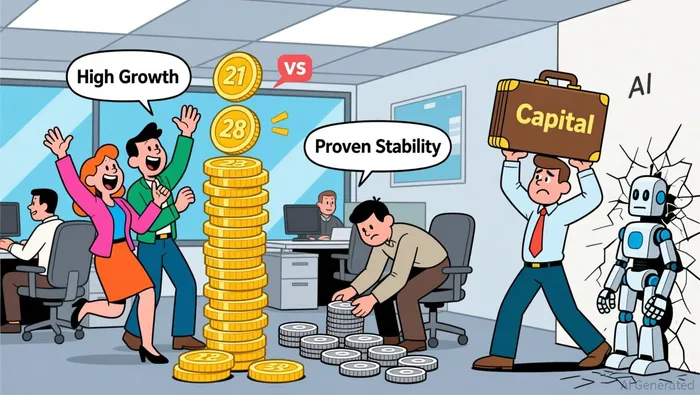
AI-driven companies in 2025 demonstrated robust financial metrics, with late-stage startups trading at revenue multiples of 21x to 28x and infrastructure providers commanding multiples above 20x. These valuations reflect investor confidence in scalable business models, yet they ignore critical risks. For instance, AI startups often face capital intensity due to high compute costs, which scale faster than revenue. warns that traditional SaaS valuation models, which prioritize predictable revenue streams, fail to account for the technical obsolescence risk inherent in AI-where open-source models or platform providers could commoditize a startup's core technology.
The Q4 2025 financial performance of AI infrastructure leaders like BroadcomAVGO-- and TD SYNNEXSNX-- underscores the sector's profitability. Broadcom reported a non-GAAP operating margin of 66.2% and adjusted EBITDA of $12.2 billion, while TD SYNNEX exceeded EBITDA estimates by 3%. However, these gains are concentrated in a narrow subset of companies. In 2025, nearly 40% of the S&P 500's total return came from just five stocks: NvidiaNVDA--, Broadcom, Alphabet, Microsoft, and Palantir. This concentration raises concerns about overexposure to "AI theater," where hype outpaces tangible economic impact.
2026: From Hype to Practical Implementation
Expert projections for 2026 suggest AI will shift from experimentation to enterprise-wide adoption. PwC predicts companies will adopt top-down AI strategies focused on specific workflows, delivering measurable outcomes in areas like cost reduction and innovation acceleration. Agentic AI, too, is expected to evolve from exploratory efforts to real-world deployments, with centralized platforms and shared agent libraries enhancing scalability.
Sustainability will also become a focal point. AI is poised to optimize ESG operations by automating reporting, improving energy efficiency, and enhancing supply chain transparency. For example, AI-driven innovations could address climate adaptation and circular economy goals, aligning with global sustainability mandates. However, this transition depends on responsible AI governance to avoid ethical pitfalls.
The Four-Year Bull Run: Risks and Realities
The sustainability of a four-year bull run through 2026-2027 depends on diversification and macroeconomic resilience. While U.S. mega-caps dominate AI investment, China's advancements in large language models and AI chips could solidify a U.S.-China duopoly in innovation. Investors are advised to expand exposure beyond public markets into private ventures, physical AI, and robotics.
Macro risks, however, loom large. The International Monetary Fund has warned of a potential speculative bubble, citing circular investment structures and fragile supply chains. Additionally, AI's energy demands are straining grid infrastructure, with global data center electricity consumption projected to double by 2030. If returns from AI investments fail to justify valuations, a market correction could follow.
Conclusion: Balancing Optimism with Caution
The 2026 stock market's bull run potential is inextricably tied to AI's ability to deliver on its promises. While the technology's transformative potential is undeniable, investors must remain vigilant against overvaluation and macroeconomic headwinds. A diversified approach-balancing exposure to AI infrastructure, enterprise adopters, and emerging markets-could mitigate risks while capitalizing on long-term gains. As the sector matures, the key to sustainability will lie not in speculative bets but in AI's capacity to generate measurable, scalable value.





Comentarios
Aún no hay comentarios