
The 2026 Semiconductor and AI Inflection Point: Intel's Manufacturing Mastery vs. Tesla's Autonomous Leap
The 2026 semiconductor and AI inflection point represents a pivotal moment for investors navigating the high-growth tech sector. As the global semiconductor market surges toward $1 trillion in revenue by 2026, driven by AI data centers and advanced manufacturing, two titans-Intel and Tesla-are charting divergent paths. This analysis examines their strategic positioning, valuation realism, and sector rotation dynamics to determine which company offers a more compelling investment thesis in the context of AI-driven innovation.
Intel: Manufacturing Mastery and Foundry Ambitions
Intel's resurgence hinges on its mastery of semiconductor manufacturing and its pivot to a foundry model. In Q3 2025, the company reported $13.7 billion in revenue, a 3% year-over-year increase, with a non-GAAP gross margin of 40%, exceeding expectations. Strategic partnerships, including a $2.0 billion investment from SoftBank Group and a $20 billion funding package from the U.S. government, underscore its commitment to scaling production. Intel's $16.5 billion R&D investment in 2025-the highest among major chipmakers-is focused on its 18A manufacturing process, a 1.8-nanometer technology critical for AI accelerators and high-performance computing.
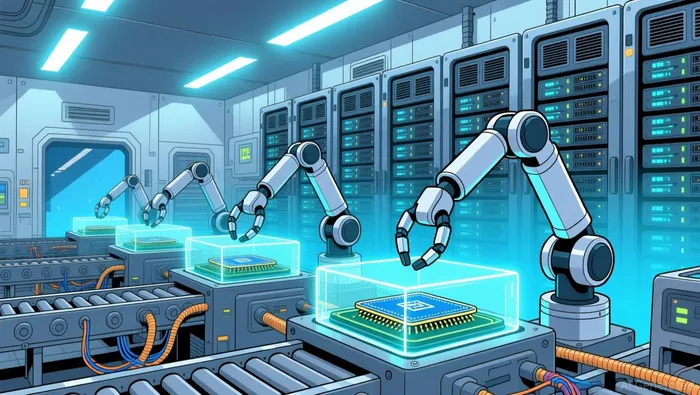
The company's transition to a foundry model, coupled with its $18 billion capital expenditure plan for 2025, positions it to capitalize on the AI semiconductor boom. Analysts highlight Intel's unique role as the only U.S.-based company with leading-edge logic R&D and manufacturing capabilities, a strategic advantage in an era of geopolitical supply chain tensions. Despite a 64% stock price decline over the past year, Intel's forward P/E ratio of 16 suggests undervaluation relative to peers like NVIDIA and ASML, which trade at premium multiples. This low valuation, combined with its $106 billion book value and $5.7 billion in U.S. government funding, creates a margin of safety for long-term investors.
Tesla: Autonomous Leap and Valuation Volatility
Tesla's 2025 financials reveal a company at a crossroads. While its 2024 revenue reached $97.6 billion, GAAP net income plummeted by 53% to $7 billion in 2024, reflecting margin pressures from rising interest costs and declining European market share. However, Tesla's $80 billion reinvestment plan between 2024 and 2030-targeting AI-driven robotics, robotaxi deployment, and humanoid robots-signals a bold bet on the future. The company aims to mass-produce 2 million Cybercabs at under $30,000 each by 2027, leveraging its Full Self-Driving (FSD) software and Unsupervised FSD rollout in Texas.
Despite these ambitions, Tesla's valuation remains speculative. A recent report estimates a $220 price target, implying a market cap slightly above $700 billion. This valuation hinges on the success of its AI and robotics initiatives, which face execution risks and competition from Chinese automakers like BYD, which sold over two million more EVs than TeslaTSLA-- in 2024. Tesla's stock volatility is further exacerbated by geopolitical headwinds, including U.S. tariff proposals and supply chain disruptions. Unlike Intel's manufacturing-driven growth, Tesla's AI bets are more aspirational, requiring significant capital and regulatory approvals to materialize.
Sector Rotation and Valuation Realism
The semiconductor sector's outperformance in 2025-driven by AI data center demand and DRAM "super cycles"- highlights a clear sector rotation toward manufacturing and infrastructure. Intel's $16 forward P/E ratio and $16.5 billion R&D spend align with this trend, offering a tangible link to the $1.2 trillion AI accelerator market by 2030. In contrast, Tesla's valuation reflects a premium on future AI-driven revenue streams, which are less certain and more exposed to macroeconomic risks.
For investors, the choice between IntelINTC-- and Tesla hinges on risk tolerance. Intel's manufacturing expertise and low valuation provide a defensive edge in a sector poised for $1 trillion in revenue by 2026. Tesla, meanwhile, offers high-growth potential but requires a leap of faith in its ability to execute on autonomous driving and robotics. As Bank of America analyst Vivek Arya notes, the semiconductor industry's 30% revenue growth forecast underscores the importance of capitalizing on manufacturing and AI infrastructure.
Conclusion
The 2026 inflection point favors companies with tangible, scalable infrastructure. Intel's manufacturing mastery and strategic partnerships position it as a cornerstone of the AI semiconductor boom, while Tesla's autonomous leap remains a high-risk, high-reward proposition. For valuation realism, Intel's undervalued metrics and sector alignment make it a more compelling bet in the near term. However, Tesla's long-term AI and robotics ambitions could redefine its trajectory-if executed successfully. Investors must weigh these dynamics carefully as the semiconductor and AI landscape evolves.





Comentarios
Aún no hay comentarios