
The 2026 Roth Catch-Up Mandate: A New Era for Tax Diversification in Retirement Planning
The 2026 Roth catch-up contribution mandate, a cornerstone of the SECURE 2.0 Act, marks a seismic shift in retirement planning for high-income earners. Starting January 1, 2026, individuals aged 50 or older who earned more than $150,000 in prior-year FICA wages will be required to direct their catch-up contributions to Roth accounts, effectively eliminating the pre-tax option for these contributions. This rule applies to 401(k)s, 403(b)s, and governmental 457(b) plans, with contribution limits set at $8,000 for 401(k) catch-ups and $1,100 for IRAs in 2026 according to Schwab's analysis. For those aged 60–63, the "super catch-up" provision allows contributions up to $11,250 in 2026 as reported by Forbes. This mandate not only reshapes tax strategies but also compels a reevaluation of asset allocation and long-term wealth management.
Strategic Tax Diversification: Balancing Immediate and Future Tax Liabilities
The mandate's core implication is the forced adoption of Roth contributions for high earners, a move that prioritizes tax diversification. By paying taxes on catch-up contributions upfront, individuals gain the advantage of tax-free growth and withdrawals in retirement, assuming they meet eligibility criteria. This creates a dual-layered retirement portfolio: traditional pre-tax accounts for current savings and Roth accounts for future tax-free access.
For example, consider a 55-year-old earning $160,000 annually. Their standard $24,500 401(k) contribution remains pre-tax, but the $8,000 catch-up must go to Roth. This structure hedges against future tax uncertainty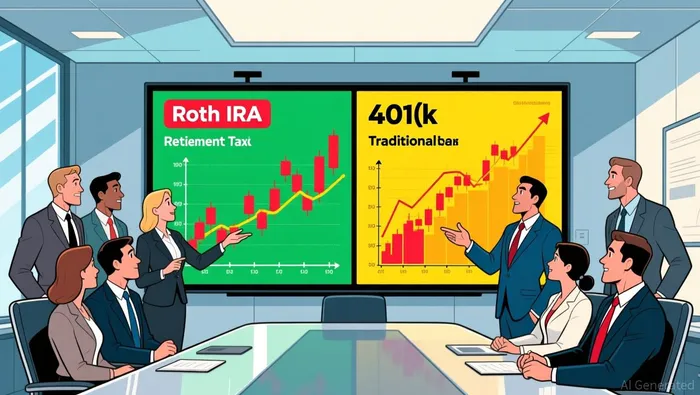 -traditional accounts may face higher rates in retirement, while Roth accounts lock in today's rates. Additionally, Roth accounts are exempt from required minimum distributions (RMDs), offering greater flexibility in withdrawal timing and estate planning as noted by Ogletree.
However, the immediate tax burden of Roth contributions is nontrivial. A high earner might face a 22% or 24% marginal tax rate in 2026, reducing their after-tax cash flow. Advisors should help clients model scenarios where Roth contributions are paired with tax-advantaged alternatives, such as Health Savings Accounts (HSAs), to mitigate this impact.
Asset Allocation in a Roth-Driven Framework
The mandate also necessitates a recalibration of asset allocation strategies within retirement accounts. Roth accounts, with their tax-free growth potential, are ideal for holding high-growth, volatile assets like equities or private equity, where compounding can maximize long-term gains. Conversely, traditional accounts-subject to future taxation-may be better suited for lower-risk, income-generating assets such as bonds or dividend-paying stocks according to Reuters analysis.
For instance, a 60-year-old investor might allocate 70% of their Roth contributions to equities and 30% to alternatives, while their traditional account holds a 60/40 stock-bond mix. This approach leverages Roth's tax-free environment for aggressive growth while using traditional accounts for stable income streams. Advisors should also consider in-plan Roth conversions or backdoor Roth IRAs for clients without access to employer-sponsored Roth options.
Employer Compliance and Employee Communication
Employers face significant administrative challenges. Plans must update payroll systems to track income thresholds and automate Roth allocations, with compliance deadlines extended for governmental and collectively bargained plans until December 31, 2026. Failure to implement these changes could result in operational errors, requiring corrective measures like in-plan Roth rollovers or W-2 adjustments.
Moreover, employee education is critical. A 2025 survey by Schwab found that only 34% of high earners fully understood the implications of Roth contributions. Employers must proactively communicate the mandate's impact, offering workshops or one-on-one consultations to help employees navigate the shift.
Conclusion: Adapting to a Tax-Neutral Future
The 2026 Roth catch-up mandate is not merely a regulatory change but a catalyst for rethinking retirement strategy. By mandating Roth contributions for high earners, the SECURE 2.0 Act encourages a balanced approach to tax diversification, ensuring that retirees are not overly reliant on a single tax treatment. For asset allocation, the focus shifts to optimizing growth within tax-advantaged vehicles while mitigating near-term tax costs. As the mandate takes effect, both individuals and employers must act swiftly to align their strategies with this new paradigm, securing long-term financial resilience in an uncertain tax landscape.







Comentarios
Aún no hay comentarios