
The 2026 Payroll Anomaly and Its Implications for HR and Payroll Technology Providers
The 2026 payroll anomaly-specifically the occurrence of 27 biweekly pay periods instead of the standard 26-represents a critical inflection point for employers and a significant opportunity for SaaS-based payroll and HR technology providers. This anomaly, driven by the accumulation of unaccounted calendar days over time, will force employers to confront budgetary and compliance challenges that only advanced software solutions can resolve. For investors, the alignment of recurring operational pain points with the rapid adoption of cloud-based, AI-driven payroll platforms creates a compelling case for near-term sector outperformance.
The 2026 Payroll Anomaly: A Recurring Operational Challenge
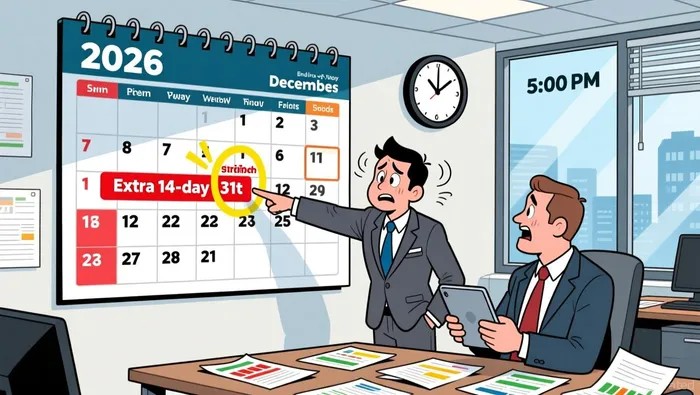
The anomaly arises because 26 biweekly pay periods cover only 364 days, leaving one or two days unaccounted for in a typical or leap year. Over 11 to 12 years, these leftover days accumulate into an extra 14-day period, necessitating a 27th pay period. In 2026, employers starting their first biweekly pay period on January 2 will issue the 27th paycheck on December 31, a shift compounded by the New Year's Day banking holiday.
This anomaly has material financial implications. Employers who calculate salaries by dividing annual figures by 26 will inadvertently pay employees 3.8% more than intended in a 27-period year. For a $52,000 annual salary, this results in an unintended $2,000 overpayment per affected employee. Such cost overruns, multiplied across large workforces, could strain budgets and necessitate adjustments to bonuses or benefits. Additionally, compliance risks emerge if employers fail to adjust deductions for healthcare or retirement contributions, which are typically calculated over 26 periods.
SaaS Payroll Solutions: A Strategic Response to Complexity
The 2026 anomaly underscores the limitations of manual payroll systems and highlights the value of SaaS-based platforms. These solutions automate critical functions, including pay period adjustments, compliance with labor laws, and real-time tax calculations. For instance, AI-powered systems can dynamically recalculate paychecks by dividing annual salaries by 27, ensuring total compensation remains aligned with contractual agreements. Automation also mitigates the risk of overpaying or underpaying employees, a challenge that becomes acute during anomalies like the 27th pay period.
Cost savings and efficiency gains further justify the shift to SaaS. Data from industry reports indicates that automated payroll systems reduce processing time by 30–35% and error correction costs by 40–60%. For employers facing the 2026 anomaly, these savings are not just operational but existential. The ability to avoid costly overpayments-each error averaging $291 to correct-becomes a critical differentiator in a competitive labor market.
Market Dynamics: A Tailwind for Fintech and HR Software Providers
The 2026 anomaly is not an isolated event but part of a recurring cycle. Historical data shows that biweekly pay periods have been the most common payroll frequency in the U.S., with 43% of private establishments using this model in 2023. Given that the anomaly occurs every 11–12 years, the demand for SaaS solutions capable of handling such disruptions will persist well beyond 2026.
This recurring demand is fueling robust growth in the SaaS payroll market. The global market, valued at $32.6 billion in 2025, is projected to reach $51.4 billion by 2030, driven by AI-driven automation and real-time compliance tools. Investors should note that 70–80% of payroll buyers prioritize compliance automation in their software selection, a feature that SaaS providers are uniquely positioned to deliver according to industry analysis. For example, platforms leveraging AI can interpret evolving labor regulations and apply them across geographies, ensuring that employers remain compliant even during complex scenarios like the 2026 anomaly.
Strategic Investment Case
The convergence of operational urgency and technological innovation positions SaaS payroll providers as prime beneficiaries of the 2026 anomaly. For employers, the cost of inaction-whether through overpayments, compliance penalties, or administrative inefficiencies-far outweighs the investment in modern software. For investors, the sector's growth trajectory is reinforced by macroeconomic trends, including the increasing complexity of global labor markets and the rising cost of regulatory noncompliance.
Moreover, the anomaly's recurrence every 11–12 years ensures a durable demand for SaaS solutions. As employers prepare for future anomalies (e.g., in 2037 or 2048), they will increasingly rely on platforms that offer flexibility, scalability, and proactive anomaly detection. This creates a flywheel effect: the more frequently anomalies occur, the more critical SaaS becomes to payroll resilience.
Conclusion
The 2026 payroll anomaly is a microcosm of broader shifts in the HR and payroll technology landscape. It exposes the fragility of traditional payroll systems while accelerating the adoption of SaaS solutions that offer precision, compliance, and cost efficiency. For investors, the sector's ability to address recurring operational challenges-coupled with its projected growth and high client retention rates-makes it a compelling long-term opportunity. As the anomaly approaches, the market for SaaS payroll providers is poised to outperform, driven by both immediate demand and the enduring need for technological agility.







Comentarios
Aún no hay comentarios