
2026: Navigating the Wealth Transfer and Positioning for Crisis-Driven Opportunity
As the global economy edges closer to a potential inflection point, the interplay between monetary policy, asset resilience, and systemic risk has never been more critical. By 2026, the forces of inflation, central bank interventions, and technological disruption will likely accelerate, creating both peril and opportunity for investors. Robert Kiyosaki, a long-time advocate for tangible assets, has positioned his 2026 forecasts as a roadmap for navigating this volatility. His emphasis on gold, silver, BitcoinBTC--, real estate, and cash-flowing businesses reflects a strategic pivot toward assets that resist the erosion of fiat currency and systemic collapse. This analysis examines the rationale behind these choices, supported by 2025 performance trends and macroeconomic dynamics, to argue for a proactive, education-driven approach to wealth preservation.
The Case for Precious Metals: Gold and Silver as Inflation Hedges
Kiyosaki's 2026 price targets for gold ($27,000 per troy ounce) and silver ($100 per troy ounce) are not mere speculation but grounded in 2025's performance. Gold surged nearly 70% year-to-date, while silver outperformed with a 150% gain, driven by central bank purchases, geopolitical tensions, and a weakening U.S. dollar. These trends align with Kiyosaki's assertion that precious metals are "outside the reach of monetary manipulation".
The "debasement trade" in 2025-where investors shifted capital to assets retaining value amid expansive monetary policies-underscored gold and silver's role as safe havens. Analysts note that gold historically leads Bitcoin by about 26 weeks, suggesting the cryptocurrency could follow suit in 2026 as its price stabilizes. 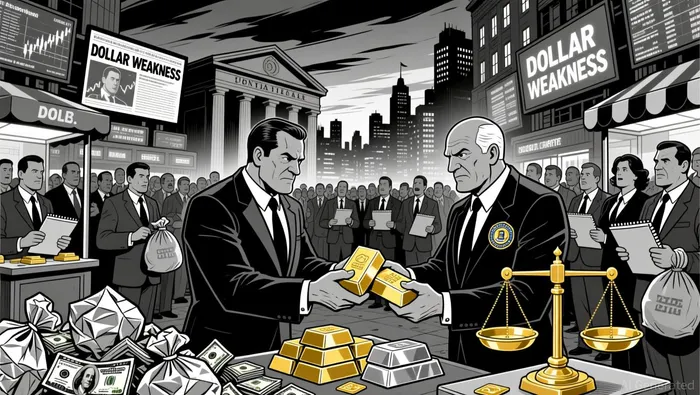 Kiyosaki's prediction of $250,000 for Bitcoin by 2026, while ambitious, gains credibility from the asset's potential to benefit from ETF inflows and regulatory clarity. However, silver's volatility, amplified by its dual role as a critical mineral and industrial commodity, makes it a high-risk, high-reward bet.
Bitcoin: A Digital Counterbalance to Fiat Erosion
Bitcoin's 2025 performance-falling below $90,000 by October after peaking near $125,000-highlighted its sensitivity to liquidity conditions and regulatory uncertainty. Yet, Kiyosaki's bullish stance hinges on its potential to outperform traditional assets in a hyperinflationary environment. His argument is bolstered by the Federal Reserve's aggressive money-printing, which he claims devalues savings and fuels a "fake economy".
Grayscale's 2026 outlook anticipates a resolution to Bitcoin's four-year market cycle, with institutional adoption and ETF approvals potentially driving it to new highs. While skeptics question Kiyosaki's $250,000 target, the broader narrative of Bitcoin as a hedge against monetary manipulation remains compelling. As Kiyosaki warns, "I am going to get richer when the fake economy crashes", a sentiment echoed by investors who view Bitcoin as a digital alternative to gold.
Real Estate and Cash-Flowing Businesses: Anchors in a Shifting Landscape
Kiyosaki's pivot to cash-flowing businesses-such as surgery centers and billboards-reflects a pragmatic shift toward assets generating passive income. By 2026, these ventures are projected to yield $27,500 in monthly tax-free income, underscoring their resilience to economic cycles. Real estate, too, remains a cornerstone of his strategy, though he cautions against overexposure to markets vulnerable to AI-driven job losses and office vacancies. Experts argue that tangible assets like commercial real estate and small businesses offer returns independent of monetary manipulation, making them critical for long-term wealth building. Kiyosaki's emphasis on diversification-balancing hard assets with strategic equity exposure-further mitigates risk in an unpredictable climate.
Navigating the Crisis: The Role of Financial Education
Kiyosaki's 2026 forecasts are not just about asset allocation but about mindset. He frames the coming years as a "black swan" event akin to the 1914 Archduke Ferdinand assassination, warning that unprepared investors will face catastrophic losses. Yet, his predictions also highlight opportunities for those who act decisively. For instance, his sale of Bitcoin profits into silver and cash-flowing businesses demonstrates a dynamic, education-driven strategy. Critics argue that a "greater depression" akin to the 1930s is unlikely, citing the Misery Index peaking at 8.1% in Q3 2025 and easing to 6.9% by year-end. However, Kiyosaki's focus on worst-case scenarios-such as hyperinflation and global economic instability-resonates with investors seeking to insulate their portfolios from systemic shocks. As he notes, "The rules of money are breaking down", and those who adapt will thrive.
Conclusion: Positioning for 2026's Dual Reality
The path to 2026 is fraught with uncertainty, but it also offers a rare chance to capitalize on mispriced assets and systemic shifts. Gold and silver, with their historical resilience, remain foundational. Bitcoin, while volatile, could serve as a digital counterpart to precious metals. Real estate and cash-flowing businesses, meanwhile, provide tangible income streams that buffer against macroeconomic turbulence.
Kiyosaki's forecasts, though polarizing, underscore a universal truth: financial education and proactive diversification are non-negotiable in an era of monetary experimentation. As the Fed's policies and global instability reshape the investment landscape, those who prioritize assets beyond the reach of central banks will be best positioned to navigate-and profit from-the coming storm.






Comentarios
Aún no hay comentarios