
The 2026 Midterm Risks and Implications for US Equities
The 2026 U.S. midterm elections loom as a pivotal moment for political and economic stability, with far-reaching implications for equities. Historical patterns suggest the president's party will face significant challenges, particularly in the House of Representatives, where narrow majorities leave little room for error. This dynamic, combined with deepening partisan divides and policy gridlock, creates a volatile backdrop for markets. Investors must navigate sector-specific risks and evolving political narratives to position portfolios effectively.
Political Instability and Legislative Constraints
The 2026 midterms are expected to follow the historical trend of the president's party losing seats, a pattern observed in 20 of the past 22 midterms. With a current narrow Republican majority in the House, even modest losses could shift the balance of power, limiting the administration's ability to advance its legislative agenda. This instability is compounded by structural factors: President Trump's unpopularity and the Democratic Party's structural advantages among college-educated voters, a demographic that typically turns out in higher numbers during midterms.
Policy risks are further amplified by unresolved issues like affordability crises and Trump's hardline immigration policies, which have left room for Democratic gains. If the president's party loses control of the House, legislative gridlock could intensify, delaying or derailing key initiatives. Such outcomes would likely introduce uncertainty into markets, particularly for sectors reliant on regulatory clarity or fiscal stimulus.
Sectoral Volatility: Tech, Energy, and Healthcare
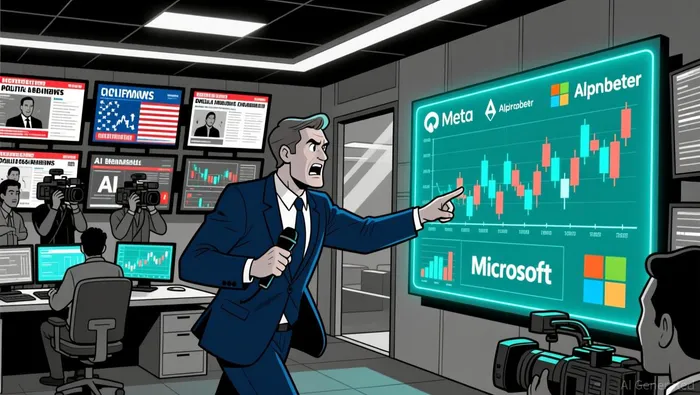
Technology: The tech sector remains a focal point of political and regulatory scrutiny. Big Tech companies, including Meta, Alphabet, and Microsoft, have ramped up lobbying efforts and super PAC investments to shape AI policy and regulatory outcomes. However, concerns about an AI "bubble" and speculative valuations persist, with investors questioning the sustainability of current growth trajectories. Political risks, such as potential changes in trade policy or antitrust enforcement, could further destabilize the sector.
Energy and Healthcare: While specific data on energy and healthcare sector volatility is sparse, broader political risks-such as shifts in climate policy or healthcare regulation-could disrupt these industries. For example, a Democratic-controlled Congress might accelerate climate-related regulations, impacting fossil fuel firms, while healthcare policy changes could alter reimbursement rates or drug pricing frameworks. Investors are advised to monitor executive actions and legislative proposals closely, as these sectors are highly sensitive to policy shifts.
Market Positioning Strategies: Hedging and Sector Rotation
To mitigate political risks, investors are increasingly adopting defensive strategies. Sector rotation toward utilities and healthcare-industries historically less sensitive to cyclical downturns-is gaining traction. This shift is partly driven by the volatility of AI-driven capital expenditures, which are heavily reliant on debt and vulnerable to rising borrowing costs.
Hedging strategies are also being prioritized. Convex hedges, such as options or short-term fixed-income instruments, are recommended during key event windows like midterms to protect against left-tail scenarios. Additionally, diversification across geographic markets and asset classes is critical. International equities, which trade at relative discounts, could benefit from U.S. dollar weakness and global fiscal stimulus. Fixed income, particularly in public and private asset-backed credit markets, is emerging as an attractive asset class for income generation and risk mitigation.
The Role of Monetary and Fiscal Policy
The Federal Reserve's expected rate cuts in 2026 will play a crucial role in shaping market dynamics. While lower rates could buoy equities, they may also exacerbate inflationary pressures from tariffs and pre-election stimulus packages. Investors must balance the benefits of accommodative monetary policy against the risks of fiscal overreach, particularly as global government debt levels remain elevated.
Conclusion
The 2026 midterms present a complex interplay of political instability, sectoral volatility, and evolving investor strategies. While the U.S. equity bull market is expected to persist, driven by AI innovation and fiscal stimulus, risks from policy shifts and economic imbalances cannot be ignored. A diversified, flexible approach-combining sector rotation, hedging, and cross-asset diversification-will be essential for navigating this uncertain landscape. As the election approaches, vigilance and adaptability will define successful investment strategies.







Comentarios
Aún no hay comentarios