
2026 Market Crash: Preparing for the Bursting of the 17-Year Debt-Driven Super Bubble
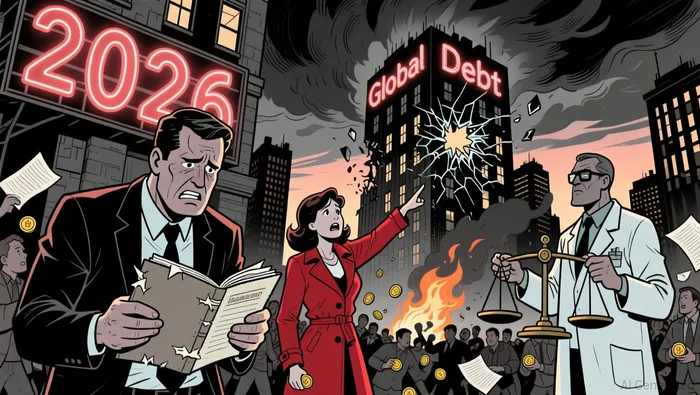
The global financial system stands at a precarious crossroads. A 17-year debt-driven super bubble, inflated by post-2008 monetary interventions, is now teetering on the edge of collapse. Harry DentDENT--, founder of HS Dent Investment, has sounded the alarm: this bubble, which began in 2009, could burst in 2026, triggering a market crash of unprecedented scale-potentially eroding 90% of stock market value according to Dent. The implications for asset prices, from equities to real estate and digital assets, are dire. Yet, amid this looming crisis, strategic defensive positioning and disciplined asset allocation offer a path to mitigate risk.
The 17-Year Debt-Driven Super Bubble: A Historical Precedent
The roots of this crisis lie in the aftermath of the 2008 financial collapse. Central banks, led by the U.S. Federal Reserve, injected trillions into global markets to stabilize the system. Instead of allowing a natural deleveraging process, these interventions artificially propped up asset prices, creating a speculative super bubble. BitcoinBTC--, often seen as a barometer for market extremes, has mirrored this pattern. Historical data shows that Bitcoin rarely reaches a new high after a four-year cycle peak, with declines of at least 77% following such peaks. By 2026, Dent predicts Bitcoin could fall to $30,000-or even $15,600-if the bubble bursts.
The AI sector, particularly stocks like NVIDIANVDA--, has become the new "Cisco" of the dot-com era, with valuations detached from fundamentals according to Dent. While AI's long-term potential is undeniable, its current pricing assumes perpetual growth in a world where debt-driven bubbles rarely end without a violent correction.
Indicators of an Impending Correction
January 2026 will be a critical litmus test. Historically, a weak January signals bearish momentum, while a strong start reinforces bullish trends. Meanwhile, U.S. Treasury bonds-often a safe haven in crises-face conflicting narratives. Dent argues that the U.S. government's ability to monetize debt makes Treasuries a rare survivor of the crash. However, economists like Peter Schiff warn of a U.S. dollar collapse, adding uncertainty to this traditional safe haven according to Schiff.
Global macroeconomic indicators also point to fragility. The U.S. federal debt now exceeds 120% of GDP, with corporate default risk hitting a post-2008 high of 9.2%. The need to refinance $9 trillion in debt in 2025 has already pushed 30-year Treasury yields to 4.98%, signaling waning demand for U.S. debt. These dynamics suggest a system under strain, where even minor shocks could trigger cascading failures.
Strategic Defensive Positioning: Asset Allocation Models for 2026
As the 2026 crash looms, tactical asset allocation must prioritize resilience over growth. Invesco's October 2025 tactical asset allocation model highlights a contraction regime, with a strong bias toward fixed income over equities and an overweight in quality and duration. This approach reflects a cautious stance amid declining global risk appetite, as captured by the Global Risk Appetite Cycle Indicator (GRACI)according to Invesco.
GMO's analysis reinforces this defensive tilt. Investors are advised to reduce exposure to AI-driven equities and rebalance toward non-U.S. equities, deep value stocks, and liquid alternatives. These sectors offer more attractive valuations and a better risk/reward profile in a potential downturn. BlackRock similarly advocates for rethinking diversification, blending liquid alternatives, digital assets, and international equities to reduce volatility.
Actionable Defensive Strategies for 2026
- Shift to High-Quality Fixed Income: U.S. Treasury bonds, TIPS, and emerging market bonds provide yield and downside protection. While the dollar's long-term viability is debated, its immediate role as a reserve currency ensures liquidity in a crisis according to Cambridge Associates.
- Diversify Beyond U.S. Equities: Non-U.S. equities, particularly in Asia and Europe, offer exposure to growth without the speculative overhang of AI-driven U.S. stocks according to GMO.
- Embrace Deep Value and Defensive Sectors: Utilities, healthcare, and consumer staples-sectors with stable cash flows and low leverage-historically outperform during corrections according to Trading Analyst.
- Leverage Liquid Alternatives: Hedge funds, private credit, and real assets like gold can act as buffers against equity market volatility according to BlackRock.
Conclusion: Preparing for the Inevitable
The bursting of the 17-year debt-driven super bubble is not a question of if but when. By adopting a defensive posture-prioritizing fixed income, diversifying geographically, and avoiding speculative overhangs-investors can navigate the storm. As Dent's warnings and 2025 asset allocation models suggest, the key to surviving 2026 lies in recognizing the fragility of the current system and acting decisively to protect capital.







Comentarios
Aún no hay comentarios