
The 2026 U.S. Manufacturing Renaissance: Strategic Sectors for High-Growth Investment
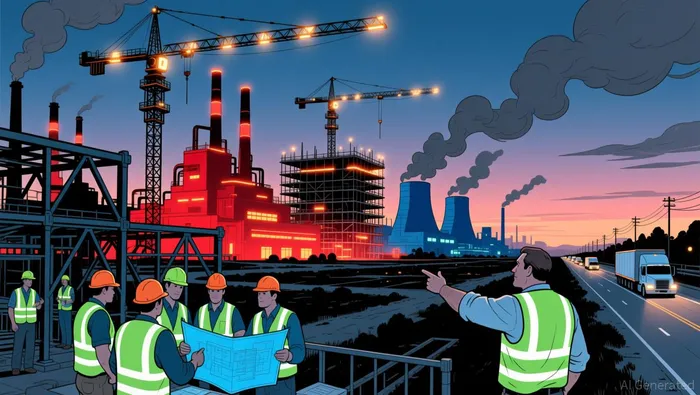
The U.S. manufacturing sector is undergoing a seismic shift in 2026, driven by a confluence of policy-driven incentives, infrastructure spending, and industrial equity repositioning. At the heart of this transformation lies a $3 trillion factory construction boom, as claimed by U.S. Commerce Secretary Howard Lutnick, who envisions a "golden age" of domestic manufacturing under Trump-era policies. While skeptics cite rising unemployment and inflation as counterpoints according to the same report, the interplay of accelerated depreciation policies, tariff-driven reshoring, and vocational education investments is creating a fertile ground for high-growth opportunities in infrastructure, industrial equities, and workforce development.
1. The $3 Trillion Factory Construction Boom: A Policy-Driven Catalyst
Lutnick's assertion of a $3 trillion annual investment in factory construction is rooted in Trump's aggressive reshoring agenda, which includes tariffs, tax incentives, and public-private partnerships. Key projects like Apple's $600 billion U.S. manufacturing pledge and Stellantis' $13 billion expansion underscore this trend. However, the feasibility of such a boom hinges on the One Big Beautiful Bill Act (OBBBA), which permanently reinstates 100% bonus depreciation for qualifying assets acquired after January 19, 2025. This provision allows businesses to fully deduct capital expenditures in the year of acquisition, effectively reducing tax liabilities and incentivizing large-scale investments in machinery, equipment, and non-residential real property.
For investors, this translates to a surge in demand for construction materials, industrial real estate, and heavy machinery. Firms like Caterpillar and Deere, which supply equipment for factory construction, have already seen strong demand in their core segments. Additionally, the OBBBA's Qualified Production Property (QPP) category-allowing immediate expensing of non-residential real property used in manufacturing- could drive a wave of facility expansions.
2. Trump-Era Tariffs: A Double-Edged Sword for Industrial Equity
Tariffs, a cornerstone of Trump's economic strategy, have polarized the market. While they aim to curb offshoring and boost domestic production, their impact is nuanced. By early 2026, the U.S. effective tariff rate stands at 15.8%-the highest since 1943, with retaliatory measures from trading partners reducing GDP growth by 0.7%. Yet, these tariffs have also spurred demand in sectors like semiconductors and aerospace, where domestic production is incentivized by the OBBBA's 25%-to-35% tax credits according to industry analysis.
Industrial equities are split: companies reliant on imported inputs (e.g., automotive and consumer goods) face margin pressures, while those benefiting from reshoring (e.g., steel, aluminum, and advanced manufacturing) see tailwinds. For example, the automotive sector may require over $50 billion to replicate Mexican production in the U.S., but the OBBBA's tax incentives could offset these costs. Investors should monitor the Supreme Court's upcoming ruling on IEEPA tariffs, which could reshape the trade landscape.
3. Accelerated Depreciation and Industrial Equity Returns
The OBBBA's tax incentives are already reshaping industrial equity valuations. By enabling immediate expensing of R&D costs, the act has spurred a 18.51% return for the industrial sector in 2025, driven by AI infrastructure and datacenter spending. For 2026, the Tax Foundation projects that manufacturing, information, and mining firms will see the largest tax liability reductions as a share of value added.
This has translated into outperformance for asset-heavy equities. Caterpillar, Deere, and Eaton Corporation have benefited from increased capital expenditures in power generation and infrastructure, while M&A activity has surged due to improved after-tax cash flow. The OBBBA's Section 179 expensing limit increase (from $1 million to $2.5 million) further amplifies this trend, allowing small and mid-sized manufacturers to optimize cash flow.
4. Vocational Education: The Unsung Infrastructure of the Renaissance
A critical but underappreciated pillar of the 2026 renaissance is vocational education. Despite a 22% cut to nondefense discretionary spending, private sector investments are filling the gap. Kellanova's partnership with Tennessee College of Applied Technology and Pella Corp.'s mentorship programs highlight how companies are directly addressing skills shortages. The Manufacturing Institute's advocacy for employer-led training and apprenticeships further underscores the sector's reliance on a skilled workforce.
For investors, this signals opportunities in technical colleges, apprenticeship platforms, and AI-driven training tools. The GE Aerospace Foundation's accelerated FAA certification program for veterans and Deloitte's emphasis on agentic AI in smart manufacturing illustrate how technology and education are converging to future-proof the industry.
5. Strategic Sectors for 2026: Where to Allocate Capital
- Industrial Real Estate: The OBBBA's 100% bonus depreciation for non-residential real property and expanded QOZs will drive demand for warehouse and manufacturing facilities.
- Heavy Machinery & Equipment: Caterpillar, Deere, and Doosan Bobcat are poised to benefit from factory construction and infrastructure upgrades.
- Semiconductors & Advanced Manufacturing: Tax credits under the OBBBA and Trump's tariffs on foreign chips make firms like Intel and TSMC attractive.
- Vocational Education Platforms: Companies like TradeTech and Apprenti, which facilitate skills training partnerships, could see exponential growth.
Conclusion: Navigating the Renaissance with a Long-Term Lens
The 2026 U.S. manufacturing renaissance is not without risks-tariff inflation, trade uncertainty, and budgetary constraints could temper growth. However, the OBBBA's tax incentives, coupled with private-sector innovation in vocational training, create a compelling case for industrial equity and infrastructure investments. For investors, the key is to balance exposure to high-growth sectors (e.g., semiconductors, AI-driven manufacturing) with defensive plays in essential infrastructure and workforce development. As the sector navigates this transformative phase, those who align with policy tailwinds and structural demand will be best positioned to capitalize on the "golden age" of U.S. manufacturing.





Comentarios
Aún no hay comentarios