
The 2026 IPO Market: A Strategic Opportunity Driven by AI and Mega Unicorns
The 2026 IPO market is poised to become a defining arena for investors seeking exposure to the next wave of technological disruption. As public market liquidity returns and interest rates stabilize, the confluence of artificial intelligence (AI) innovation and the anticipated public listings of mega unicorns is creating a unique inflection point. For those who position themselves strategically, this environment offers the potential to capitalize on high-growth opportunities while navigating the complexities of valuation sustainability and regulatory scrutiny.
The AI-Driven IPO Renaissance
The resurgence of AI-driven IPOs in 2024 and 2025 has laid the groundwork for 2026's momentum. According to a Morgan Stanley report, the U.S. IPO market saw a 46% increase in volume in 2024 compared to 2023, with technology, media, and telecommunications (TMT) companies accounting for 15% of listings and AI integration as a key differentiator. By Q4 2025, the trend had accelerated: 23 U.S.-based companies listed with valuations exceeding $1 billion, collectively raising $125 billion-a doubling of year-over-year figures. This surge reflects investor confidence in AI's ability to transform enterprise operations, from automating workflows to enabling data-driven decision-making.
The Federal Reserve's anticipated rate cuts in 2026 are expected to further fuel this momentum. As noted by PwC, a "risk-on" sentiment is likely to emerge, encouraging capital allocation to high-growth AI ventures. However, investors are becoming more discerning, favoring companies with clear monetization strategies and robust financial foundations. This shift underscores the importance of not just technological innovation but also operational scalability and regulatory preparedness.
Mega Unicorns: The New Public Market Powerhouses
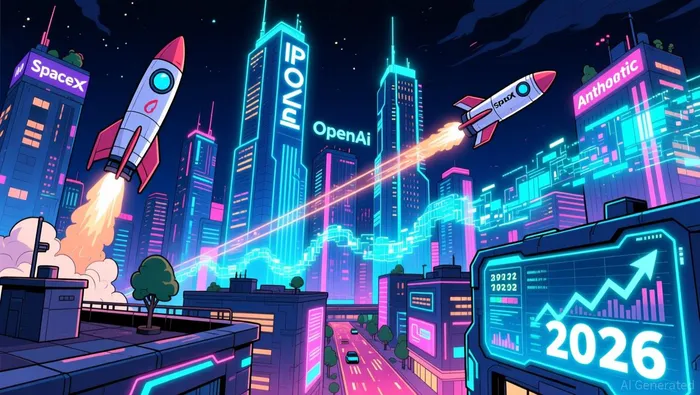 The 2026 IPO pipeline is dominated by AI mega unicorns, whose public listings could redefine market dynamics. SpaceX, OpenAI, and Anthropic are among the most anticipated names. SpaceX is reportedly planning a $30 billion IPO at a potential $1.5 trillion valuation, positioning itself as a generational bet on the space economy. Its Starlink broadband business and commercial rocket launch dominance provide a unique value proposition, blending AI-driven logistics with infrastructure innovation.
OpenAI, valued at $500 billion, is projected to achieve $70 billion in annualized revenue by 2028 through enterprise adoption of its generative AI tools. Its competitive edge lies in pioneering consumer AI applications and strategic cloud partnerships, though challenges such as high compute costs and regulatory scrutiny remain. Anthropic, developer of the Claude AI models, is also preparing for a 2026 IPO, with a valuation range of $200–300 billion driven by strong enterprise traction and cloud partnership economics.
These companies exemplify a broader trend: AI is no longer a vertical but a foundational layer of the technology ecosystem. Their public listings will likely attract long-term investors seeking exposure to transformative technologies, while also setting benchmarks for valuation metrics in AI-driven sectors.
Databricks and the Infrastructure Revolution
While the spotlight often falls on consumer-facing AI applications, the infrastructure layer is equally critical. Databricks, a leader in enterprise AI infrastructure, is set to debut in 2026 with a valuation above $130 billion. Its lakehouse architecture-a hybrid of data lakes and warehouses-has evolved into an AI-native platform capable of handling structured, semi-structured, and unstructured data. Innovations like Lakebase and Unity Catalog, which ensures open governance across data ecosystems, position Databricks as a key enabler of AI scalability.
The company's focus on democratizing data access through tools like Genie and Databricks One further underscores its strategic importance. As enterprises migrate toward AI-native architectures, Databricks' role in simplifying data governance and analytics will likely attract significant investor interest.
Navigating Challenges and Strategic Positioning
Despite the optimism, challenges persist. Regulatory scrutiny of AI models is intensifying, with concerns around data privacy, cybersecurity, and algorithmic bias. Additionally, the high capital expenditures required to maintain AI competitiveness-estimated at $527 billion in 2026-pose risks for companies lacking sustainable revenue streams.
For investors, strategic positioning involves balancing these risks with opportunities. Prioritizing companies with defensible moats-such as SpaceX's infrastructure dominance or Databricks' governance tools-is essential. Moreover, monitoring macroeconomic signals, such as the pace of interest rate cuts, will be critical in timing entries into the market.
Conclusion
The 2026 IPO market represents a pivotal moment for investors willing to navigate the complexities of AI-driven growth. As mega unicorns like SpaceX, OpenAI, and Anthropic prepare to go public, and infrastructure innovators like Databricks redefine enterprise capabilities, the stage is set for a new era of technological capital formation. For those who align their strategies with the fundamentals of AI monetization, governance, and market readiness, the rewards could be substantial.







Comentarios
Aún no hay comentarios