
Why 2026 Is the Inflection Point for Autonomous Infrastructure: The IDRV Bet
The autonomous vehicle sector is poised for its first major inflection. After years of pilot programs and incremental progress, the industry is shifting from experimental to commercial reality. This year, 2026, is emerging as the potential inflection point where rider comfort and adoption could accelerate significantly. The catalyst is a wave of concrete, scaled rollouts that are making self-driving technology a tangible part of urban life.
This transition is already visible at the ground level. At CES 2026, major partnerships signaled a move toward deployment. NVIDIANVDA-- unveiled a city-street autonomy deal with Mercedes-Benz, while LucidLCID-- and UberUBER-- announced a robotaxi alliance. More broadly, Waymo plans to expand its fleet to 12 new cities this year, targeting over one million weekly rides. These are not just announcements; they are the first steps onto the steep part of the adoption S-curve, where usage grows exponentially as the technology proves its reliability and utility.
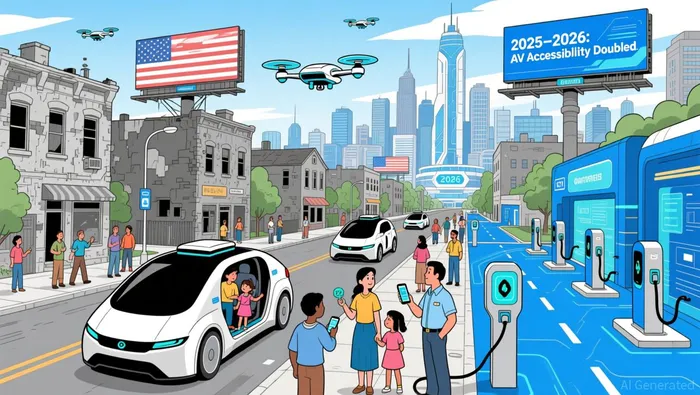
Morgan Stanley's research team frames this precisely. They project that autonomous driving availability in the U.S. will more than double, from about 15% to over 30% of the urban population, within a single year. This isn't just a statistical jump; it's a paradigm shift in accessibility. As more people experience seamless, safe rides in cities like Los Angeles and San Francisco, the psychological barrier to adoption begins to erode. The key driver is the safety flywheel: as fleets prove they can drive more miles without an accident than a human, regulatory approval follows, enabling faster scaling.
For an investor, the strategic play is to capture the foundational infrastructure as this paradigm shifts. The iShares Self-Driving EV and Tech ETF (IDRV) offers a diversified, low-cost exposure to the entire value chain at this early commercial stage. With $168 million in assets and a modest 0.47% expense ratio, the fund's valuation fits the profile of a thematic investment entering its inflection phase. It holds companies across automakers, battery suppliers, materials producers, and emerging autonomy players, spreading risk while betting on the exponential growth of the autonomous transportation rails. The setup is clear: 2026 is the year the pilots end and the real adoption begins.
Portfolio as Infrastructure Layer: Diversification on the First Principles of Autonomy
The strategic bet here is not on a single winner, but on the infrastructure layer itself. The autonomous vehicle paradigm is still in its early innings, and the winner is far from clear. This is the core uncertainty that IDRV's construction is built to hedge against. Instead of picking a horse, the fund captures the entire stack, from the materials that power the batteries to the software that drives the cars.
The diversification is comprehensive. IDRV spreads its exposure across automakers like Tesla and Rivian, battery suppliers including LG Energy Solution and LG Chem, materials producers such as Albemarle, and emerging autonomy players like Aurora Innovation. This full-stack approach means the fund benefits from growth at every stage of the value chain. The equal-weight methodology further limits single-company risk, capping any one holding at just 4.7% of assets. In a sector where the leader could be a consumer EV maker, a pure-play robotaxi operator, or a low-cost Chinese manufacturer, this broad exposure is a deliberate shield.
Yet this diversification comes with a specific geopolitical and market-specific risk. The fund carries roughly 11% China exposure through holdings in BYD, NIO, and XPeng. This is a direct bet on the rapid scaling of Chinese EV production, but it also makes the portfolio vulnerable to shifts in U.S. trade policy or escalating tensions. If tariffs intensify, these positions could underperform sharply, a tangible cost of that particular diversification choice.
The bottom line is that IDRV is structured as a first-principles investment in the rails of the future. It acknowledges that the autonomous paradigm is still being defined, and it avoids the high-stakes gamble of backing one technology path. By capturing the infrastructure layer across multiple approaches, it aims to ride the exponential adoption curve regardless of which specific company ultimately claims the lead. For an investor, it's a way to get long the S-curve without needing to predict the winner.
Financial Profile: Cheap Valuation on an Exponential Growth Curve
The fund's financial profile is a classic setup for an inflection point. It trades at a valuation that looks cheap for a technology ETF, even as the sector it tracks is entering its commercialization phase. This disconnect is the opportunity. IDRV's P/E ratio around 13 is notably low for a thematic fund betting on exponential growth. It suggests the market is still pricing in the old paradigm of delays and uncertainty, not the new reality of scaled rollouts and partnerships that are now the headline.
That skepticism is being overcome by momentum. The fund's 32% return over the past year demonstrates strong recent performance, crushing the S&P 500 by 14 percentage points. This isn't a speculative pop; it's the market catching up to the accelerating adoption curve. The 3% gain year-to-date in 2026 shows that momentum is continuing as the commercialization narrative solidifies. For an investor, this means the fund is capturing the early wave of capital flowing into the autonomous infrastructure layer.
Yet the fund's small size is a double-edged sword. With just $168 million in assets, it is highly sensitive to the core themes driving its holdings. This concentration amplifies both gains and risks. The high portfolio turnover of 51% indicates the fund is actively chasing the S-curve, which can generate tax inefficiencies. More critically, the small asset base means it is vulnerable to liquidity swings and redemptions during market stress-a tangible friction for a thematic investment.
The bottom line is that IDRV offers a cheap entry point onto an exponential growth curve. Its valuation lags its performance, and its size means it will likely move sharply with the sector's trajectory. For a strategic bet on the rails of the autonomous future, the fund's financial profile fits: it's priced for a slow climb but positioned for the steep part of the S-curve.
Catalysts, Risks, and What to Watch in 2026
The investment thesis for IDRV hinges on a clear set of near-term milestones and risks. The coming year will be a proving ground for the sector's shift from promise to performance.
The primary catalyst is the aggressive scaling by the leading player. Waymo's plan to expand to 12 new cities this year while targeting over one million weekly rides is the most concrete validation of the commercialization narrative. Success here would demonstrate the operational and regulatory feasibility of large-scale robotaxi deployment, directly feeding the safety flywheel and accelerating the adoption S-curve. Any stumble in this rollout, however, would be a major red flag.
Execution and scaling delays remain the sector's persistent risk. After years of delays, the industry is finally moving to commercial reality, but the history of setbacks is long. The primary risk is that the planned expansion faces unforeseen technical, regulatory, or logistical hurdles. Any significant slowdown in Waymo's timeline or a stumble in its safety record would challenge the inflection point thesis and pressure the entire autonomous value chain.
A specific, material risk factor is the fund's China exposure. IDRV carries roughly 11% of its holdings in Chinese EV makers like BYD, NIO, and XPeng. This is a direct bet on their rapid global scaling, but it also makes the portfolio vulnerable to regulatory shifts. Investors must monitor any escalation in U.S. trade policy or tariffs that could restrict these companies' global market share. A sudden policy change could cause these positions to underperform sharply, a tangible cost of that diversification choice.
The bottom line is that 2026 is the year the fund's thesis gets tested. Watch for concrete progress on Waymo's expansion as the key validation signal. Simultaneously, keep a close eye on the geopolitical and policy landscape for any shift that could impact the Chinese holdings. The setup is one of high potential reward, but it is also one where the execution risk is now front and center.





Comentarios
Aún no hay comentarios