
2026 U.S. Growth Outlook: Strategic Sectors for Capitalizing on Policy-Driven Momentum
The U.S. economic landscape in 2026 is poised for a pivotal shift, driven by a combination of policy reforms, trade adjustments, and tax incentives. As the One Big Beautiful Bill Act (OBBBA) reshapes incentives for manufacturing, energy, and tax-sensitive consumer sectors, investors face a unique opportunity to align capital with policy-driven momentum. This analysis identifies high-conviction investment opportunities across three strategic sectors, supported by granular data and policy timelines.
1. Manufacturing: Reshoring and Innovation Under OBBBA
The OBBBA's tax provisions are catalyzing a domestic manufacturing renaissance, particularly in capital-intensive industries. The act permanently reinstates 100% bonus depreciation for qualifying assets placed in service after January 19, 2025, enabling immediate cost deductions for machinery, equipment, and new facilities. This provision is especially impactful for steel producers and automotive manufacturers, which require large upfront investments. For example, companies expanding production capacity in 2025–2026 can deduct 100% of the cost of new equipment in the year of purchase, significantly improving cash flow.
Additionally, the OBBBA expands Section 179 expensing limits to $2.5 million, with a phaseout threshold of $4 million, providing flexibility for small and mid-sized manufacturers to reduce taxable income. The legislation also 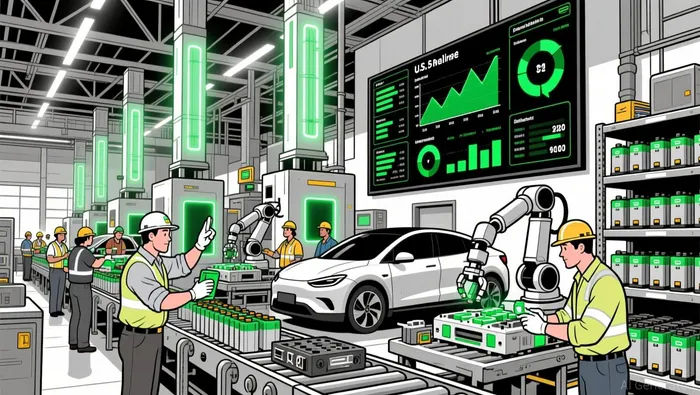 introduces a 100% first-year deduction for nonresidential manufacturing facilities constructed between 2025 and 2029, provided they are placed in service by 2031. This incentivizes reshoring of supply chains, as companies prioritize domestic production to avoid tariffs and supply chain disruptions.
Key beneficiaries:
- Steel manufacturers (e.g., U.S. Steel, Nucor) leveraging bonus depreciation for new mills.
- Automotive producers (e.g., FordF--, General Motors) capitalizing on tax breaks for domestic assembly plants.
- Advanced manufacturing firms (e.g., 3D printing, robotics) utilizing R&D expense deductions under Section 174A.
2. Energy: Clean Fuel and Carbon Capture Under OBBBA
The energy sector is undergoing a dual transformation under OBBBA: a phase-out of traditional clean energy credits and a surge in incentives for carbon capture and hydrogen production. While solar and wind projects face accelerated deadlines (e.g., must begin construction by July 4, 2026, or be placed in service by 2027 to qualify for tax credits), the act introduces $85 per metric ton tax credits for carbon sequestration under Section 45Q, up from $60 previously. This makes carbon capture projects more viable, particularly for industrial firms and direct air capture startups.
Hydrogen production is another focal point. The Clean Hydrogen Production Credit (Section 45V) now requires projects to begin construction by December 31, 2027, creating urgency for developers. Additionally, the 30% ITC (Section 48E) for fuel-cell systems simplifies financial modeling for hydrogen projects, with no bonus multipliers. These incentives are layered with domestic content rules, favoring companies that source materials from U.S. suppliers.
Key beneficiaries:
- Carbon capture firms (e.g., Carbon Engineering, Climeworks) leveraging Section 45Q credits.
- Hydrogen producers (e.g., Plug Power, Air Products) racing to meet 2027 construction deadlines.
- Agri-biodiesel producers (e.g., Renewable Energy Group) benefiting from extended Section 40A credits.
3. Tax-Sensitive Consumer Sectors: Stimulus and Tariff-Driven Shifts
The OBBBA's tax reforms are directly boosting disposable income for households, particularly in retail and housing. The standard deduction for 2026 has increased to $32,200 for married couples and $16,100 for single taxpayers, while a new $6,000 deduction for seniors enhances spending power in housing and automotive sectors. These changes are projected to drive a 44% increase in tax refunds compared to 2025, spurring retail sales and home improvement demand.
However, trade policy shifts complicate this outlook. Tariffs on automobiles (15–20%) and imported goods are raising production costs for automakers and retailers. For instance, European producers are increasingly shifting production to the U.S. to avoid retaliatory tariffs, creating opportunities for domestic automotive suppliers. Meanwhile, the OBBBA's 10,000 annual deduction for U.S.-assembled car loans further incentivizes domestic automotive production.
Key beneficiaries:
- Homebuilders (e.g., Lennar, D.R. Horton) capitalizing on increased disposable income and tax deductions for energy-efficient upgrades.
- Automotive suppliers (e.g., Magna International, Lear Corporation) benefiting from reshoring trends.
- Retailers (e.g., Home Depot, Lowe's) seeing demand from tax-boosted consumer spending.
Conclusion: Policy-Driven Momentum in 2026
The OBBBA and 2025 trade policy shifts are creating a clear roadmap for 2026 investments. Manufacturing firms stand to gain from tax incentives that reduce capital costs and encourage reshoring. Energy companies in carbon capture and hydrogen production are positioned to capitalize on enhanced credits and accelerated timelines. Tax-sensitive consumer sectors, while facing inflationary pressures from tariffs, benefit from stimulus-driven spending.
Investors should prioritize companies with near-term visibility into these policy-driven opportunities, particularly those with strong domestic supply chains and compliance-ready operations. As the U.S. economy navigates a projected 2.4% GDP growth in 2026, aligning capital with these strategic sectors offers a compelling path to outperformance.







Comentarios
Aún no hay comentarios